Red poppies are a familiar sight in November, worn by individuals and displayed at memorials and in many other settings. Yet their meaning can sometimes seem lost amid the arguments about how they should be worn, the significance of alternative colours, what the poppies represent and what wearing one says about a person.
I wanted to look back at how these traditions began, in the years immediately after the First World War, when a nation was trying to celebrate victory while coming to terms with an almost unimaginable loss of life. The stories of the Cenotaph, the Unknown Warrior and the poppy are ultimately stories about remembrance: of those who never came home, of those who mourned them, and of the enduring need to remember.
Celebrating Victory
On 19 July 1919, London held a grand parade to celebrate the Allied victory in the First World War. Fighting had ceased with the Armistice on 11 November 1918, but the war formally ended with the signing of the Treaty of Versailles on 28 June 1919, after months of negotiations at the Paris Peace Conference.
Two days after the signing, the War Cabinet met to plan a public celebration. Saturday 19 July was declared a public holiday across the United Kingdom. Its centrepiece would be a London procession of nearly fifteen thousand uniformed troops from the victorious nations. Led by Allied commanders Pershing, Foch and Haig, they would march past a temporary monument in Whitehall, designed by Sir Edwin Lutyens at Prime Minister David Lloyd George’s request.
Built from wood, plaster and canvas, the monument was a cenotaph, from the Greek for ‘empty tomb’. Intended as a temporary saluting point for the parade, it symbolised a tomb for those buried far from home or whose resting places were unknown.
Even before the celebrations began, the monument had acquired a significance its creators could scarcely have foreseen.
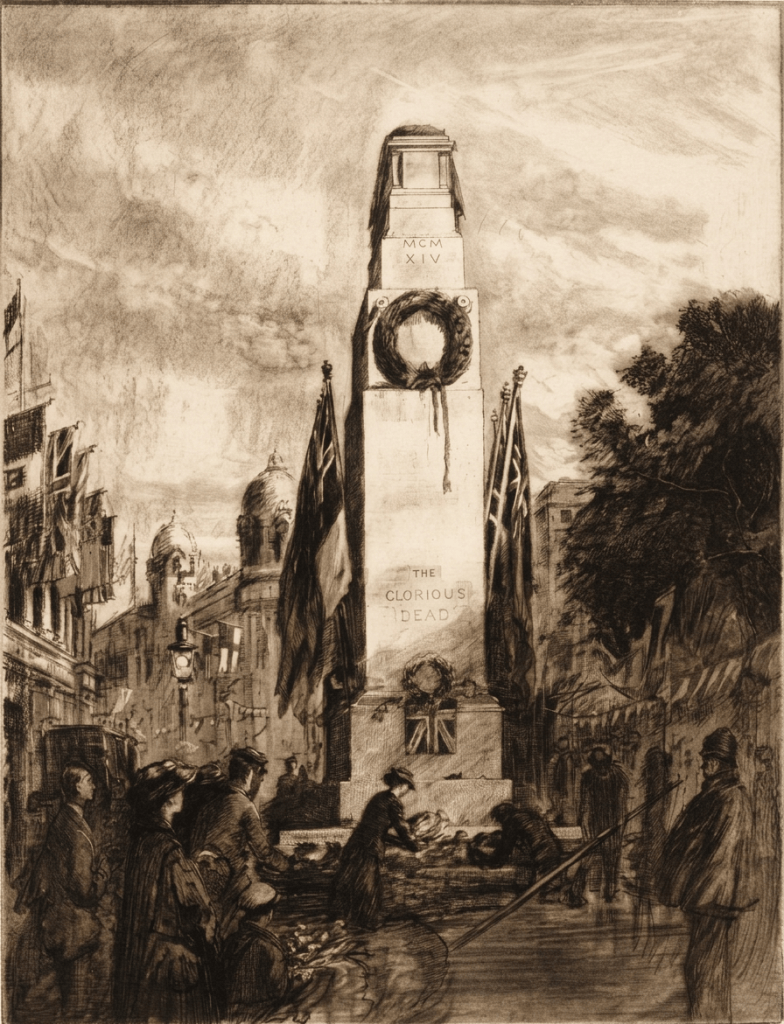
In the early hours of 19 July, as crowds gathered in London, a small group – mostly women, some with children – laid wreaths at its foot. Outside the official programme, these bereaved mothers and wives had found their own way to honour the dead and missing.
That morning, King George V sent a message to those whose injuries prevented them from joining the celebrations: “To these, the sick and wounded who cannot take part in the festival of victory, I send out greetings and bid them good cheer, assuring them that the wounds and scars so honourable in themselves, inspire in the hearts of their fellow countrymen the warmest feelings of gratitude and respect.”[ii]
Bands played throughout the day, and performances drew crowds to London’s central parks. Beyond the capital’s main spectacle, local authorities and communities held celebrations in cities, towns and villages nationwide.
The temporary cenotaph was meant to stand for just a week. In that time, more than a million people visited, leaving wreaths and flowers in a spontaneous expression of grief for the dead and missing.
The government had intended the parade and monument to unite the nation in celebrating victory and honouring the fallen. The public response revealed something deeper: alongside relief and pride lay immense personal grief. More than a backdrop to a military parade, the Cenotaph had already become a place of remembrance.
How the Nameless Dead Came Home
During the First World War, the British government prohibited the repatriation of the bodies of military casualties. The dead would be buried in military cemeteries, wherever possible close to where they had fallen. But what of those whose remains could not be identified, or who had disappeared without trace?
For the families of the missing, there was often no body to bury, no funeral to attend and no grave to visit. The scale of the losses made it difficult for hundreds of thousands of bereaved families to find any sense of closure.
The concept of bringing home one unidentified serviceman, to represent all those who had died without a known grave, offered a way to address that absence.
The idea originated with the Reverend David Railton, an Army chaplain who had served at the Front. In 1916, at Armentières in France, he came across a grave in a back garden marked with a rough wooden cross on which was pencilled the words “An Unknown British Soldier”.
Railton wondered whether the remains of one unidentified man could represent all those who had died, allowing bereaved families to feel that the unknown soldier might be their own lost husband, son or brother.
In August 1920, he wrote to the Dean of Westminster, Herbert Ryle, suggesting that an unknown soldier should be brought home and buried in Westminster Abbey. Dean Ryle supported the proposal and helped secure the necessary backing for the memorial.
There has been much speculation about who the Unknown Warrior might have been. The selection of remains associated with the earlier years of the war has led to suggestions that he was a regular soldier who had served in the British Expeditionary Force in 1914.
However, the circumstances of his death and his identity remain unknown. He could have come from any part of the British or colonial forces, and it is this uncertainty that allows him to represent so many who never came home.
The arrangements were made in great secrecy. The remains of four unknown servicemen were exhumed, one from each of four battle areas on the Western Front: Ypres, Arras, the Aisne and the Somme. The selection process took place at St-Pol-sur-Ternoise, the headquarters of British troops in France and Flanders. Although some details of the operation remain disputed, the intention was clear: the chosen man must remain truly unknown.
The bodies were brought to a chapel at the headquarters, each laid on a stretcher and covered with a union flag. The commanding officer, Brigadier General LJ Wyatt, entered the chapel with another senior officer, Lieutenant Colonel EAS Gell. Neither knew from which battlefield any individual body had come.
Wyatt selected one of the bodies. The two officers placed it in a plain coffin and sealed it. The other three were removed for reburial.
The following morning, chaplains representing the Church of England, the Roman Catholic Church and Nonconformist churches held a service in the chapel. The coffin was then taken to Boulogne, where it was prepared for the journey home.
There, the simple wooden casket was enclosed within a specially constructed outer coffin made from two-inch-thick oak from the grounds of Hampton Court Palace. Lined with zinc and secured with wrought-iron bands, it also incorporated a sixteenth-century crusader’s sword from the Royal Armouries collection. A plaque bore the inscription:
A British Warrior who
Fell in the Great War
1914-1918
for King and Country
The coffin was draped with the union flag that Reverend Railton had used as an altar cloth during the war. This later became known as the Padre’s Flag and still hangs in Westminster Abbey.
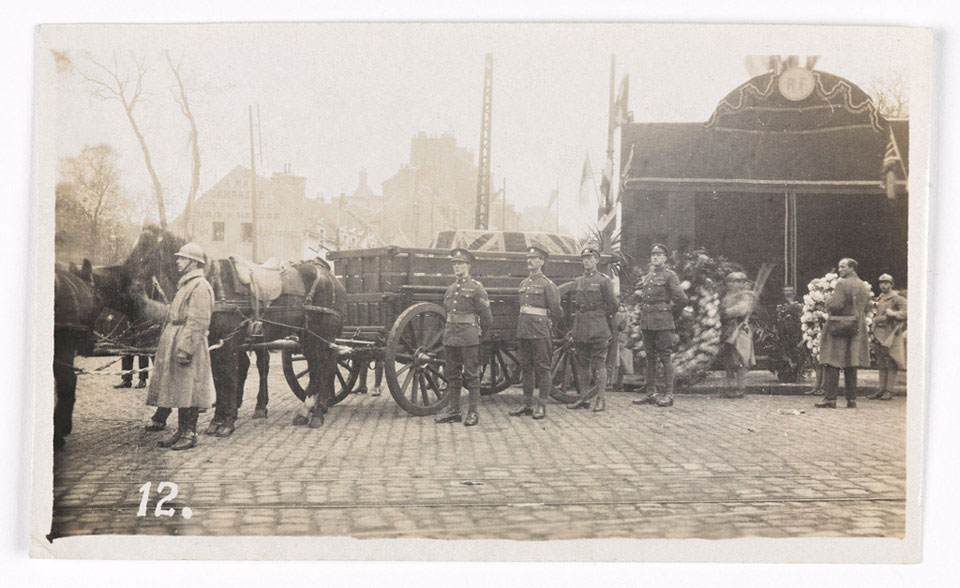
At Boulogne, the coffin was carried by horse-drawn carriage through ranks of soldiers to the quayside. Church bells rang, French cavalry trumpets and bugles sounded, and Marshal Ferdinand Foch, the Supreme Allied Commander, saluted as the coffin was taken aboard the destroyer HMS Verdun. The ship slipped its moorings shortly before noon, accompanied by an escort of six destroyers, for the crossing to Dover.
As the flotilla approached Dover, a nineteen-gun Field Marshal’s salute was fired from Dover Castle. The Verdun then entered Dover Harbour alone.
From Dover, the Unknown Warrior travelled by train to London. Along the route, crowds gathered at stations and beside the railway lines, silently waiting for the train to pass. Many were women dressed in black, some of whom had stood patiently in the rain for the briefest glimpse of the train carrying the nameless dead.
The train consisted of just two carriages. The first, a simple white topped guard’s van dark and shuttered, carried the coffin; the second was ablaze with lights and filled with wreaths and floral tributes of red roses, white arum lilies and purple immortelles.
At Faversham, ex-servicemen, some disabled, filled the platform while a detachment of Boy Scouts sounded The Last Post. At Gillingham, a naval guard of honour stood with heads bowed and arms reversed as the train drew alongside, and soldiers presented arms at Chatham.[iv]
For those watching, the coffin might have contained the remains of someone they had lost. They could never know. That was precisely the point: the Unknown Warrior belonged to them all.
Late on the evening of 10 November, as thousands waited outside hoping to catch a glimpse, the train arrived at Platform 8 at Victoria Station. During the previous four years countless men had departed from this station during the war on their way to the Front. Now, the coffin of one unknown soldier had returned to London. It was carried into the station and placed under guard overnight by a platoon of Grenadier Guards.
The following day, 11 November 1920, the Unknown Warrior would be laid to rest in Westminster Abbey, among the nation’s kings and queens, writers, poets and scientists, providing a permanent focus for the nation’s grief.
Armistice Day 1920
On the morning of 11 November at 9:40am, the coffin containing the Unknown Warrior was placed on a gun carriage drawn by six black horses of the Royal Horse Artillery. A battered soldier’s steel helmet, side arms and webbing belt was placed on the union flag that covered the coffin as a nineteen-gun Field Marshal’s salute was fired in Hyde Park.
Escorted by twelve senior officers – three Admirals-of-the-Fleet, two Admirals, four Field Marshals, two Generals and one Air Marshal – the cortege began its slow journey to Westminster Abbey. [v] Behind them marched more than one thousand mourners representing the Army, Navy, RAF and various ex-servicemen’s organisations, while immense, silent crowds lined the streets.
At 10:40am, King George V stepped from the Home Office and took up his position facing the newly rebuilt Portland stone Cenotaph, which was covered by two huge Union Flags. The gun carriage carrying the Unknown Warrior came to rest in front of him. The King saluted and placed a wreath of red roses and bay leaves on the coffin, accompanied by a handwritten card:
In proud memory of those warriors who died unknown in the Great War.
Unknown, and yet well known, as dying and behold they lived.
George R.I. November 11th 1920
As Big Ben began to strike eleven, the King turned towards the Cenotaph and pressed a button on a small pillar in front of him, releasing the flags that concealed the memorial. The flags fell as the chimes rang out. As the sound died away, the two-minute silence began.
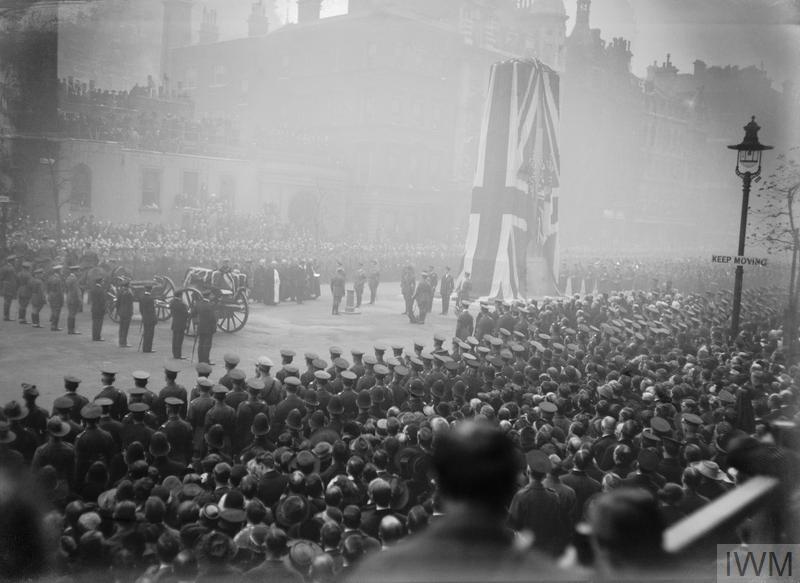
For two minutes, the crowds stood motionless and silent. The usual sounds of London fell away as traffic and movement ceased, and people across the country and throughout the Empire paused to honour those who had died in the war.
The two-minute silence had first been observed on the second anniversary of Armistice Day in 1919, but the events of 1920 gave it a new and particularly poignant setting. The unveiling of the permanent Cenotaph and the funeral of the Unknown Warrior brought together the nation’s public commemoration and its personal grief.
After two minutes, a solitary bugler sounded The Last Post. The procession resumed its journey to Westminster Abbey, with the King following the gun carriage on foot as chief mourner. The Cenotaph had been unveiled; now the Unknown Warrior would be laid to rest.
Within a short time, the base of the Cenotaph was covered with thousands of wreaths and flowers. People from all walks of life had patiently queued from Trafalgar Square along Whitehall to lay their own personal tribute of respect and remembrance.
Meanwhile, at Westminster Abbey, massed bands playing Chopin’s Funeral March announced the arrival of the procession. The Unknown Warrior was carried into the West Nave flanked by a guard of honour of one hundred recipients of the Victoria Cross from all three services.
Inside the Abbey, more than one thousand mothers and widows took their places. Seats had been allocated by ballot, with priority given to wives who had lost both their husband and all their sons, or their only son; mothers who had lost all their sons, or their only son; and widows.[vii] Not every woman who applied received a ticket.
The coffin was borne through the congregation to the grave. The King stepped forward and scattered a handful of French earth from a silver shell into the grave as the coffin was lowered. At the close of the burial service, trumpeters sounded the Reveille.
The Abbey remained open to the public during the week following the burial, allowing mourners to pay their respects at the grave. Servicemen kept watch at each corner while the organ played and thousands filed past. By the time the grave was filled in on 18 November, more than a million people had visited.
Poppies for Remembrance
The red poppy has become one of the most familiar symbols of remembrance. Its story began with a poem written in 1915, when Canadian Lieutenant Colonel John McCrae, service as a doctor near Ypres, was inspired by the poppies growing among the graves and devastated landscapes of the Western Front. His poem In Flanders Fields, captured the terrible contrast between the beauty of the flowers and the destruction of war.
In the years that followed, the poppy became both a symbol of remembrance and a means of providing practical support for those affected by war. Inspired by McCrae’s poem, American humanitarian Moina Michael championed the wearing of poppies, while Frenchwoman Anna Guérin helped bring the idea to Britain. In 1921, the newly formed British Legion, now the Royal British Legion, held its first Poppy Appeal, raising funds to support ex-servicemen and their families. More than a century later, the red poppy remains a symbol of remembrance, connecting us with those who died and those whose lives were changed by war. Its story began with the battlefields of Flanders, but its meaning has travelled far beyond them.
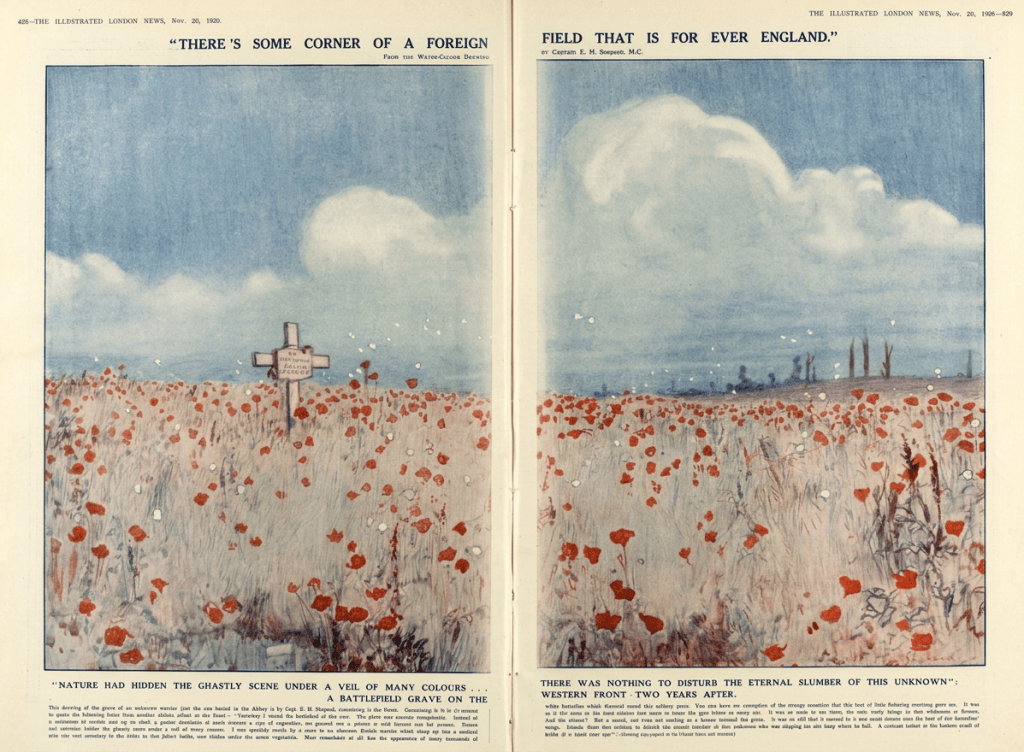
The watercolour below, published in the Illustrated London News in 1920, depicts the grave of an unknown British soldier surrounded by poppies. It was painted by Captain E. H. Shepard MC, who served at the Front before becoming known to generations of children as the illustrator of Winnie-the-Pooh.
Beneath the image was a letter from an unnamed British officer describing a visit to a battlefield a year after the fighting. Whether the letter was reproduced exactly as written or edited for publication is unknown, but his description of the transformed landscape is haunting:
“Yesterday I visited the battlefield of last year. The place was scarcely recognisable. Instead of the wilderness of ground torn up by shell, a perfect desolation of earth without a sign of vegetation, the ground was a garden of wild flowers and tall grasses. Nature had certainly hidden the ghastly scene under a veil of many colours.
I was specially struck by a cross to an unknown British warrior which stood up like a sentinel over the vast cemetery of the fallen in last year’s battle, now hidden under the dense vegetation. Most remarkable of all was the appearance of many thousands of white butterflies which fluttered around this solitary grave. You can have no conception of the strange sensation that this host of little fluttering creatures gave me. It was as if the souls of the dead soldiers had come to haunt the spot where so many fell. It was so eerie to see them, the only living things in that wilderness of flowers.
And the silence! Not a sound, not even the rustling of a breeze through the grass. It was so still that it seemed as if one could almost hear the beat of the butterflies’ wings. Indeed, there was nothing to disturb the eternal slumber of this unknown who was sleeping his last sleep where he fell. A contrast indeed to the hideous crash of battle a short year ago.”
[i] Illustrated London News 26 Jul 1919 via findmypast.co.uk accessed 26 Oct 2026
[ii] The London Gazette via https://www.thegazette.co.uk/all-notices/content/100215 accessed 26 Oct 2026
[iii] National Army Museum Image number: 264411 accessed 26 Oct 2026
[iv] Daily Mirror 11 Nov 1920 via Findmypast.co.uk accessed 26 Oct 2026
[v] Illustrated London News 13 Nov 1920 via Findmypast.co.uk accessed 26 Oct 2026
[vi] Imperial War Museum Image: IWM (Q 14965) reproduced under IWM Commercial Licence
[vii] Known Unto God: Searching for the Missing by Simon Fowler published 2025 by Amberley
[viii] Illustrated London News 20 Nov 1920 via Findmypast.co.uk accessed 26 Oct 2026
