
In July 1915, my great aunt Constance May Brock, known to the family as Sissie, married Guy Greville Napier in Buckland, Surrey. Their wartime wedding took place during Guy’s four days’ leave from the trenches. They would be married for just 71 days.
Guy Greville Napier
Guy was born in 1884, the eldest child and only son of Thomas Bateman Napier, former MP and county court judge and his wife Florence Emily (née Roberts). He was educated at Marlborough College, a prestigious public school in Wiltshire, before attending Pembroke College, Cambridge.
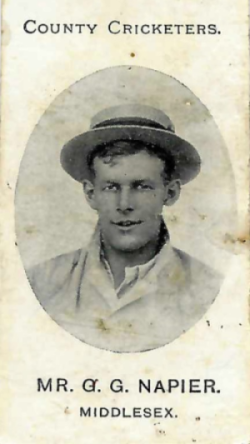
At Cambridge, Guy proved to be a talented cricketer. He represented the university against Oxford for four consecutive years and played 81 first-class matches, chiefly for Middlesex and Cambridge University, as a right-arm medium-pace bowler and tail-end batsman. Wisden Cricket Almanac described him as one of the best medium-pace bowlers of his generation.[i]
In 1905, Guy’s cricketing career took him across the Atlantic. On 11 July, he sailed from Liverpool aboard the Carpathia, with his fellow members of the cricket touring party, arriving in New York ten days later. Seven years later, the same ship would become famous for rescuing survivors of the Titanic.
After graduating from Cambridge with a BA in 1907, Guy embarked on a military career in India. He received his commission on 17 August 1907 and joined the 35th Sikhs, becoming a lieutenant on 17 November 1909. [ii] I have not yet established what first took him to India, but his years there formed an important chapter in his life before the First World War brought him to the Western Front.
From India to the Western Front
In 1914, the Indian Army’s expeditionary forces were mobilised for overseas service. [iii] The 47th Sikhs was an infantry regiment of the British Indian Army, made up largely of Sikh soldiers. Guy, then a Lieutenant in the 35th Sikhs, was attached to the 47th Sikhs, which formed part of the 8th Jullundur Brigade in the 3rd Lahore Division.
The regiment embarked aboard the SS Akbar at 3.45pm on Saturday 29 August. According to its war diary, the force comprised seven British officers, eighteen Indian officers, one Sub-Assistant Surgeon (ranking as a Subedar), 809 non-commissioned officers and men, 28 transport drivers, 27 public followers, 18 private followers, 13 horses and 74 mules.[iv]
The voyage was not without its difficulties. The stalls provided for the mules were too small, and several developed large sores on their sides from rubbing against them. Fortunately, the seas were calm enough for the animals to be stood outside their stalls, although one mule was so badly injured that it had to be destroyed before the ship reached land.
The men’s rations also came in for criticism. The atta (flour) contained a considerable proportion of millet, while the ghee was tainted with copra oil and what the diary described as “a substance which looks like mashed potatoes”.
The Akbar reached Suez at 7 pm on 13 September. From there, the regiment travelled by train to Cairo and on to Heliopolis. On 17 September, orders arrived for the men to proceed to Alexandria the following morning. There, the trains drew alongside the Akbar so that the baggage could be loaded. The animals had to be hoisted aboard in slings.
The ship left Alexandria at 10 am on 19 September and joined a convoy that departed at 1 pm. It reached Marseille at about 2 pm on 26 September, but the men did not disembark until the following afternoon. Once ashore, they had to carry their rifles to the Ordnance Department, where these were exchanged for the newer pattern designed to fire pointed bullets.
The officers and men then marched about five miles to Parc Borély, arriving after dark. Their kits, transported on carts, had become mixed up along the way and did not arrive until the afternoon of 28 September. Meanwhile, the regiment began marking its rifles and was issued with 200 rounds of ammunition per rifle and 10,000 rounds per machine gun.
On 28 September, the regiment established its camp at Parc Borély. The following morning, the men paraded at 9.30 am. Lieutenant Guy Napier is in the centre of the photograph below.
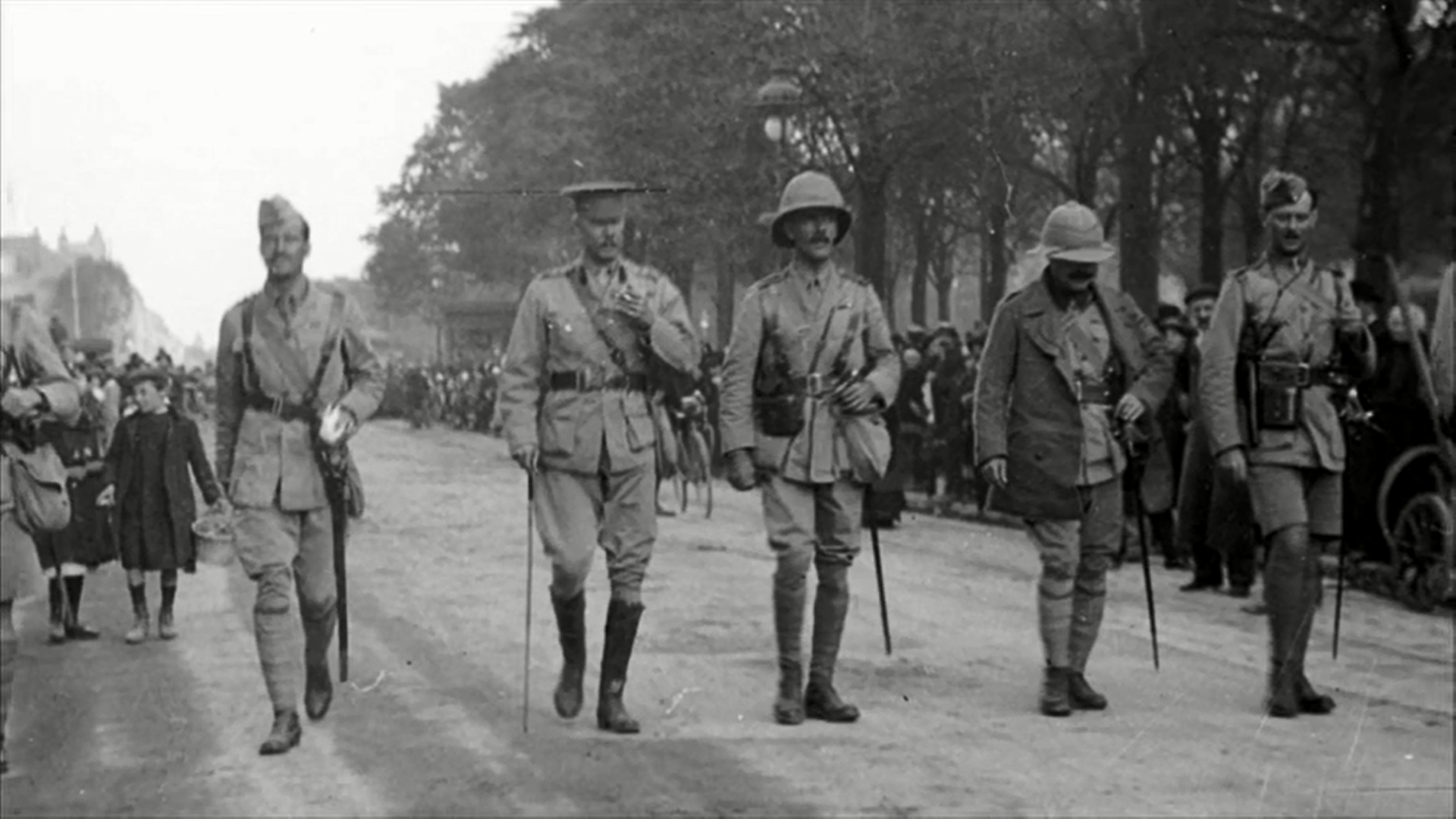
At 5.15 am on 30 September, the regiment left camp and entrained for the Western Front. After a month of travel, they were finally on their way to the fighting.
Over the following months, the 47th Sikhs served in the trenches and suffered heavy losses.
Christmas 1914 brought a brief respite from the trenches. The regiment withdrew on 23 December and went into billets at Allouagne, near Béthune. According to the war diary, the men remained there on Christmas Eve and Christmas Day, returning to the trenches in mid-January, when they relieved a Gurkha regiment. The conditions they found were far from comfortable: the ground was very wet, and the trenches were full of water.
Marriage to Sissie
Meanwhile, in England, twenty-four-year-old Sissie was living in Buckland, near Dorking, Surrey, with her maternal aunt, Mary Constance Bovill (née Brock), and her uncle, John Bovill, a prosperous corn merchant.
Sissie’s father had died in 1898, and her mother in 1906, when she was just fourteen. Her older brother, later my grandfather, had joined the Royal Navy as a cadet in September 1897 and subsequently risen to the rank of Lieutenant. After their mother’s death, John and Mary Bovill took Sissie and her older sister, Lilian, into their home, despite already having five children of their own – two sons and three daughters. Sadly, Lilian died of tuberculosis the following year.
It’s not known how Sissie and Guy met, or how they maintained their courtship whilst he was serving on the Western Front. Nevertheless, on Friday 16 July 1915 they were married in Buckland village church, during his brief four days’ leave from the trenches.
The church was beautifully decorated for the military wedding, and the pews were crowded with friends and relatives of the bride and bridegroom. The service was choral, and Sissie, given away by her uncle, wore a dress of white ninon adorned with pink rosebuds and carried a bouquet of pink carnations. A contemporary newspaper report concluded its description of the couple with the words: “The bridegroom looked the beau ideal of a soldier.”[v]
After the ceremony, a reception was held at the Bovills’ home. The newlyweds then left for London with Sissie wearing a blue taffeta travelling costume and matching hat. [vi]
The Battle of Loos
The Battle of Loos began on 25 September 1915. It is remembered in part as the first occasion on which the British Army used poison gas on the Western Front. For Guy and the men of the 47th Sikhs, the morning began in damp, misty conditions.
The regiment’s war diary records that the British bombardment intensified at 5.30 am. Twenty minutes later, a mine was exploded beneath the German trenches opposite the Meerut Division’s front, just north of Neuve-Chapelle. Smoke bombs and trench mortars created a smoke screen along the Indian Corps’ front, while gas was released on the Meerut front. The diary notes that there was very little wind, and what wind there was blew along the British front. [vii]
The diary records heavy fire directed at the Indian troops’ positions. Within just ten minutes, Lieutenant Napier had been wounded. One other rank was killed and approximately forty were wounded, all by high-explosive field-gun fire.
At first, Guy’s injuries were not thought to be serious. A fellow officer later described what happened: [viii]
“He was hit in the left arm and shoulder. He was quite splendid, as he always was in times of stress, and kept on apologising to the doctor for giving trouble. He walked part of the way, but we had to put him on a stretcher.”
Guy died later that morning, he was just thirty-one years old.
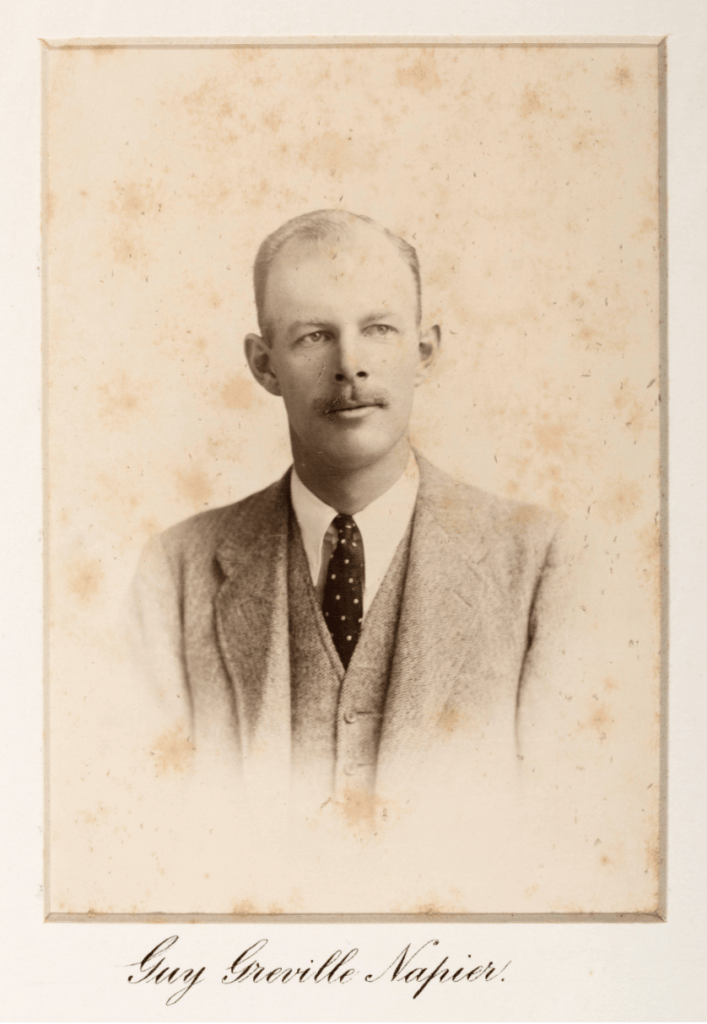
Guy and Sissie had been married for just 71 days. His four days’ wedding leave had given them very little time together as husband and wife.
The war brought further tragedy to the family who had taken Sissie in. John and Mary Bovill lost both their sons and both their sons-in-law during the First World War. The home that had welcomed Sissie after the loss of her parents would itself be touched by profound bereavement.
Reflections on Sissie
I remember Sissie in her later years as a diminutive, kind and thoughtful woman. She joined the St John Ambulance Brigade and, during the Second World War, served with the ARP Eastbourne Women’s Transport Service. She was also involved with several animal rescue charities.
I was delighted when she gave me her 1928 copy of First Aid to the Injured. As a child, I studied it avidly, carefully learning its archaic first-aid practices and marvelling at the bizarre illustrations of moustachioed gentlemen sporting improvised bandages.
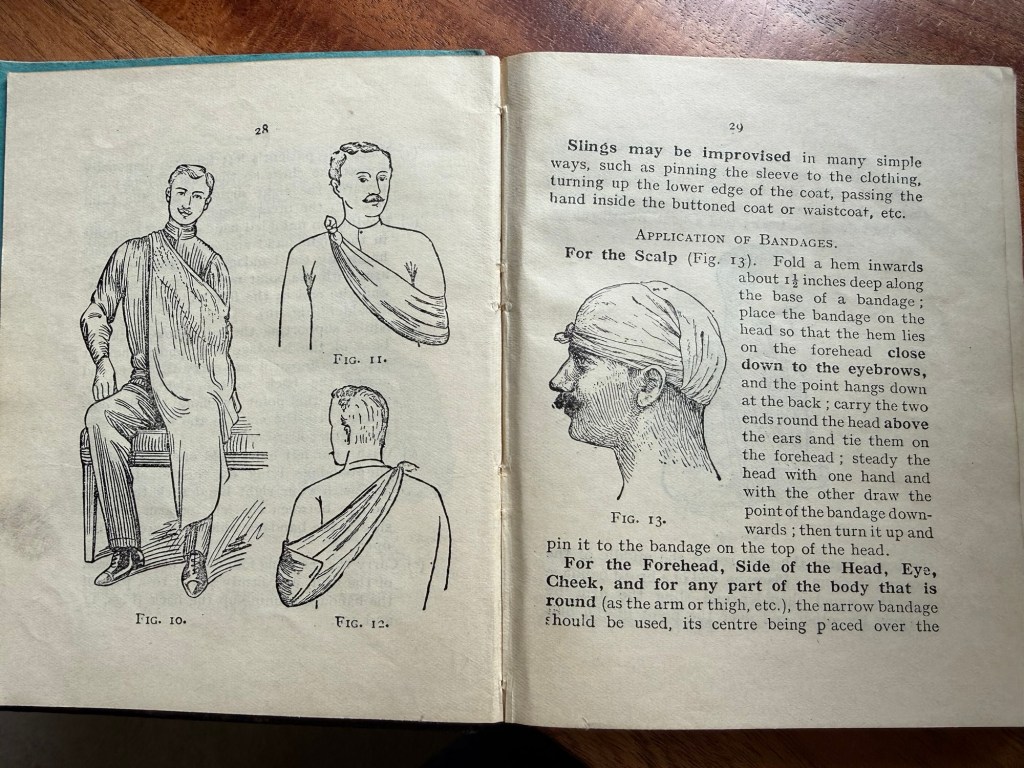
Auntie Sissie died in 1975, aged eighty-three. I never knew the young woman who stood in Buckland church in July 1915, newly married and with her life ahead of her. The old newspaper reports have brought that young woman, and the man she married, into sharper focus for me.
Guy’s cricketing achievements and military career are part of his story, but what stays with me is the brevity of his marriage to Sissie: a wedding full of family, music and flowers, followed just ten weeks later by his death.
Sissie never remarried.
[i] Wisden Cricketers’ Almanack via https://www.cricinfo.com/cricketers/guy-napier-18054 accessed 20 Oct 2026
[ii] London Gazette via http://www.london-gazette.co.uk/issues/28362/pages/3073 accessed 20 Oct 2026
[iii] 47th Sikhs War Diary WO 95/3927/4 via the National Archives, Kew
[iv] ibid
[v] Dorking and Leatherhead Advertiser Sat 24 Jul 1915 via findmypast.co.uk accessed 20 Oct 2026
[vi] ibid
[vii] 47th Sikhs War Diary WO 95/3927/4 via the National Archives, Kew
[viii] Dorking and Leatherhead Advertiser 09 October 1915 via findmypast.co.uk accessed 20 Oct 2026
[ix] Marlborough College WW1 Roll of Honour via https://marlboroughcollege.daisy.websds.net accessed 20 Oct 2026
