
How does a young woman from a rural island of farmers, fishermen, brickmakers, and smugglers, end up giving birth inside a mainland asylum for “females of unsound mind”?
For generations, the story of my third great-grandmother, Mary Ann Cooper, appeared to be a very Victorian scandal: an unmarried mother, a missing father, and a baby born far from home.
But the truth, uncovered through DNA matches, census puzzles and forgotten archive records, tells a very different story. This is not a tale of abandonment. It is a story of love, duty, sacrifice – and a couple determined to protect their family’s dignity.
In 1840, Hayling Island was a world apart from the busy naval docks of Portsmouth. Shaped like a bell and separated from the mainland by a small wooden toll bridge and a ferry, it was a close-knit community of only a few hundred people.
Its people farmed the land, worked the shoreline, made bricks – and occasionally lived by less official means. It was the sort of place where everyone knew everyone else’s business.
It was here that Mary Ann Cooper and Isaac Dibben fell in love.
Their path to marriage, however, was far from straightforward: Isaac was nearly ten years older than Mary Ann, and his life was already tied to heavy family responsibilities.
Isaac’s family were outsiders who had crossed over from the Isle of Wight around 1813, eventually settling in North Hayling. By 1840, Isaac was already thirty years old, unmarried, and still living at home. His parents were elderly and frail; his father, Joseph, was eighty, and his mother, Jane (née Rogers), was seventy.[i]
In a world without old-age pensions or social safety nets, Isaac was his parents’ primary lifeline. Leaving the family home to marry Mary Ann and set up his own household would have meant leaving his elderly parents without the support on which they depended. Joseph would ultimately die a few years later, in 1846, of “gradual decay” – a slow decline that required constant care.[ii]
Bound by duty to his parents, yet deeply in love with Mary Ann, Isaac found himself facing an impossible choice when Mary Ann became pregnant.
In the years after the New Poor Law of 1834, the workhouse had become a place many families feared. Poor relief was no longer simply a matter of receiving help from the parish; entry into the workhouse could mean a loss of independence, separation from family, and public exposure of private hardship.
For proud rural families like the Dibbens and the Coopers, the prospect of the parish becoming involved would have been deeply distressing.
An unmarried pregnancy threatened to bring not only social disgrace, but the involvement of the parish and the dreaded workhouse.
By 15 May 1840, Mary Ann had crossed the water to the mainland. She did not enter a public workhouse, but instead gave birth at Stamshaw House in Portsea, an institution run by surgeon William F. Martell.
At first glance, Stamshaw House seems an unlikely place for the birth of a child. The word “asylum” suggests a place of incarceration, but in Victorian usage such institutions could provide very different forms of care. Martell’s main house catered for private patients, while contemporary advertisements reveal that the establishment also had a separate provision for poorer residents:
“In an adjoining Building there is every convenience for the pauper patients.”[iii]
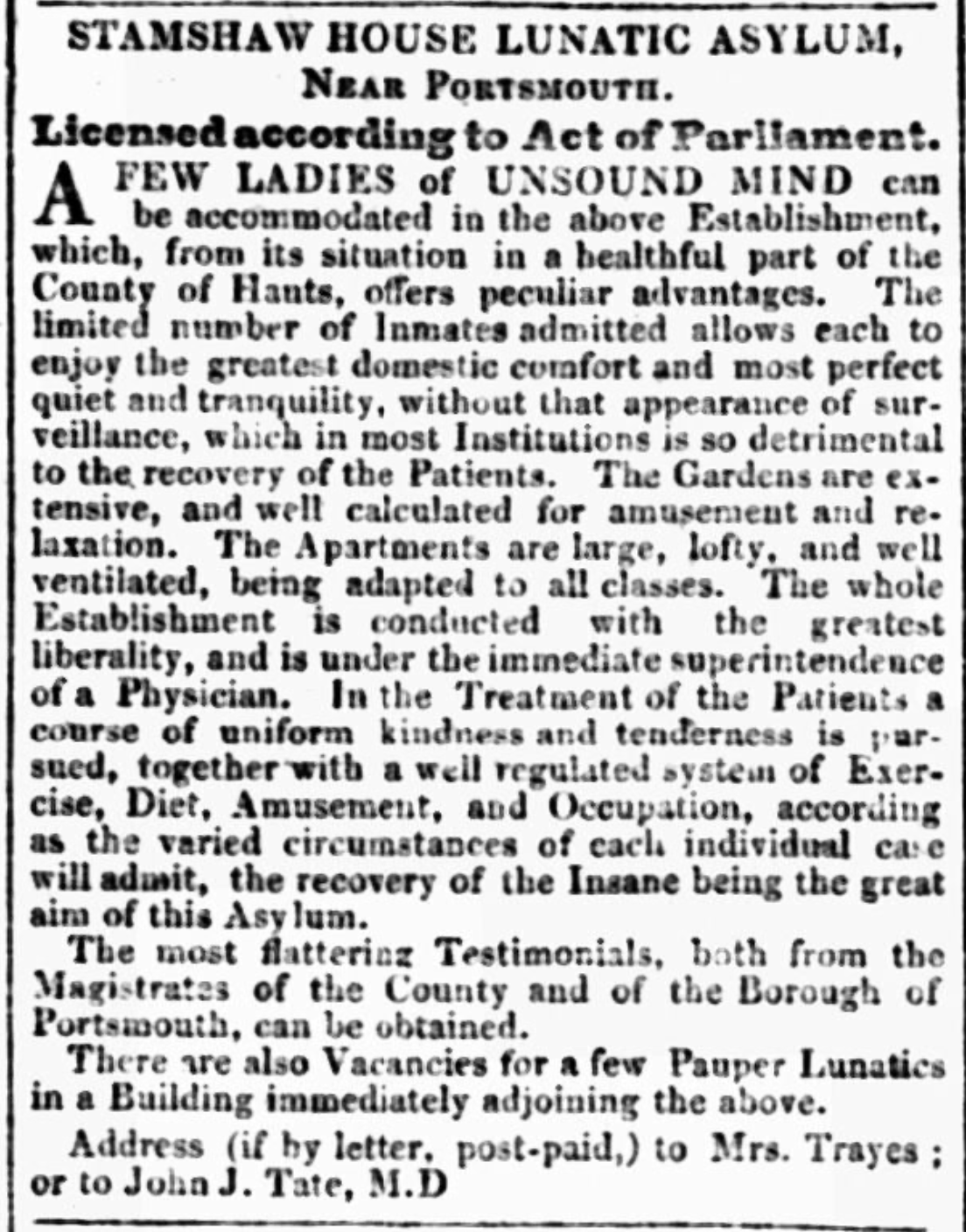
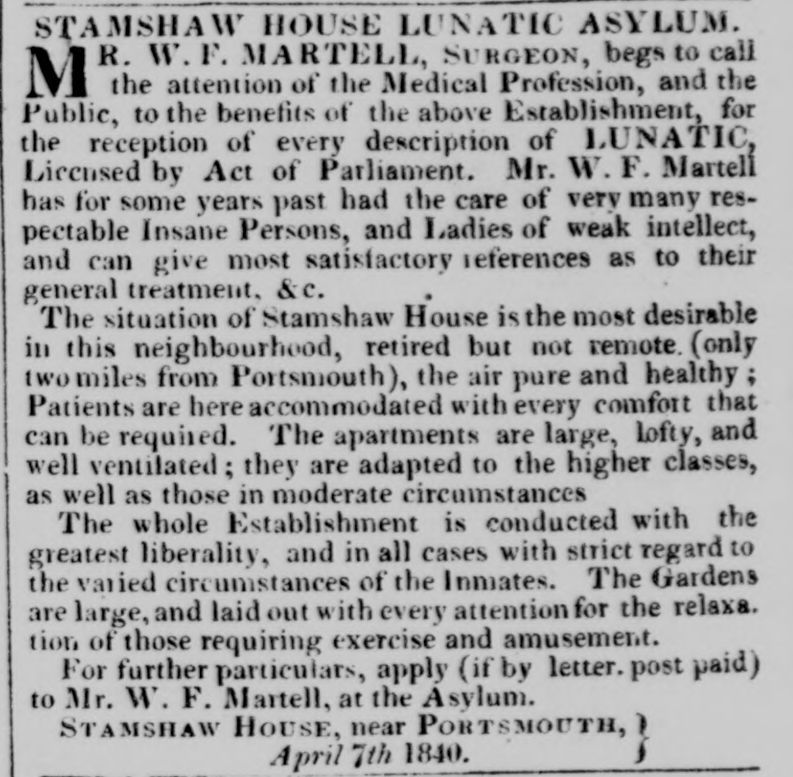
For Mary Ann, Stamshaw House may have offered something that the workhouse could not: a discreet place to give birth away from the scrutiny of parish officials.
A baby boy named George Cooper was baptised at St Mary’s, Portsea, on 21 June 1840. The parish register presents a picture of a conventional family: the parents are listed as Isaac, a labourer, and Mary Ann Cooper, of Hayling Island

But when you look at the civil birth certificate, the respectable facade falters. Baby George had been born a month earlier, on 15 May 1840. The place of birth was not a family home on Hayling Island, but Stamshaw House in the parish of Portsea.
To shield the baby’s father from parish inquiry, no father was named and the space for the father’s occupation was left blank. Mary Ann registered the birth herself, signing the document with a simple “X” – her mark.

For years, it looked as though Mary Ann had been abandoned. But modern science tells a different story. DNA testing has uncovered five genetic matches linking my family to both George and his younger brother, William. The evidence points strongly to Isaac Dibben as George’s biological father.[vii]
Isaac had not abandoned Mary Ann and their son. Instead, he may have used his meager earnings to arrange a private, discreet birth at Stamshaw House, protecting them from parish interference while remaining at home to care for his elderly parents.
The following year, the 1841 census captures the family still living apart. Isaac Dibben is recorded with his parents in North Hayling. Mary Ann is in South Hayling with her parents, George Cooper, an agricultural labourer, his wife Mary and several children – including one-year-old George.
Curiously, Mary Ann’s age is recorded as twelve. This appears to be a simple error by the enumerator, as she was actually twenty-one.
Three months later, on 12 July 1841, Isaac and Mary Ann finally stood together at the altar of Hayling South church. They were married by banns, and their choice of witnesses reveals the close-knit, protective nature of their rural community.
The official witnesses were Emily Vincent and Friend Rogers. On the 1841 census, both were recorded as 15-year-old neighbours of Isaac. However, because ages over 15 were often rounded down to the nearest multiple of five in the 1841 census, Friend and Emily were likely young adults in their late teens or early twenties.
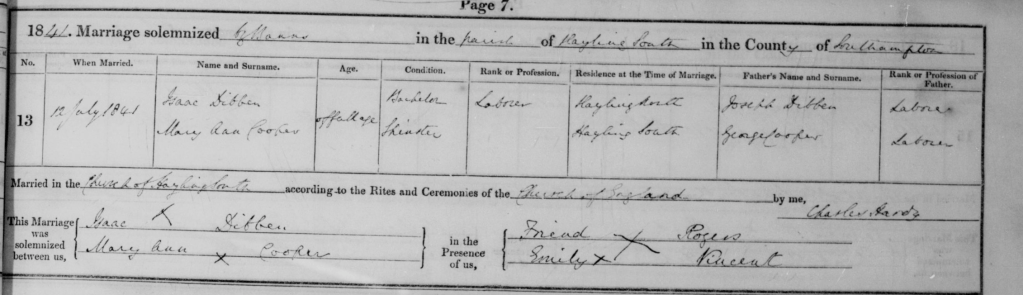
The name Rogers was everywhere on Hayling Island. In 1841 there were twenty-four men bearing the name in North Hayling alone, and Isaac’s own mother’s maiden name was Rogers. Furthermore, Isaac earned his living as an agricultural labourer for a local farmer named Thomas Rogers.
Whether Friend Rogers was a maternal relative, a connection through Isaac’s employer, or simply a trusted neighbour, the couple was surrounded by a protective network. The community did not cast them out; they helped shield them until Isaac and Mary Ann could legally marry.
A Legacy of Fierce Independence
The ultimate proof of Isaac’s character came in the decades that followed. The couple remained married for nearly fifty years, bringing ten children into a life of chronic poverty. Isaac continued to work as a farm labourer, and eventually rose to become parish clerk at St Peter’s Church – a post he held for nearly thirty years.
His achievement was recognised with three financial awards from the Bishop of Winchester – not for wealth or status, but for raising a large family while relying on as little parish assistance as possible.
The trail that seemed to disappear at the gates of Stamshaw House has, more than 180 years later, led back to a very human story.
A young couple faced an impossible choice: acknowledge their love openly and risk losing everything, or hide their happiness temporarily while Isaac cared for the parents who depended on him.
What looked like a Victorian scandal was actually a story of love, duty and a fierce determination to keep a family together.
The baby born in the asylum was not the beginning of a family scandal. He was the beginning of a family that endured.
[i] 1841 England Census, North Hayling HO107/389/1 via ancestry.co.uk last accessed 24 Jun 2026
[ii] Digital copy of death record1846 Q2 Havant Union Vol 07 p69 via GRO last accessed 24 Jun 2026
[iii] Hampshire Independent 25 Feb 1837 via findmypast.co.uk accessed 13 Jan 2024
[iv] Hampshire Independent 10 Nov 1838 via findmypast.co.uk accessed 13 January 2024
[v] Parish Records for Portsea, Portsmouth, baptism 21 Jun 1840. COOPER, George. Parents Isaac, a labourer, and Mary Ann Cooper, of Hayling Island. CHU 3/1B/26. via findmypast.co.uk accessed 13 January 2024
[vi] Digital copy of birth record 1841 Stamshaw House, Portsea, 15 May 1840, COOPER George, via GRO last accessed 24 Jun 2026
[vii] DNA matches via ancestry.co.uk last accessed 24 Jun 2026
[viii] Parish records for South Hayling marriage 12 Jul 1841 via findmypast.co.uk accessed 17 Jul 2019
