Imagine opening a letter only to find the text running both horizontally and vertically, woven together like a fabric of ink.
In the nineteenth century, paper was a precious commodity, and postage was charged by the sheet. To save space and money, writers sometimes used a method known as “cross-writing”. After filling a page normally, they would turn the paper ninety degrees to write across their own words.
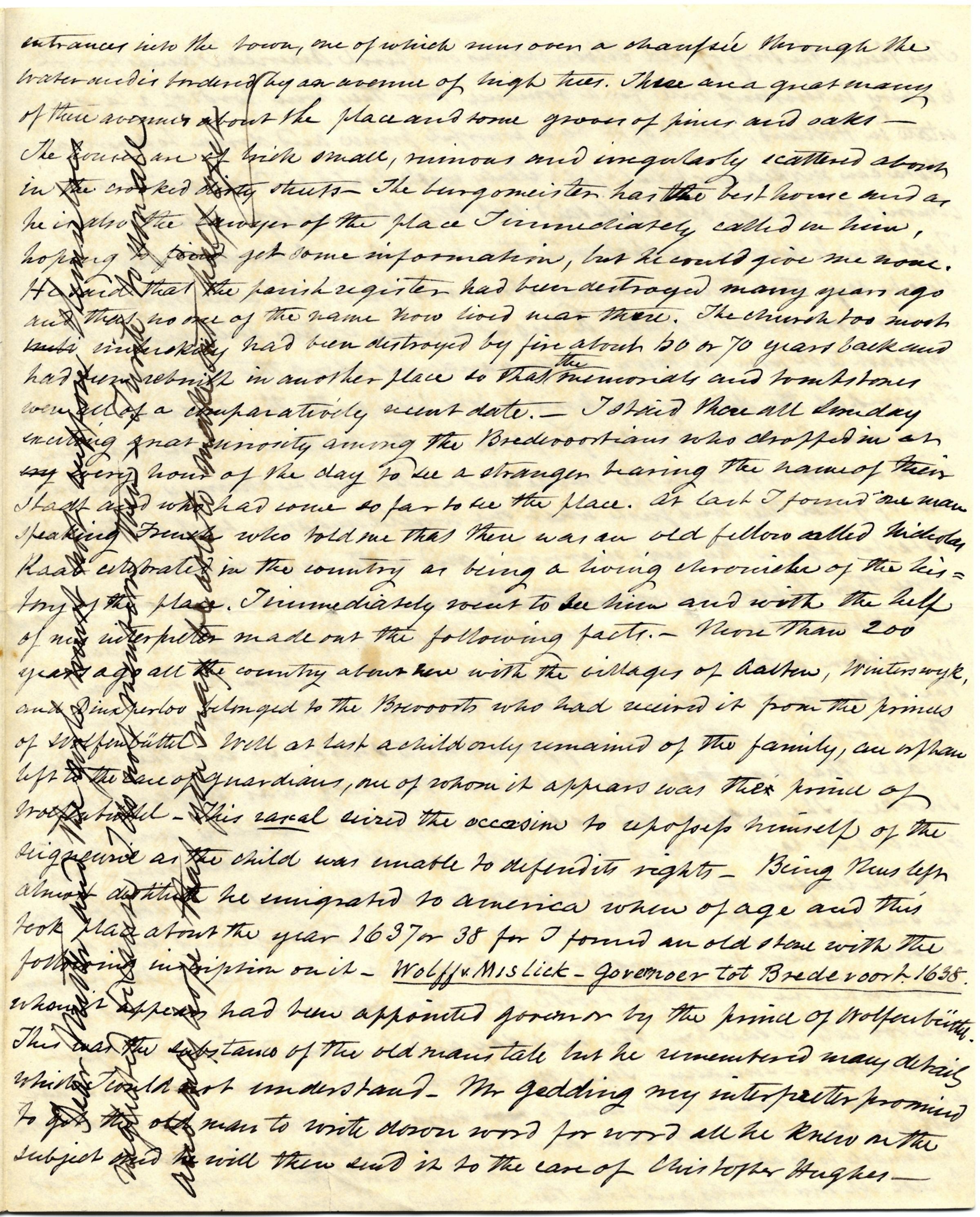
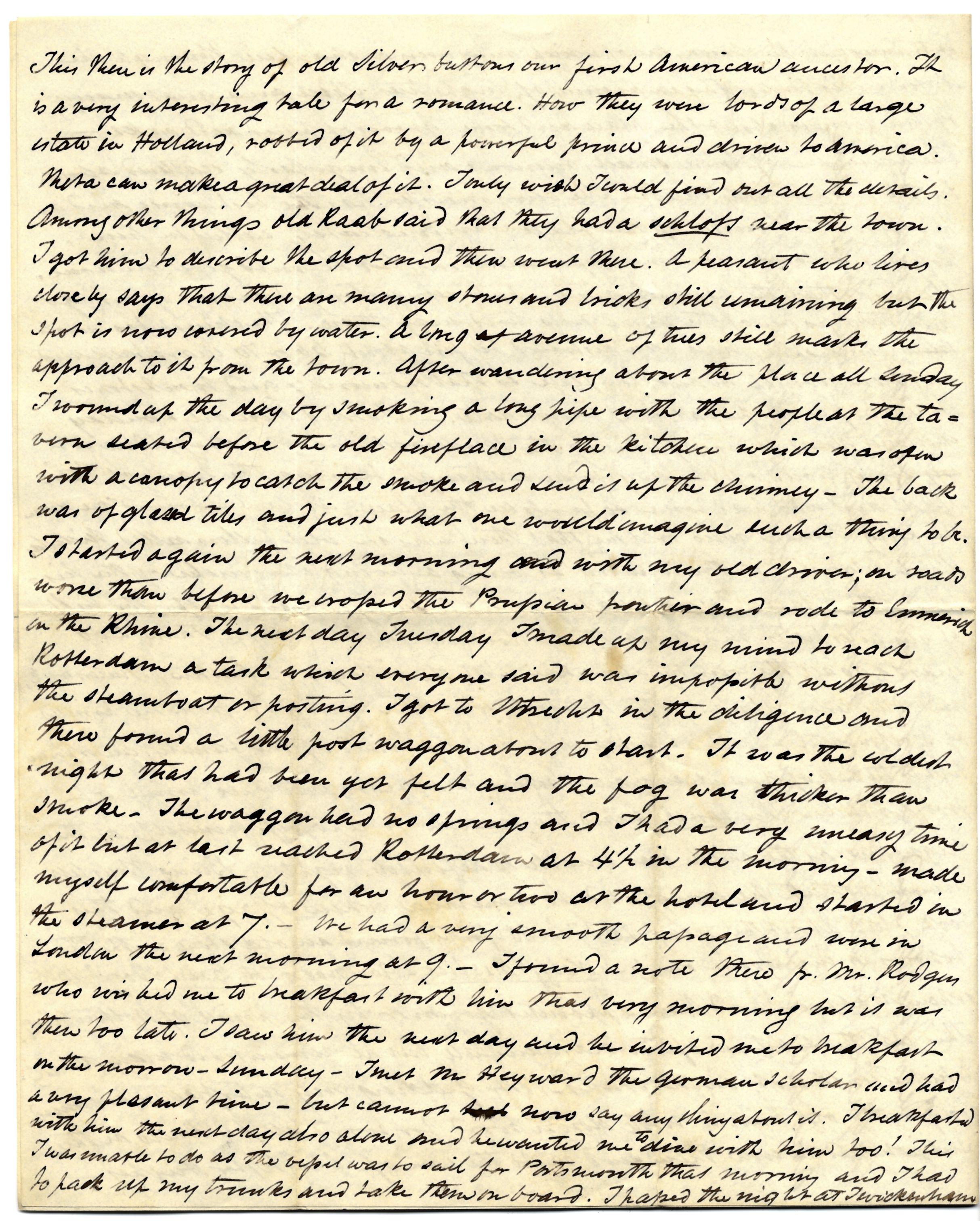
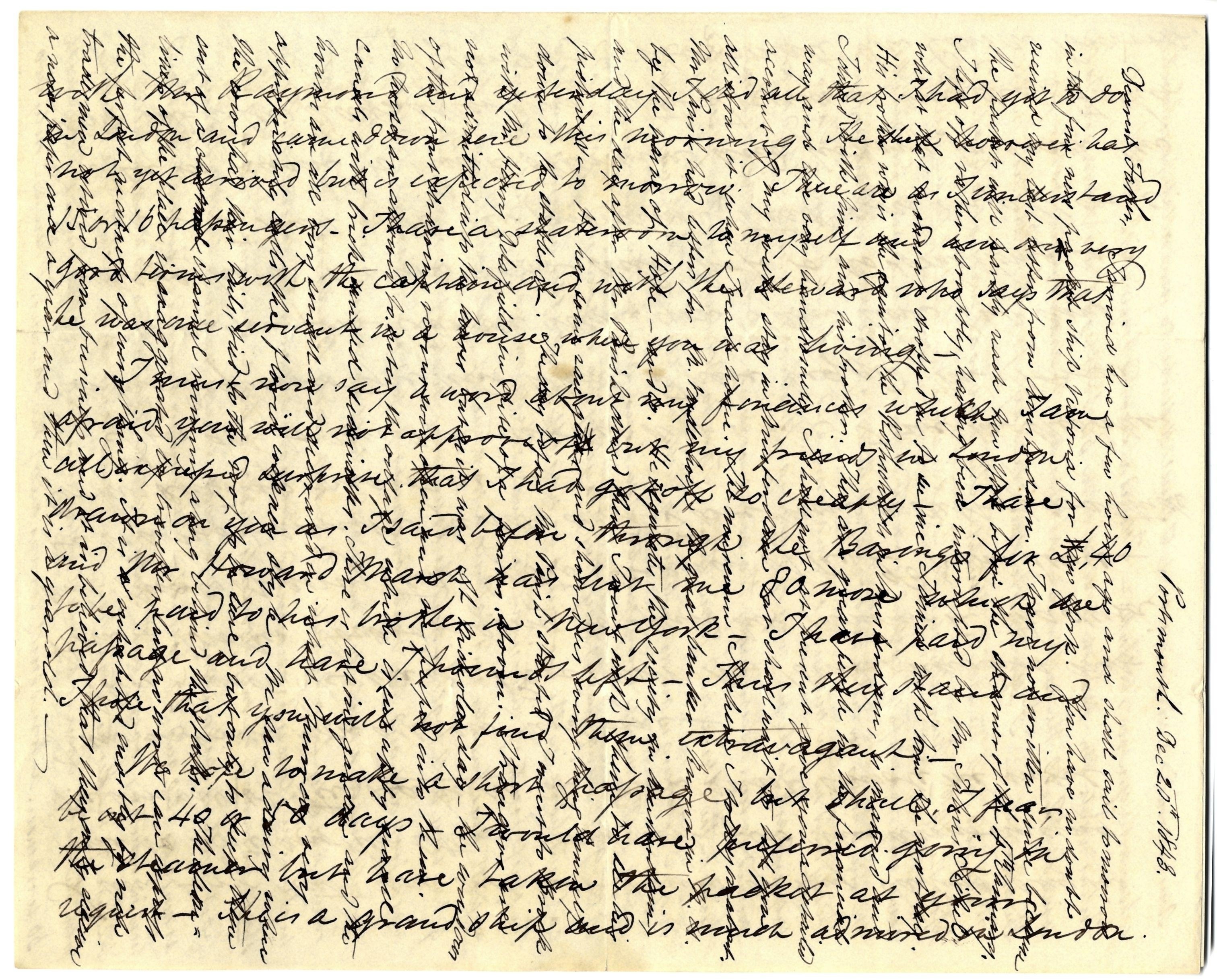
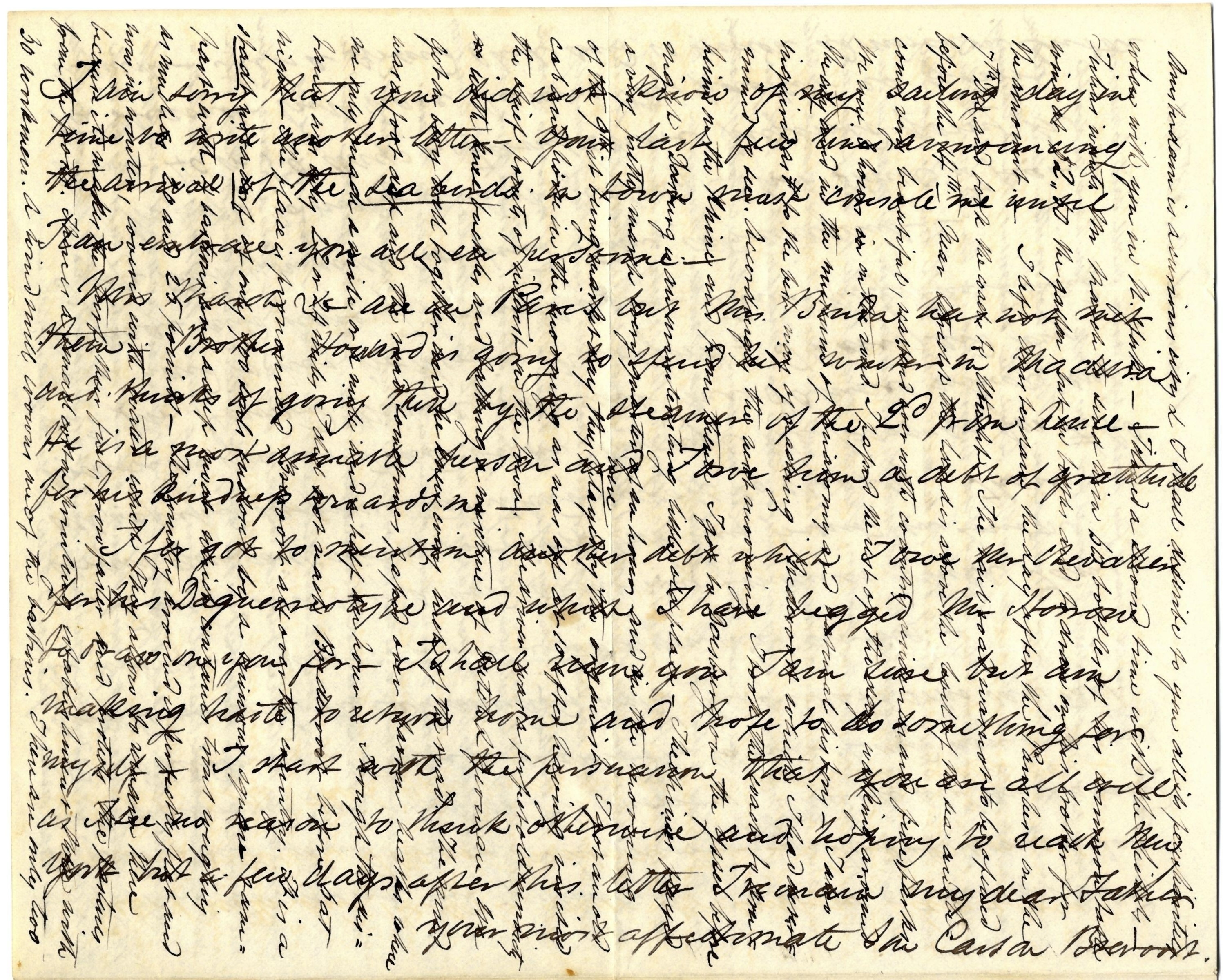
A beautiful example of this is a letter sent from Portsmouth on 20th December 1843 by 25-year-old Carson Brevoort to his father in New York.[i] Part of this cross-written letter describes a snowy, muddy quest into the Dutch countryside to uncover his family roots, offering us a wonderful glimpse into mid-19th-century travel. Deciphering this chaotic grid of lines has revealed not only Carson’s ultimate ancestral discoveries, but a remarkable reminder of the incredible efforts people once made just to stay in touch.
Looked at closely, the complex structure of this letter is more than just a clever way to save on Victorian postage – it looks very much like a deliberate, psychological pre-emptive strike aimed straight at his father. Henry Brevoort Jr. was notoriously practical and conservative with his finances, a trait Carson clearly kept front-of-mind.
By meticulously turning the paper ninety degrees and packing every single square inch of the page with overlapping ink, Carson fitted a seven-page letter onto just two sheets. He was providing visual, unassailable proof to his father that he was not wasting a single penny or sheet of paper. This was a subtle, clever dig: Look how practical and frugal I am being with your resources.
This defensive posture becomes explicit on the turned pages, where Carson shifts to an anxious accounting of his travel expenses. He fields potential criticism directly, writing that his elite friends in London were actually “surprised that I had got off so cheaply,” and pleading, “I hope that you will not find them extravagant.” He even wraps up by reminding his father that he gave up the comfort and speed of a contemporary steamship to take the long, cold, 45-day sailing packet crossing purely “at your request.”
The entire letter – from its muddy genealogical detours down to its claustrophobic, cross-written grid of ink – serves as a young man’s elaborate proof to his wealthy father that he was being a responsible, dutiful, and thrifty son.
Although transcribing a crossed letter today can be challenging, it is a wonderful reminder of the care, effort, and ingenuity people put into keeping in touch.
🍷 Stop 1: High Society, Art, and Bulk Wine in Amsterdam
Carson’s letter opens with a look into the glittering, elite social circles of mid-19th-century Europe. During a week-long stay in Amsterdam, he rubs shoulders with the continental banking elite, dining with Julius Isidor, who was a high-level agent for the legendary Rothschild banking empire, and his brother. Carson notes that they are “great people in the financial way and live very handsomely.”
The trip wasn’t all business, as Carson secures an exclusive invitation from Mr. Van der Hoop (of the famous banking firm Hope & Co.) to tour his country estate, view his private art collection down to the “rare gems,” and even inspect the stables. Amidst all this high-class networking, Carson drops a fabulously mundane detail: Julius Isidor requests that a mutual acquaintance ship him massive bulk bottles of common American table wine at $2.50 a gallon, proving that even the wealthiest Europeans appreciated a good import deal.
🐄 Stop 2: Broek and the Cleanliness Obsession
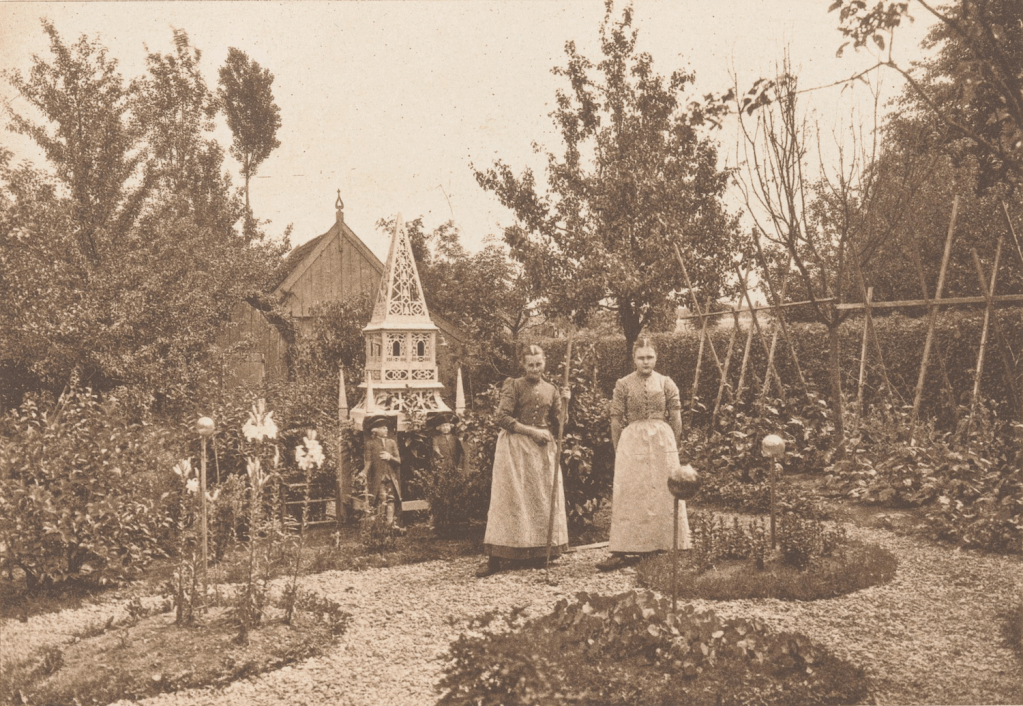
Before leaving the area, Carson braves a “ferocious storm” to visit the historic village of Broek in Waterland alongside a prominent New York merchant, Mr. Henry Delafield. In the 1840s, Broek was world-famous among tourists for its almost pathological neatness and gaudily painted wooden houses with different coloured polished tile roofs, and doors and windows always kept firmly closed – except for very special occasions. A popular guidebook of the time describes these houses somewhat condescendingly as “something between Grecian, Chinese, and Saracenic” vying with one another “in extravagance and absurdity”.[ii]
Carson notes that no horses are allowed to enter the village, which is cut up by tiny canals and immaculate brick-paved sidewalks. He remarks with amazement that “there is but one gutter” in the whole town. Because it was St. Nicholas Day, the windows of the local homes were wide open, allowing Carson to peep inside at the “florid cockney style” decor. He even explores a local show-dairy, confirming a famous piece of Dutch folklore to his father: the cows really did have their tails tied up to the ceiling rafters! Although Carson clarifies this was simply to keep them clean from the channel running behind the stalls.
🗺️ Stop 3: The Muddy Trek to Bredevoort
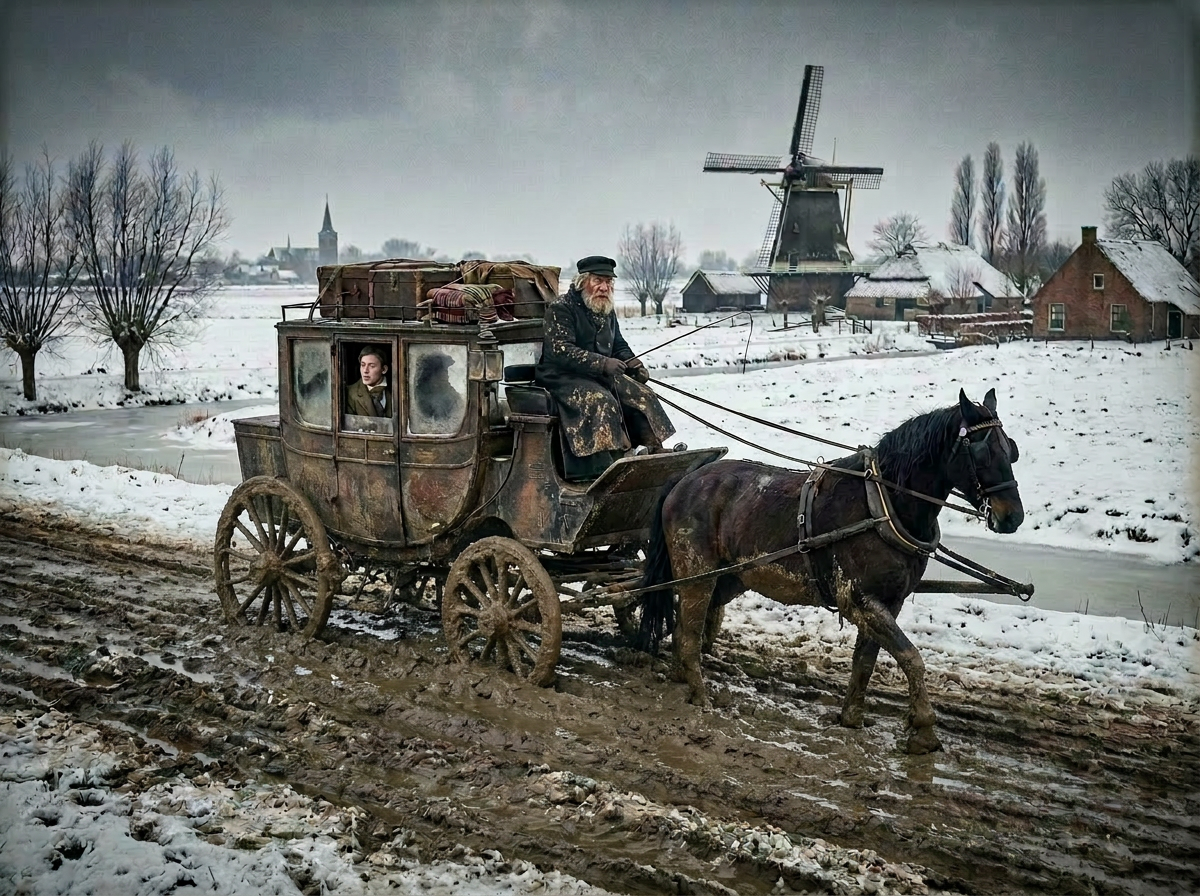
The heart of Carson’s letter shifts from a luxury trip to a rugged genealogical quest. Determined to find the ancestral home of the Brevoort family, he heads east. The journey is anything but comfortable. Although the Dutch Rhijnspoorweg from Amsterdam to Utrech had been officially opened on 6th December 1843,[iv] Carson gripes that “the railroad was not to be opened before the 14th” as it would be a few days until the first trains were open to passengers. Travelling by coach through Utrecht and Arnhem, he reaches the historic fortified town of Doesburg, where church chimes play pretty marches every quarter of an hour.
From there, Carson hires an old cab and a horse driven by a “perfect old curiosity” of a driver who wore traditional knee buckles and spoke a confusing mixture of Dutch and German. Together, they battle roads where the mud is a foot deep. Passing over barren winter heaths, the horse can only manage a gruelling mile or a mile and a half per hour. It takes them a full day of travelling to cover just 22 miles, finally reaching the tiny, isolated town of Bredevoort by nightfall.
🏰 Stop 4: Tracing the Legend of “Silver Buttons”
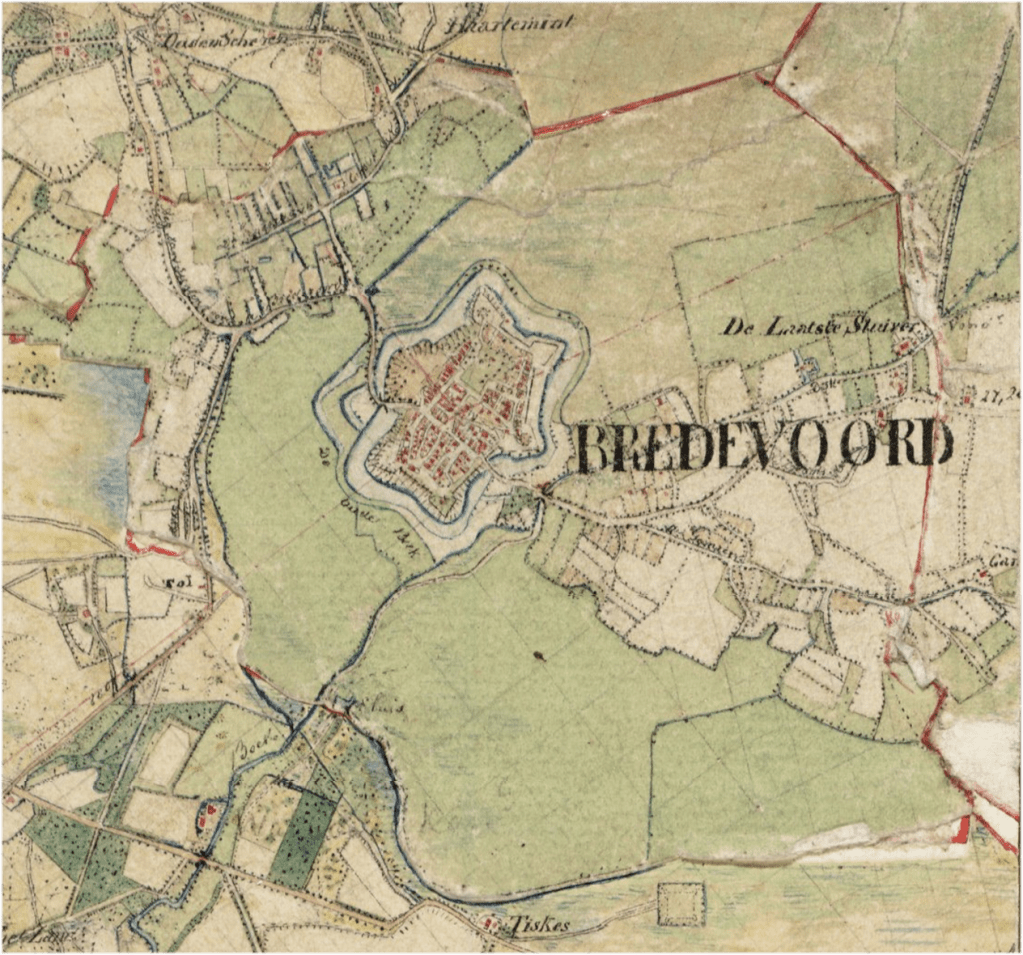
Bredevoort turns out to be an atmospheric, ruinous little town with a population of just 900, completely enclosed by a continuous square rampart, four bastions, and a deep moat filled with massive trout. Unfortunately for Carson, his archival search hits a brick wall: the local burgomaster (who doubles as the town lawyer) informs him that the parish registers and the historic church had been completely destroyed by fire seventy years previously.
Undeterred, Carson finds a French-speaking local interpreter named Mr. Geddink, who introduces him to an old town chronicler named Nicholas Raat. Sitting before a grand open fireplace in a local tavern and smoking a long pipe, Carson listens as Raat unravels the 200-year-old family legend of “Silver Buttons”, believed to be his first American ancestor.
As romantic as the old historian’s tavern tale was, it turns out old Nicholas Raat’s local memories had tangled two completely different families together. The legendary figure known for wearing iconic coats with double rows of flashing silver buttons was actually Lt. Hendrick Jochemszen Schoonmaker, a notable military figure in 17th century Albany, New York.
Poor Carson had braved a foot of freezing mud, smoked long pipes with local strangers, and stared out across a flooded field at a ruined castle, all based on a beautifully distorted bit of 200-year-old local hearsay.
In the time-honoured tradition of genealogical ‘rabbit holes’, Carson is led to believe that his ancestors were once powerful lords who owned the surrounding countryside, having acquired it from the Princes of Wolfenbüttel. However, the lineage dwindled down to a single, defenceless orphan child. A “rascal” guardian used the opportunity to seize the family estate. Left entirely destitute, the young heir was forced to emigrate to America around 1637. Carson even finds an old stone governor’s monument in town from 1638 to validate the timeline before trekking out to see the water-logged stones where the ancestral family castle (schloss) once stood.
However, just when I thought modern genealogy had debunked Carson’s muddy pilgrimage, official Dutch regional shipping manifests in an online archive show that on 8th March 1660, a man named Hendrick Janszen, accompanied by his wife and four children (aged 3, 12, 16 and 17), boarded the ship De Moesman bound for the New World. At that time there was no official surname, and someone was recorded with their first name, patronymic (Janszen, or ‘son of Jan’) and the place where they came from (in this case ‘Brevoort’). The archives prove that he was recorded simply as Hendrick Janszen ‘van Brevoort’ – denoting the fortified home town he had left behind. Carson hadn’t been completely fooled by tavern gossip and had successfully tracked his bloodline across the Atlantic, pushing through a foot of freezing mud to stand in the exact place his ancestor had left near two hundred years earlier.[vi]
⚓ The Journey Home: A Reluctant Ocean Crossing
After his successful historical hunt, Carson pushes through the freezing winter cold and thick fog to Rotterdam, crosses the English Channel, and arrives in London. There, he spends a whirlwind couple of days hobnobbing with the British intelligentsia, enjoying breakfast parties with the famous banker-poet Samuel Rogers and the German scholar Abraham Hayward.
The letter concludes in Portsmouth, where Carson is preparing to board the sailing packet ship Victoria for the long journey back to New York. In a classic touch of family dynamics, Carson admits he would have much preferred to take a modern, fast steamship, but is taking the slower sailing packet purely at his father’s request. Facing a brutal 40-to-50-day winter crossing across the Atlantic, Carson squares his finances through the Baring Brothers bank, hopes his father won’t find his expenses too extravagant, and prepares to set sail for home.
Knowing how dense and dizzying his cross-written grid of ink has become, Carson signs off with a final, sympathetic warning to his father: “…I only hope that you may be able to make out half of it.” It took me several days, and plenty of modern detective work, to decipher his missive, but two hundred years later we can share his historic journey.
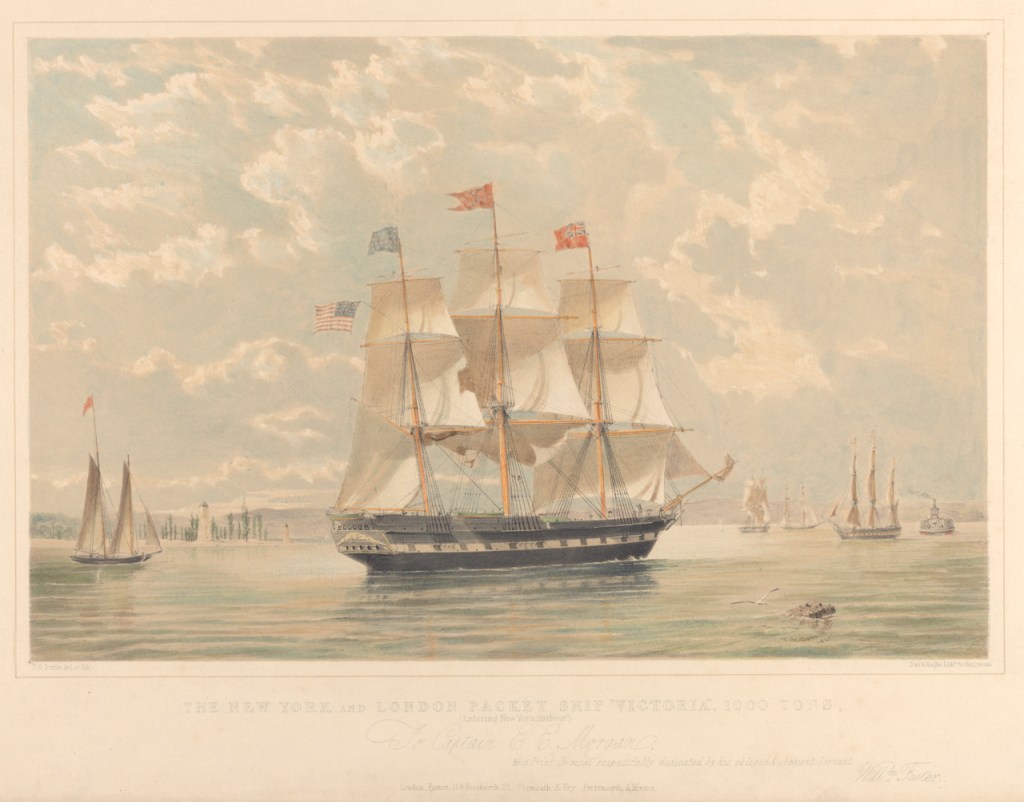
🏛️ The Man Who Left the Mud Behind: Who was James Carson Brevoort?
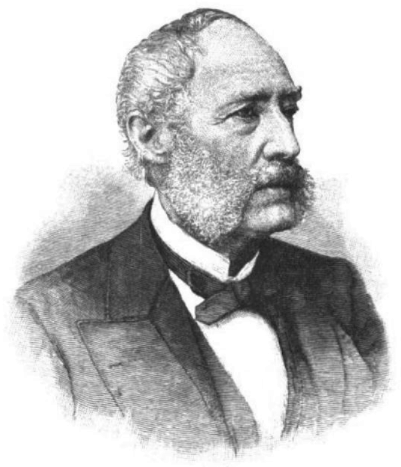
To understand the young man enduring this damp Dutch pilgrimage, it helps to look at who James Carson Brevoort (1818–1887) eventually became. Born into wealth as the son of prominent New York landowner and literary patron Henry Brevoort Jr. (who happens to be my 3rd great-grandfather!), Carson was educated in France and Switzerland, graduating as a civil engineer. Shortly before this 1843 trip, he served as the private secretary to none other than celebrated author Washington Irving during his diplomatic mission to Spain.
Carson went on to marry Elizabeth Lefferts, inheriting the vast Lefferts estate in Bedford-Stuyvesant, Brooklyn. Rather than just living a life of leisure, he became a towering figure in New York’s intellectual golden age. He served as the Superintendent of the Astor Library (which later became the New York Public Library), was the President of the Long Island Historical Society, and was a renowned expert on early American geography and numismatics. He even amassed a legendary private library of over 10,000 rare books and a world-class collection of fish specimens. Later in life, with his distinctive white whiskers and elegant bearing, he looked every bit the distinguished Victorian scholar – a far cry from the shivering young man smoking pipes in a muddy Dutch tavern!
📜 The Original Letter and Transcripts
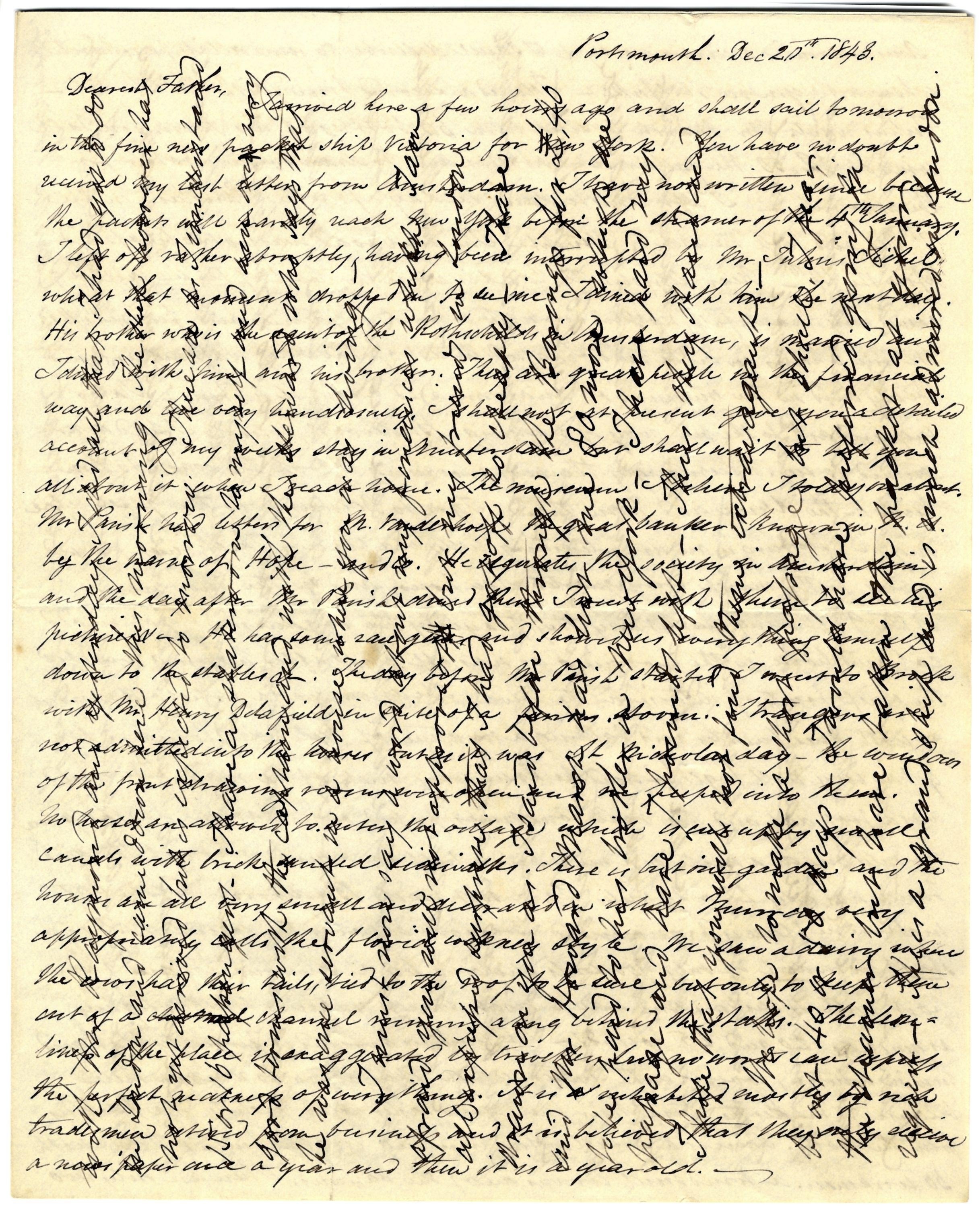
Click here for Page 1 transcript
Portsmouth Dec 20th 1848
Dearest Father
I arrived here a few hours ago and shall sail tomorrow
in the fine new packet ship Victoria for New York. You have no doubt
received my last letter from Amsterdam. I have not written since because
the packets will hardly reach New York before the steamer of the 4th January.
I left off rather abruptly, having been interrupted by Mr Julius Isidor
who at that moment dropped in to see me. I dined with him the next day.
His brother who is the agent of the Rothschilds in Amsterdam, is married and
I dined with him and his brother. They are great people in the financial
way and live very handsomely. I shall not at present give you a detailed
account of my week’s stay in Amsterdam but I shall wait to tell you
all about it when I reach home. The museum I believe I told you about.
Mr Parish had letters for M. Van der Hoop[ix] the great banker known in NY
by the name of Hope – and Co. He regulates the society in Amsterdam
and he day after Mr Parish dined there I went with them to see his
pictures &ct. He has some rare gems and showed us everything himself
down to the stables &ct. The day before Mr Parish started I went to Broek[x]
with Mr Henry Delafield[xi] in spite of a ferocious storm. Strangers are
not admitted into the houses but as it was St Nicholas day – the windows
of the principal drawing rooms were open and we peeped into them.
No horses are allowed to enter the village which is cut up by small
canals with brick paved sidewalks. There is but one gutter and the
houses are very small and decorated in what Murray very
appropriately calls the florid cockney style. We saw a dairy where
the cows had their tails, tied to the roof to be sure, but only to keep them
out of a channel running along behind the stalls. The clean-
liness of the place is exaggerated by travellers but no words can express
the perfect neatness of everything. It is inhabited mostly by rich
tradesmen retired from business and it is believed that they only receive
a newspaper once a year and then it is a year old. ~
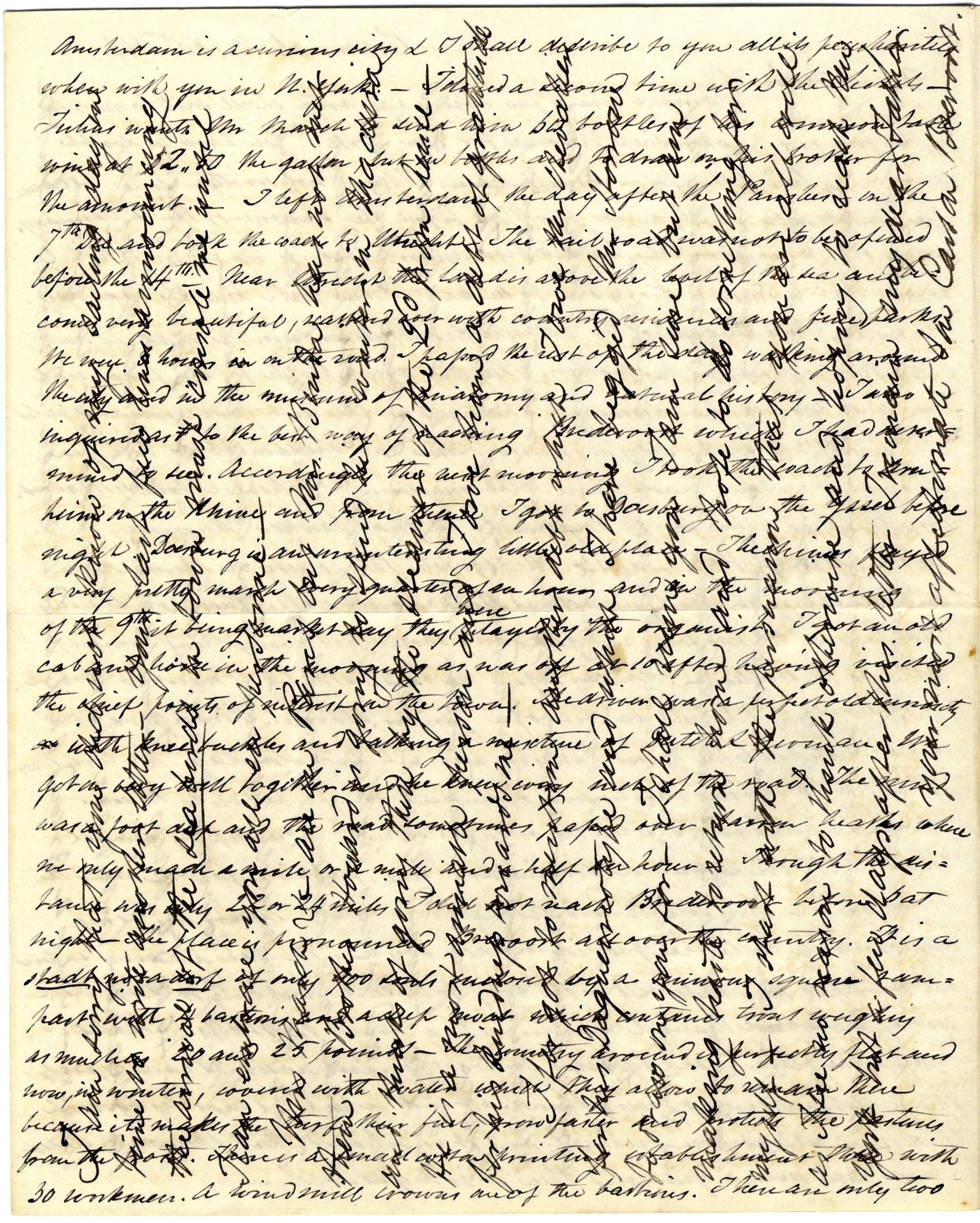
Click here for Page 2 transcript
Amsterdam is a curious city & I shall describe to you all its peculiarities
when with you in N York. – I dined a second time with the Isidors –
Julius wants Mr March to send him big bottles of his common table
wine at $2.50 the gallon, but in bottles and to draw on his brother for
the amount. I left Amsterdam the day after the Parishes on the
7th of Dec and took the coach to Utrecht. The rail road was not to be opened
before the 14th. Near Utrecht the land is above the level of the sea and be
comes very beautiful, scattered over with country residences and fine parks.
I saw many fine houses on the road. I passed the rest of the day walking around
the city and in the museums of anatomy and natural history- I also
inquired to the best way of reaching Bredevoort which I had deter-
mined to see. Accordingly the next morning I took the coach to Arn-
heim on the Rhine and from there I got to Doesburg on the Ijssel before
night. Doesburg is an interesting little old place. The chimes played
a very pretty march every quarter of an hour and in the morning
of the 9th it being market day they were played by the organist. I got an old
cab and horse in the morning and was off at 10 after having visited
the chief points of interest in the town. The driver was a perfect old curiosity
with knee buckles and talking a mixture of Dutch and German. We
got on very well together and he knew every inch of the road. The mud
was a foot deep and the road sometimes passed over barren heaths where
we could only make a mile or a mile and a half an hour. Though the dis-
tance was only 22 or 24 miles I did not make Bredevoort before that
night- The place is pronounced Brevooort all over the country. It is a
stadt not a dorf of only 900 souls enclosed by a continuous square ram-
part with 4 bastions and a deep moat which contains trout weighing
as much as 20 and 25 pounds- The country around is perfectly flat and
now, in winter, covered with water which they allow to remain there
because it makes the turf their fuel, grow faster and protects the pastures
from the frost. There is a small cotton printing establishment there with
30 workmen. A windmill crowns one of the bastions. There are only two
Click here for Page 3 transcript
entrances into the town, one of which runs over a chaussée through the
water and is bordered by an avenue of high trees. There are a great many
of these avenues about the place and some groves of pines and oaks –
The houses are of brick small, ruinous and irregularly scattered about
in the crooked dirty streets – The burgomeister has the best house and as
he is also the Lawyer of the place I immediately called on him,
hoping to get some information, but he could give me none.
He said that the parish register had been destroyed many years ago
and that no one of the name now lived near there. The church too most
unfortunately had been destroyed by fire about 60 or 70 years back and
had been rebuilt in another place so that the memorials and tombstones
were all of a comparatively recent date.- I stayed there all Sunday
exciting great curiosity among the Bredevoortians who dropped in at
every hour of the day to see a stranger bearing the name of their
stadt and who had come so far to see the place. At last I found one man
speaking French who told me that there was an old fellow called Nicholas
Raat celebrated in the country as being a living chronicle of the his-
tory of the place. I immediately went to see him and with the help
of his interpreter made out the following facts.- More than 200
years ago all the country about here with the villages of Aalten, Winterswyk,
and Dinxperloo belonged to the Brevoorts who had acquired it from the princes
of Wolfenbüttel. Well at last a child only remained of the family, an orphan
left to the care of guardians, one of whom it appears was the prince of
Wolfenbüttel. This rascal used the occasion to repossess himself of the
seigneurie as the child was unable to defend its rights – Being thus left
almost destitute he emigrated to America when of age and this
took place about the year 1637 or 38 for I found an old stone with the
following inscription on it- Wolff v Mislick – Governoer tot Bredevoort 1638.
whom it appears had been appointed governor by the prince of Wolfenbüttel.
This was the substance of the old mans tale but he remembered many details
which I could not understand- Mr Gedding my interpreter promised
to get the old man to write down word for word all he knew on the
subject and he will then send it to the care of Christopher Hughes-
Click here for Page 4 transcript
This then is the story of old Silver Buttons our first American ancestor. It
is a very interesting tale for a romance. How they were lords of a large
estate in Holland, robbed of it by a powerful prince and driven to America.
Meta can make a great deal of it. I only wish I could find out all the details.
Among other things that old Raat said that they had a schloss near the town.
I got him to describe the spot and then went there. A peasant who lives
close by says that there are many stones and bricks still remaining but the
spot is now covered by water. A long avenue of trees still marks the
approach to it from the town. After wandering about the place all Sunday
I wound up the day by smoking a long pipe with the people at the ta-
vern seated before the old fireplace in the kitchen which was open
with a canopy to catch the smoke and send it up the chimney – The back
was of glazed tiles and just what one would imagine such a thing to be.
I started again the next morning with my old driver; on roads
worse than before we crossed the Prussian frontier and rode to Emmerich
on the Rhine. The next day Tuesday I made my mind to reach
Rotterdam a task which everyone said was impossible without
the steamboat or posting. I got to Utrecht in the diligence and
there found a little post waggon about to start. It was the coldest
night that had been yet felt and the fog was thicker than
smoke – The waggon had no springs and I had a very uneasy time
of it but at last reached Rotterdam at 4 ½ in the morning – made
myself comfortable for an hour or two at the hotel and started in
the steamer at 7.- We had a very smooth passage and were in
London the next morning at 9.- I found a note there from Mr Rogers[xii]
who wished me to breakfast with him that very morning but it was
then too late. I saw him the next day and he invited me to breakfast
on the morrow – Sunday – I met Mr Hayward the German scholar[xiii] [1]and had
a very pleasant time – but cannot now say anything about it. I breakfasted
with him the next day also alone and he wanted me to dine with him too! This
I was unable to do as the vessel was to sail for Portsmouth that morning and I had
to pack up my trunks and take them on board. I passed the night at Twickenham
Click here for Page 5 transcript
with Mr Raymond and yesterday I did all that I had yet to do
in London and came down here this morning. The ship however has
not yet arrived but is expected to morrow. There are as I understand
15 or 16 passengers. I have a stateroom to myself and am on very
good terms with the captain and with the steward who says that
he was once a servant in a house where you was living –
I must now say a word about my finances which I am
afraid you will not approve of but my friends in London
all expressed surprise that I had got off so cheaply- I have
drawn on you as I said before through the Barings[xiv] for £40
and Mr Howard March[xv] has advanced me 80 more which are
to be paid to his brother in New York- I have paid my
passage and have 7 pound left- Thus they stand and
I hope that you will not find them extravagant-
I hope to make short passage but shall, I fear,
be out 40 or 50 days- I would have preferred going in
the steamer but I have taken the packet at your
request. She is a grand ship and is much admired in London.
Click here for Page 6 transcript
I am sorry that you did not know of my sailing day in
time to write another letter- Your last few lines announcing
the arrival of the Sea Birds in town must console me until
I can embrace you all in personne-
Mrs &ct are in Paris but Mrs Binda[xvi] has not met
them. Brother Howard[xvii] is going to spend his winter in Madiera
and thinks of going then by the steam of the 20th from Venice-
He is a most amiable person and I owe him a debt of gratitude
for his kindness toward me-
I forgot to mention another debt which I owe Mr Chevalier[xviii]
for his Daguerrotype and which I have begged Mr Hone[xix]
to pay on my account. I shall soon see you I am sure but am
making haste to return home and hope to do something for
myself I start with the persuasion that you are all well
as I have no reason to think otherwise and hoping to reach New
York but a few days after this letter. I remain my dear Father
Your most affectionate son J. Carson Brevoort.
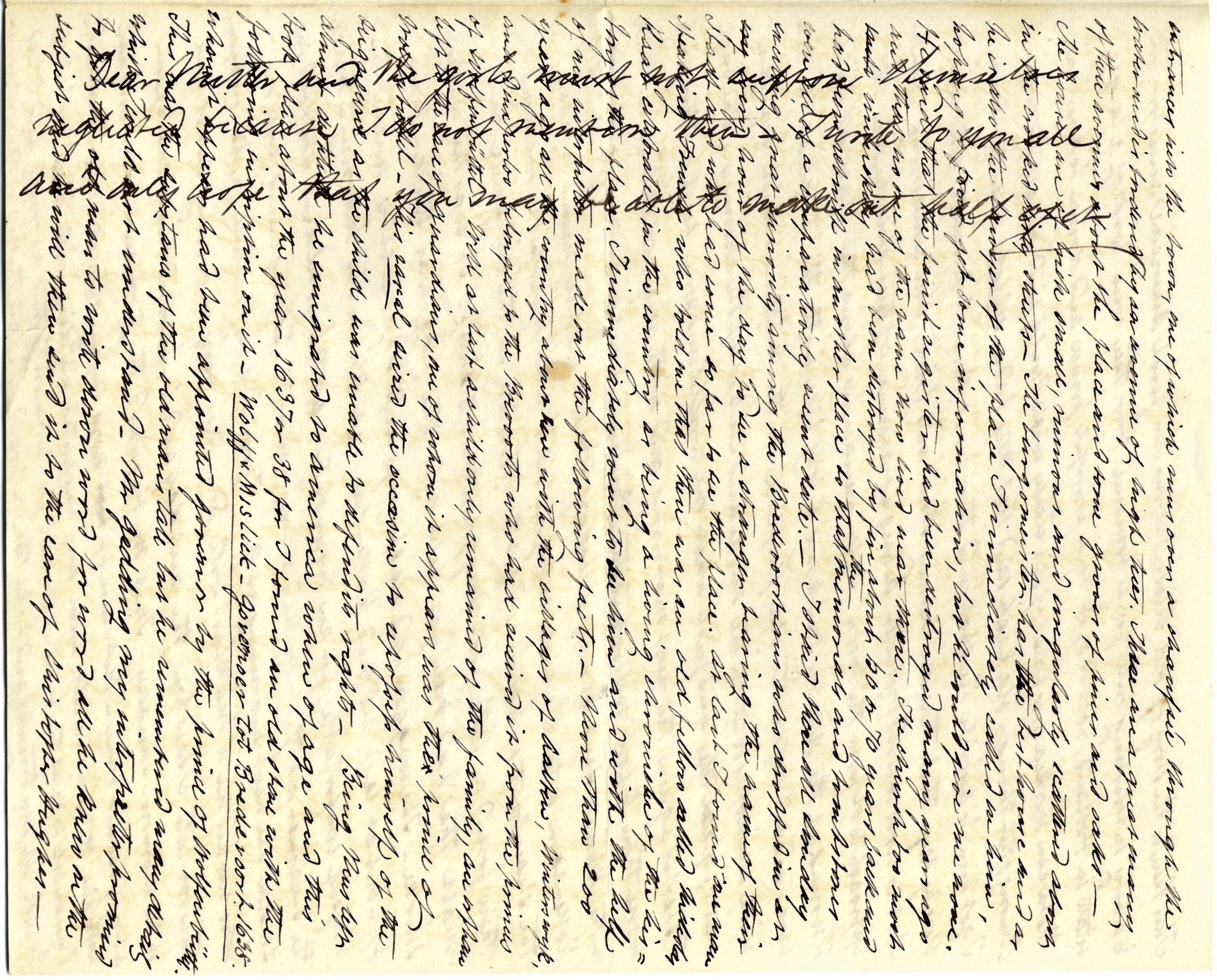
Click here for Page 7 transcript
Dear Mother and the girls must not suppose themselves
neglected because I do not mention them- I write to you all
and only hope that you be able to make out half of it.
[i] Carson Brevoort in Portsmouth to father SP08: Winslow Family Papers, Box 1, Folder 8: Correspondence of Carson Brevoort, 1839-1871, undated (bulk 1839-1843) Salve Regina University via JSTOR.org ref 29688111 last accessed 10 Jun 2026
[ii] A handbook for travellers on the continent: being a guide through Holland, Belgium, Prussia, and northern Germany, and along the Rhine, from Holland to Switzerland published 1851 by John Murray, London, via archive.org last accessed 16 Jun 2026
[iii] Rijksmuseum photograph of two unknown women in a garden in Broek c.1884, CC0, via Wikimedia Commons last accessed 16 Jun 2026
[iv] https://www.canonvannederland.nl/nl/utrecht/onderwijscanon/rhijnspoorweg last accessed 16 Jun 2026
[v] Plan of Bredevoort in 1844 by J.A. v/d Bosch – Nationaal Archief, Public Domain, via Wikimedia Commons ref 16073941last accessed 16 Jun 2026
[vi] https://oldaalten.nl/en/emigration/usa/traces-of-brevoort-in-new-york last accessed 16 Jun 2026
[vii] ID: PAH0577 via Royal Museums Greenwich under Creative Commons Attribution, Non-Commercial, No Derivatives (CC-BY-NC-ND) licence last accessed 16 Jun 2026
[viii] image of James Carson Brevoort via Wikimedia Commons last accessed 15 Jun 2026
[ix] The Van der Hoop family were hugely important in Dutch banking at the time who frequently collaborated with the Rothschilds and Baring Brothers
[x] Broek was globally famous in the 1800s for its neatness and the “florid cockney style” houses described in John Murray’s famous Handbooks for Travellers
[xi] Portrait of James Carson Brevoort (1818–1887) from Narrative and Critical History of America, Volume I, 1889 via commons.wikimedia.org last accessed 15 Jun 2026
[xii] Samuel Rogers, the famous banker-poet who famously hosted breakfast parties for visiting literati
[xiii] This is almost certainly Abraham Hayward, the prominent 19th-century British essayist, translator of Goethe’s Faust, and high-society intellectual who was well known for hosting American visitors in London around the time the letter was written
[xiv] Baring Brothers & Co., the legendary London merchant bank that handled financial drafts for wealthy American travellers
[xv] Howard March (John Howard March), the incredibly prominent American merchant and long-serving US Consul to Madeira
[xvi] Mrs Binda was the wife of Joseph A. Binda, a prominent Italian-born diplomat who served as the United States Consul at Leghorn (Livorno), Italy. The Bindas moved in the exact same high-society European and American expatriate circles as the Brevoorts
[xvii] Howard March (John Howard March), the incredibly prominent American merchant and long-serving US Consul to Madeira
[xviii] Mr Chevalier was the legendary Parisian optician, lens-maker, and early daguerreotype photographic pioneer.
[xix] Philip Hone was the former Mayor of New York, and close friend of the Brevoorts who wrote about their famed Fancy Ball in 1840.
