
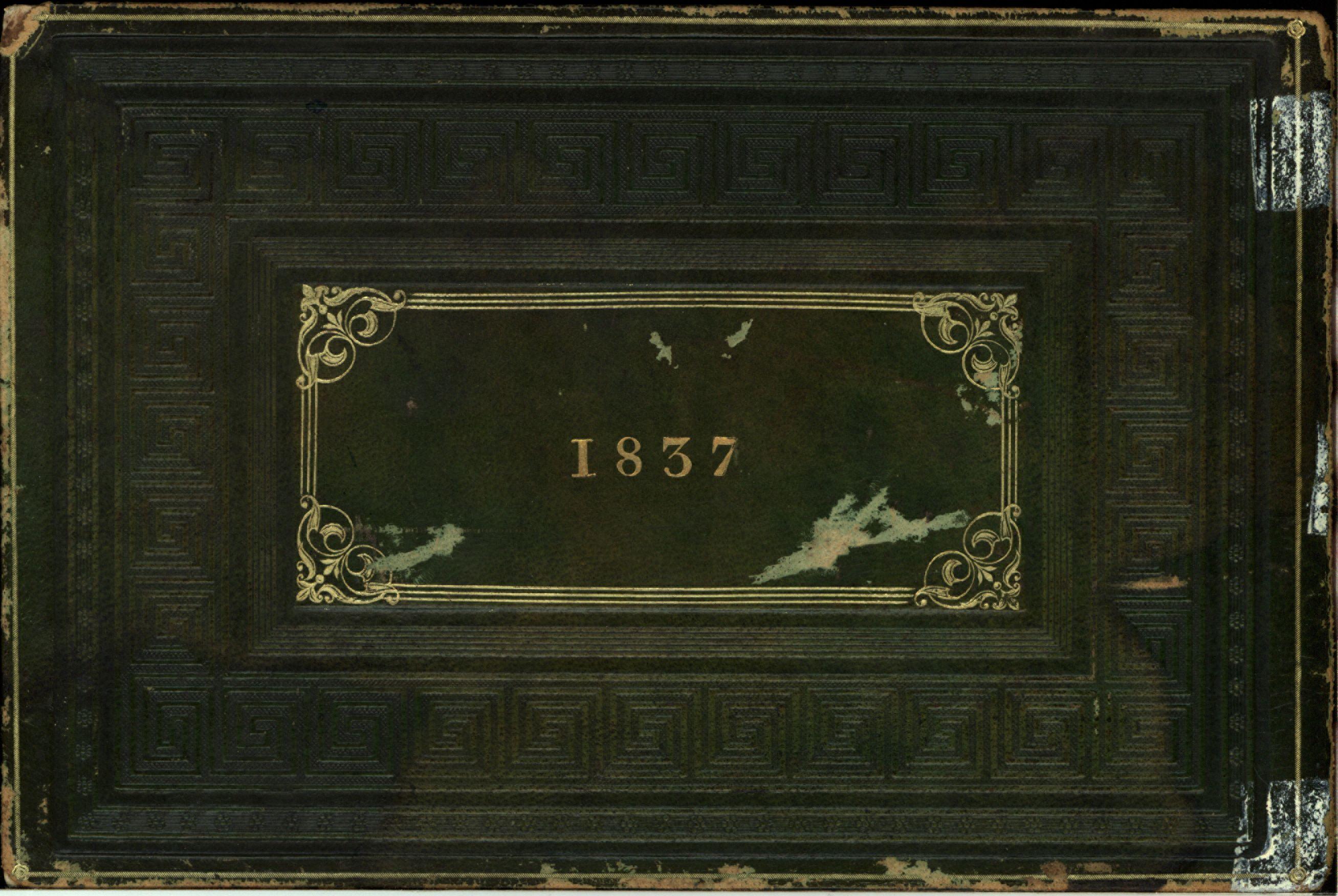
Recently, whilst researching some of my Brevoort ancestors, I came across the most wonderful find in a digital copy of a “Commonplace Book” by the Brevoort children, including my second great-grandmother Elisabeth. This unique book was created by the children when they were living in Paris around 1837. It is preserved in a scuffed and worn brown embossed leatherbound slipcover bearing the initials L. B. in gold, surrounded by a decorative border also in gold – likely the initials of their mother Laura Brevoort née Carson). The back of the slipcover features the year 1837 embossed in gold surrounded by a similar gold border.
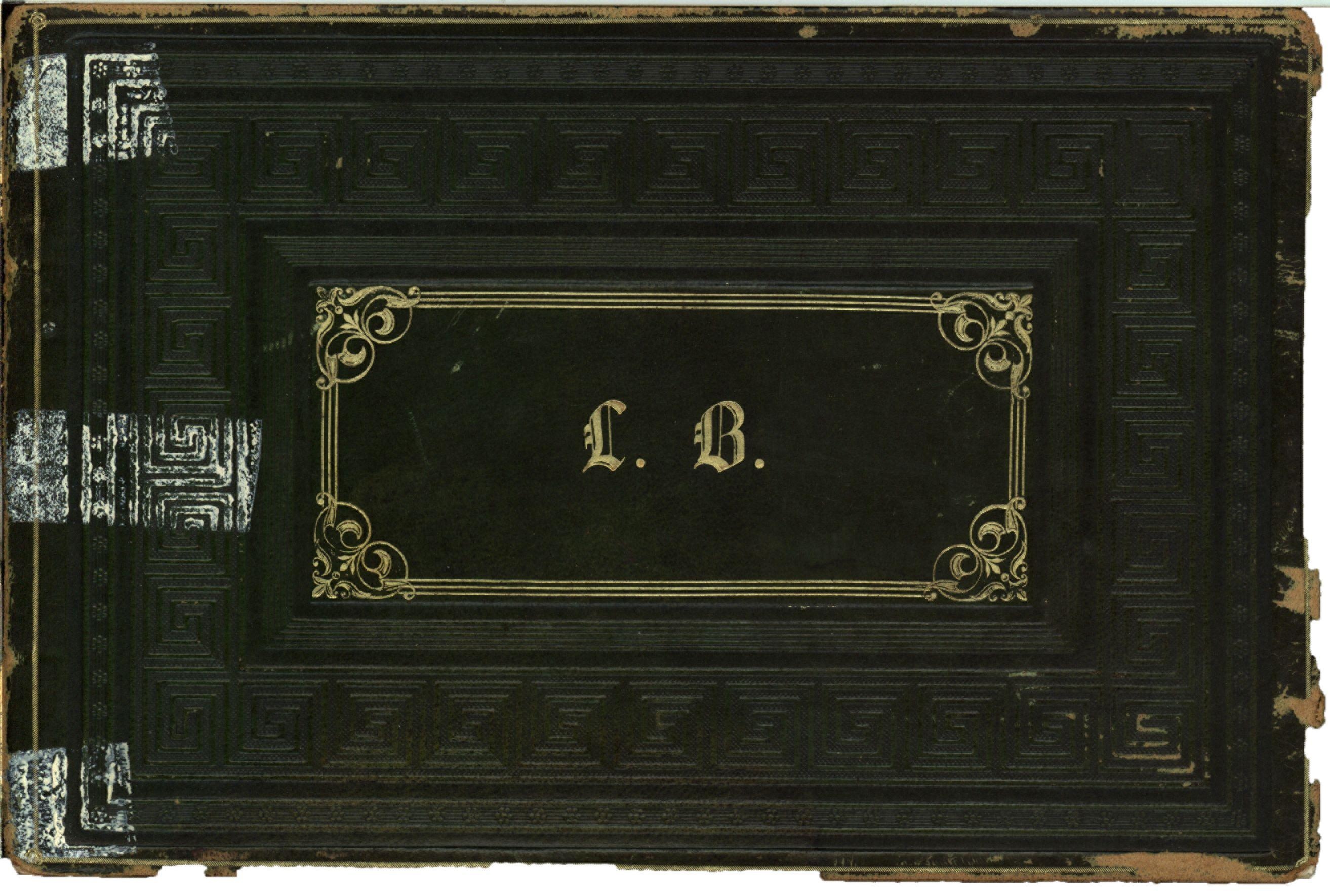
Filled with quotations and poems in English, French, and German, alongside sketches, and a musical score, the book offers a rare insight into the children’s personalities, talents, and expectations from nearly two hundred years ago.
Their father, Henry Brevoort Jr, was a wealthy and well-travelled New Yorker. He was descended from early Dutch settlers who arrived in the 1600s and, by the mid-18th century, owned vast swathes of farmland s across what is now Manhattan. By the early 19th century, the Brevoort fortune was firmly cemented as the family sold off parcels of land to accommodate the rapid growth of New York City. As a young man, Henry had accompanied the explorers Lewis and Clark on part of their expedition to the Pacific Northwest and spent years in the wilderness working for John Jacob Astor’s American Fur Company. He later travelled extensively across Europe before returning to America to marry Laura Elizabeth Carson of Charleston, South Carolina.
Eight children were born of the marriage, spending much of their formative years moving between New York and Europe. Both boys and girls were educated in Paris, as well as the Hofwyl School – a progressive institution in Switzerland. Hofwyl integrated manual labour, agricultural training, and academic instruction with the radical goal of bridging the gap between social classes. It was highly unconventional for the era, strictly forbidding corporal punishment, rewards, or competitive incentives.
In 1834, at the peak of his wealth and social influence, Henry Brevoort Jr commissioned the building of a grand Greek Revival mansion in New York to house his family and his massive collection of books. Though based mostly in Europe at the time, his finances were hit badly by the Great Fire of New York in 1835, which decimated the city’s commercial district. Yet, even when a subsequent financial crisis triggered the nationwide Panic of 1837 – causing a major economic depression in the United States – there is no evidence in available sources that the Brevoorts’ comfortable lifestyle in Paris was directly derailed.
Most of the handwritten contributions in the album were made by Elisabeth, then aged about fifteen, and her younger sisters Laura, Meta, and Constance. Their brother Henry, aged about seven, added his contributions in a childish scrawl, and there is one from their youngest sister Edith, aged about six. Carefully pasted into the album at a later date are a music score and a couple of impressive pencil sketches by the eldest brother James Carson. One sibling is missing from the pages: William Augustus, the middle of the three brothers, who had died in 1834 while away at school in Hofwyl aged just fourteen.
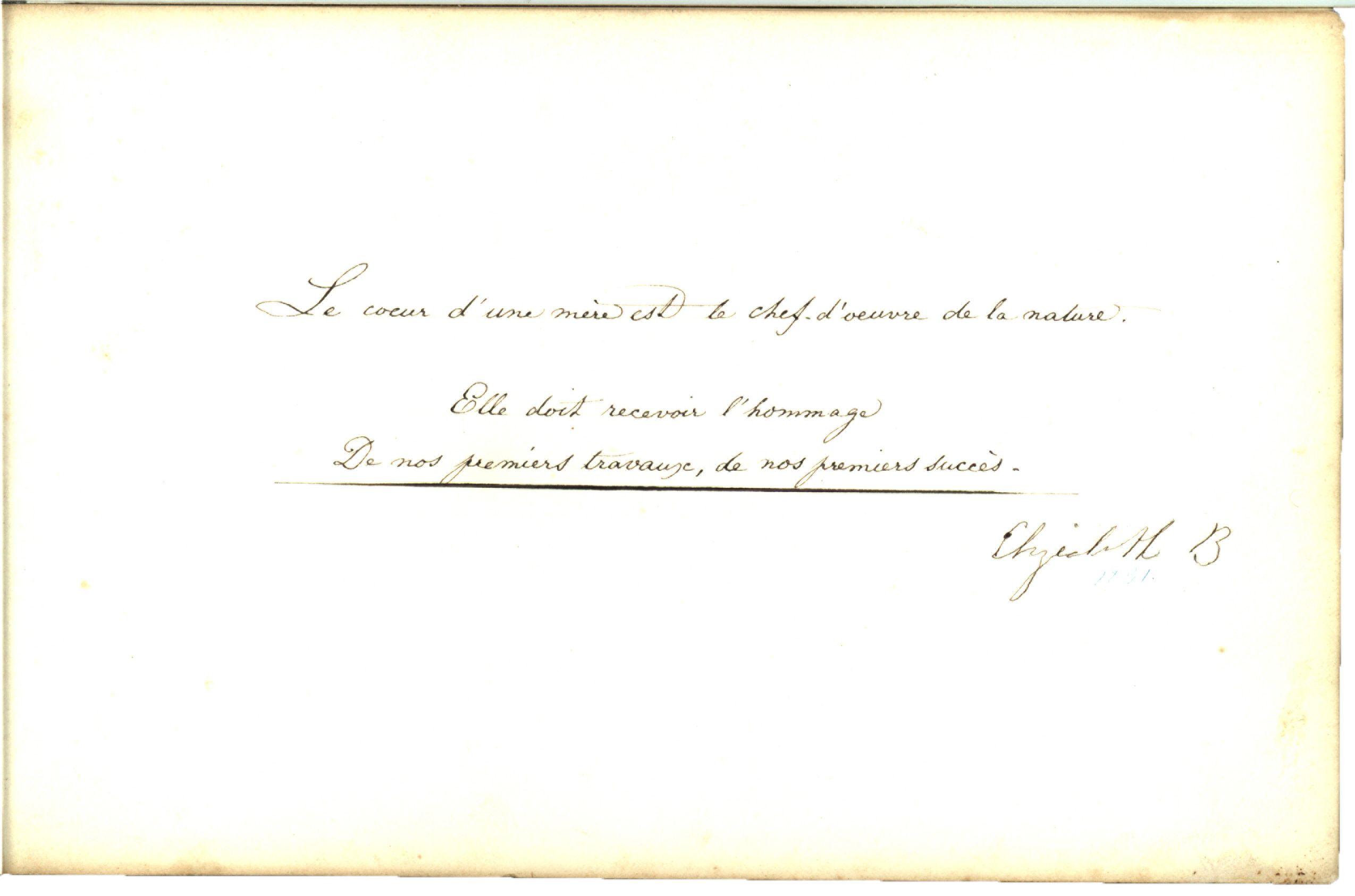
The dedication at the front of the album reads:
Le coeur d’une mère est le chef-d’oeuvre de la nature.
Elle doit recevoir l’hommage
De nos premiers travaux, de nos premiers succès.
- Elizabeth B
This roughly translates to:
“A mother’s heart is nature’s masterpiece. It must receive the tribute of our first works, of our first successes. Elizabeth B”
Following this touching tribute to their mother, the pages unfold with the distinct voices of the younger siblings. Among them, nine-year-old Constance found inspiration in classical French literature, copying out a verse that perfectly mirrored her own identity.
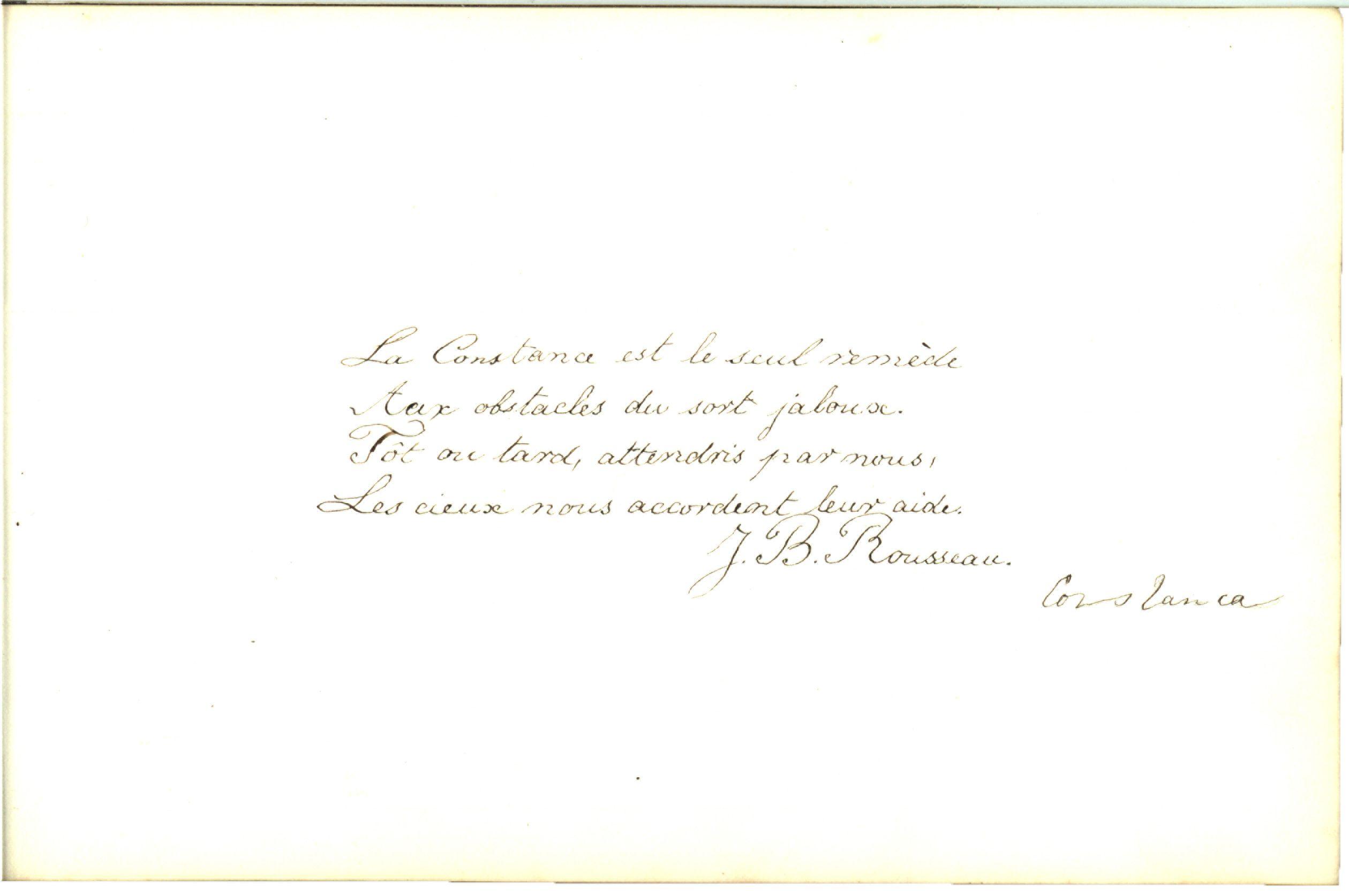
La Constance est le seul remède
Aux obstacles du sort jaloux.
Tôt ou tard, attendri par nous,
Les dieux nous accordant leur aide.
JB Rousseau
Constance
This translates as:
“Constancy is the only remedy
Against the obstacles of a jealous fate;
Sooner or later, moved by our plight,
The heavens grant us their aid”
Choosing this extract from Ode X (Palinodie) by French poet and dramatist Jean-Baptiste Rousseau (1671–1741), [iv] the young girl clearly delighted in the profound connection between her own name and the poem’s theme of enduring resilience.
Turning the pages past Constance’s entry, we find a contribution by fourteen-year-old Laura, the second of the five sisters. Laura used two pages to carefully transcribe, in English, a popular late-18th-century poem by Thomas Gisborne titled The Worm. Written as a lesson in empathy and humility, the verses caution the reader against looking down on the humblest of God’s creatures:
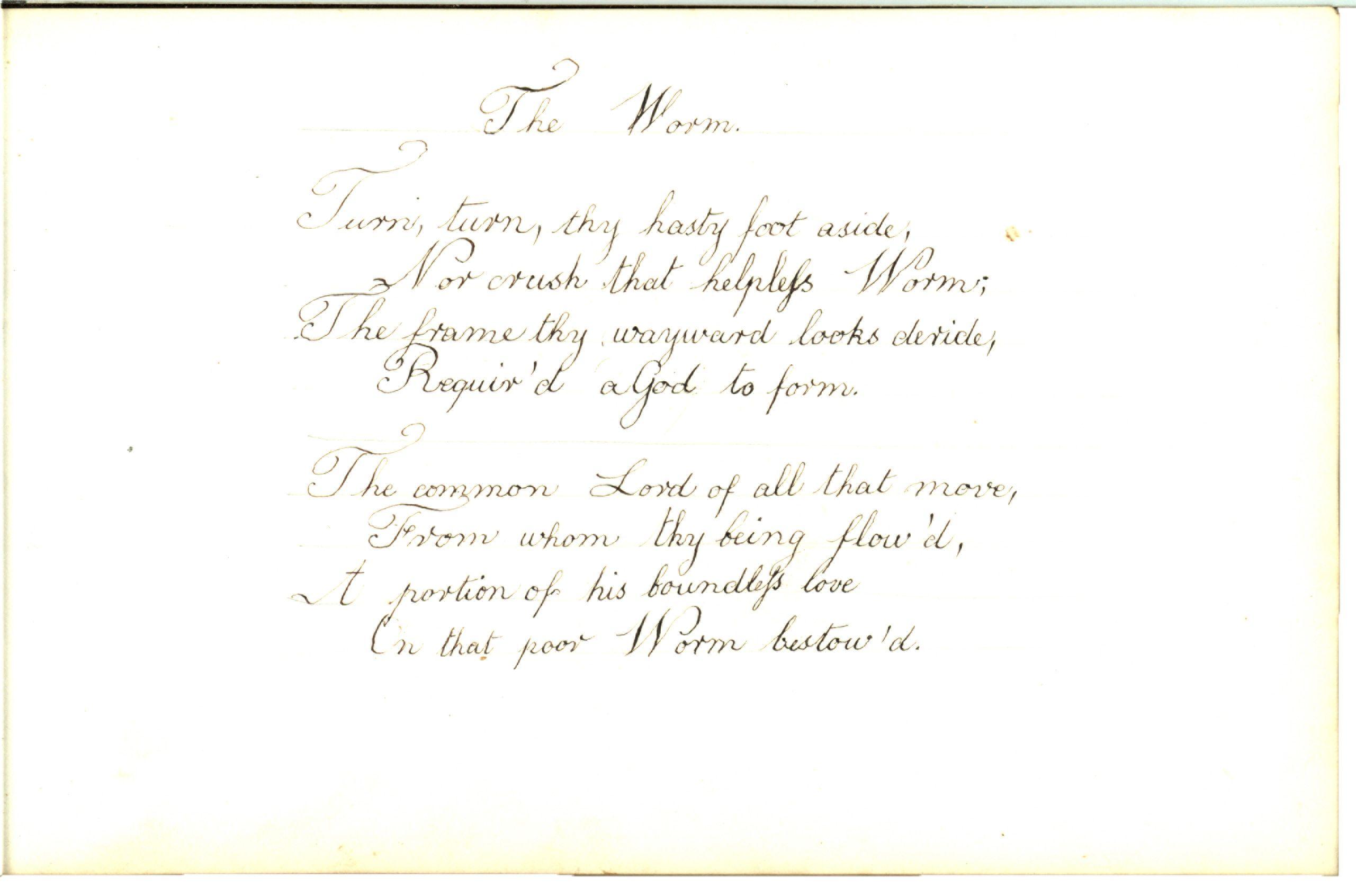
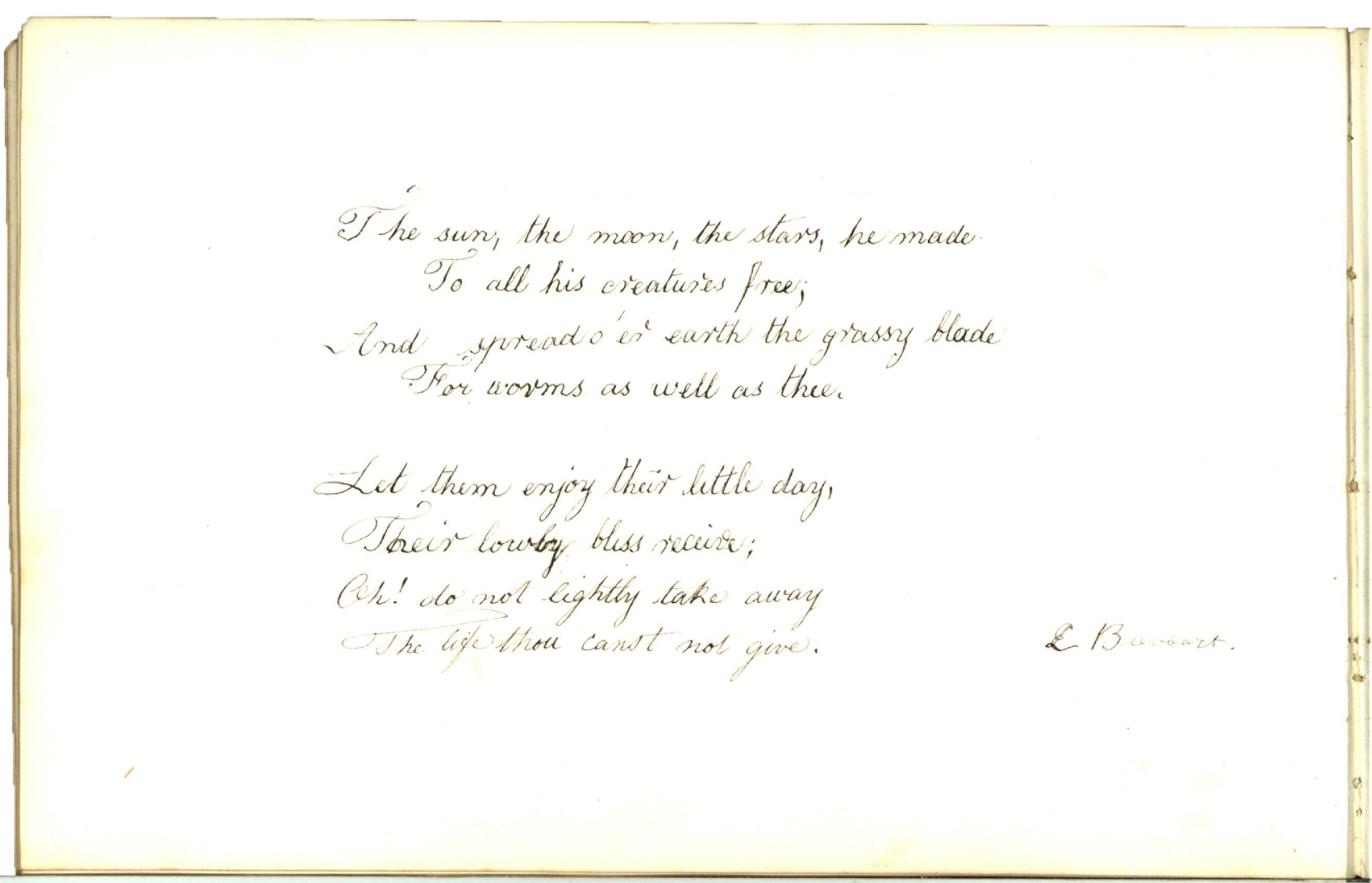
Turn, turn thy hasty foot aside,
Nor crush that helpless worm:
The frame thy scornful looks deride
Requir’d a God to form.
The common Lord of all that move,
From whom thy being flow’d,
A portion of his boundless love
On that poor worm bestow’d.
The Sun, the Moon, the Stars He made
To all his Creatures free;
And spreads o’er earth the grassy blade
for worms as well as thee.
Let them enjoy their little day,
Their lowly bliss receive;
O do not lightly take away
The life thou canst not give!
Laura’s choice of text reflects a deeply compassionate worldview. The final stanza she transcribed carries a profound moral weight, reminding the reader of the sanctity and fragility of life. This sentiment beautifully mirrors the progressive, egalitarian values the Brevoort children were absorbing during their time in Europe – particularly at the Hofwyl School in Switzerland, where strict social hierarchies were intentionally broken down in favour of mutual respect. By practicing her English penmanship with a reminder that even the smallest creature deserves to “enjoy their little day,” Laura was anchoring her own moral compass.
Although the majority of the entries belong to the four older sisters, there are a couple from their brothers.
The eldest boy, a young man of nineteen by 1837, was James Carson – known throughout his life simply as Carson. Unlike his younger siblings who wrote directly onto the album’s pages, three of Carson’s works were carefully pasted into the book on successive pages at a later date. Among them is a lovely sketch that clearly demonstrates the hand of a masterfully talented artist. At the top of the page, beneath his pencilled name, a different hand has added a faint date in blue ink: 1845.
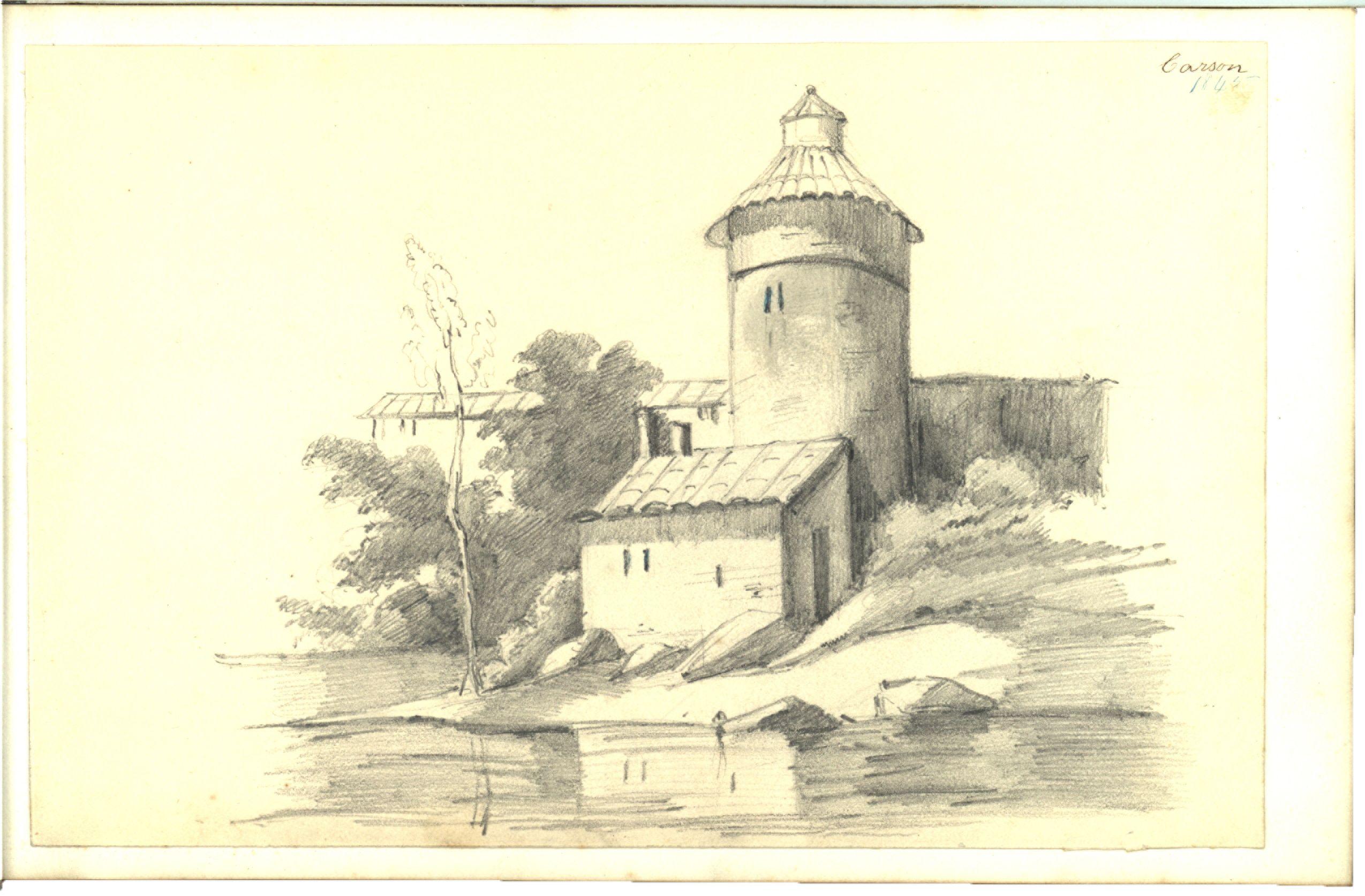
Carson’s exceptional draughtsmanship was backed by a rigorous technical education. He had studied in Switzerland and Paris, eventually graduating with a civil engineering degree from the prestigious École Centrale des Arts et Manufactures. Yet, the delicate linework of his sketch reveals that his scientific mind was perfectly balanced by an artist’s soul.
The year inscribed on the sketch, 1845, carries a heavy weight for the Brevoort family story, as that was the year of their mother’s untimely death at just forty-eight years old. Seeing his artwork preserved inside the leather slipcase bearing Laura’s golden initials transforms this sketch from a simple artistic exercise into a deeply poignant monument. It represents a family clutching onto beauty, talent, and connection during a time of immense personal grief.
Towards the end of the book dated 14th February 1838 – their mother’s birthday -Constance and Meta added a poem each. These are followed immediately by a contribution from Henry, who had just turned seven and signed using the French spelling of his name:
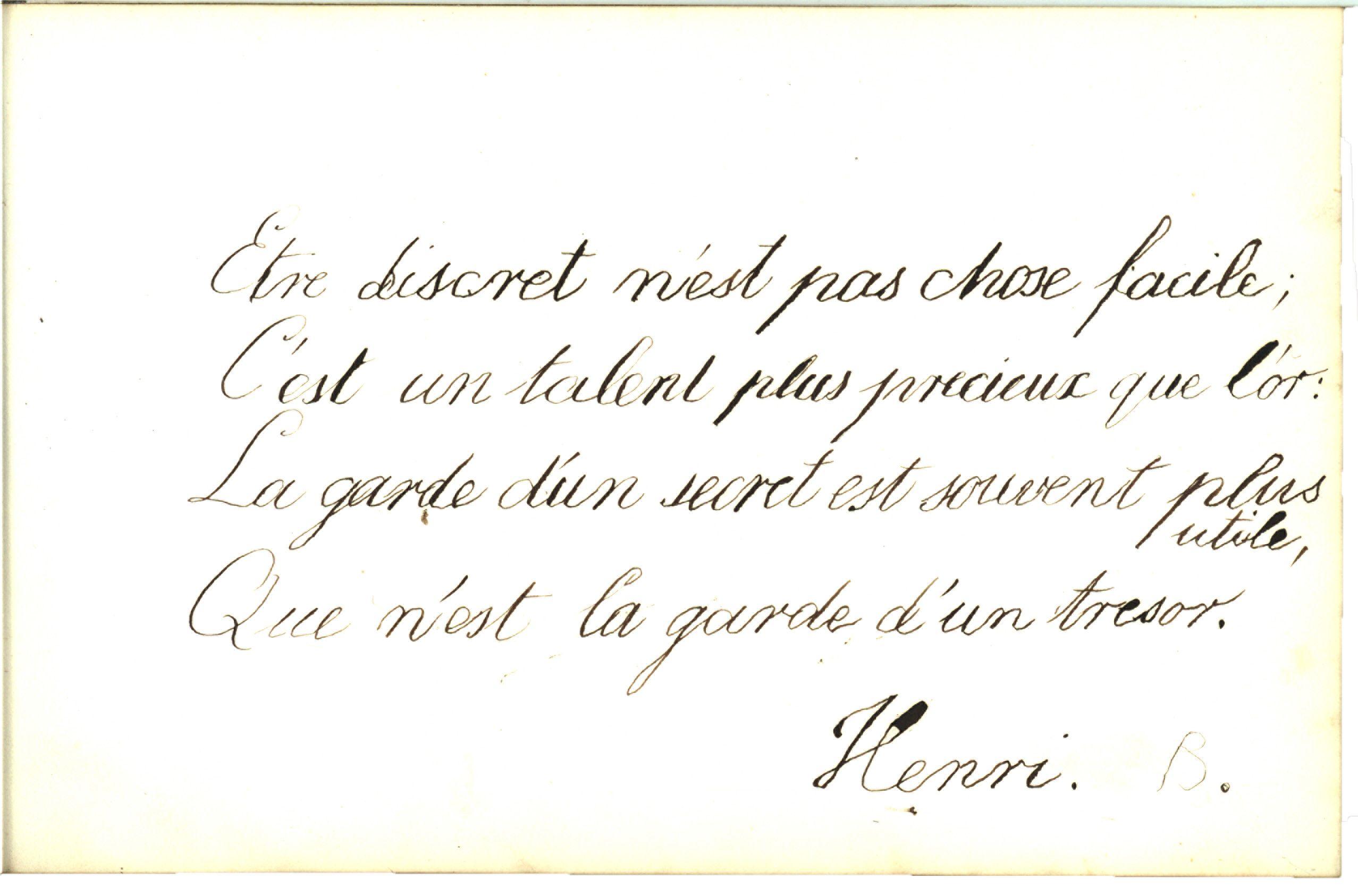
In English, Henry’s contribution reads:
Being discreet is not easy;
It is a talent more valuable than gold:
Keeping a secret is often more useful,
Than guarding a treasure.
Looking at the page, it’s easy to imagine young Henry laboriously copying this out in his large, deliberate, almost-copperplate handwriting. You can almost see his little face contorting with sheer concentration as he tries to keep his ink from smudging. There is a lovely, timeless irony in a seven-year-old boy meticulously writing out a stern moral maxim about the immense difficulty of keeping secrets. His contribution, complete with a few missing accents typical of a child learning to write, offers a sweet, grounded glimpse into the daily lessons and moral education of the Brevoort children.
Two pages later is a charming entry from six-and-a-half year-old Edith, known affectionately as ‘Fifi’ to her family throughout her life – though here she signs as Ella.
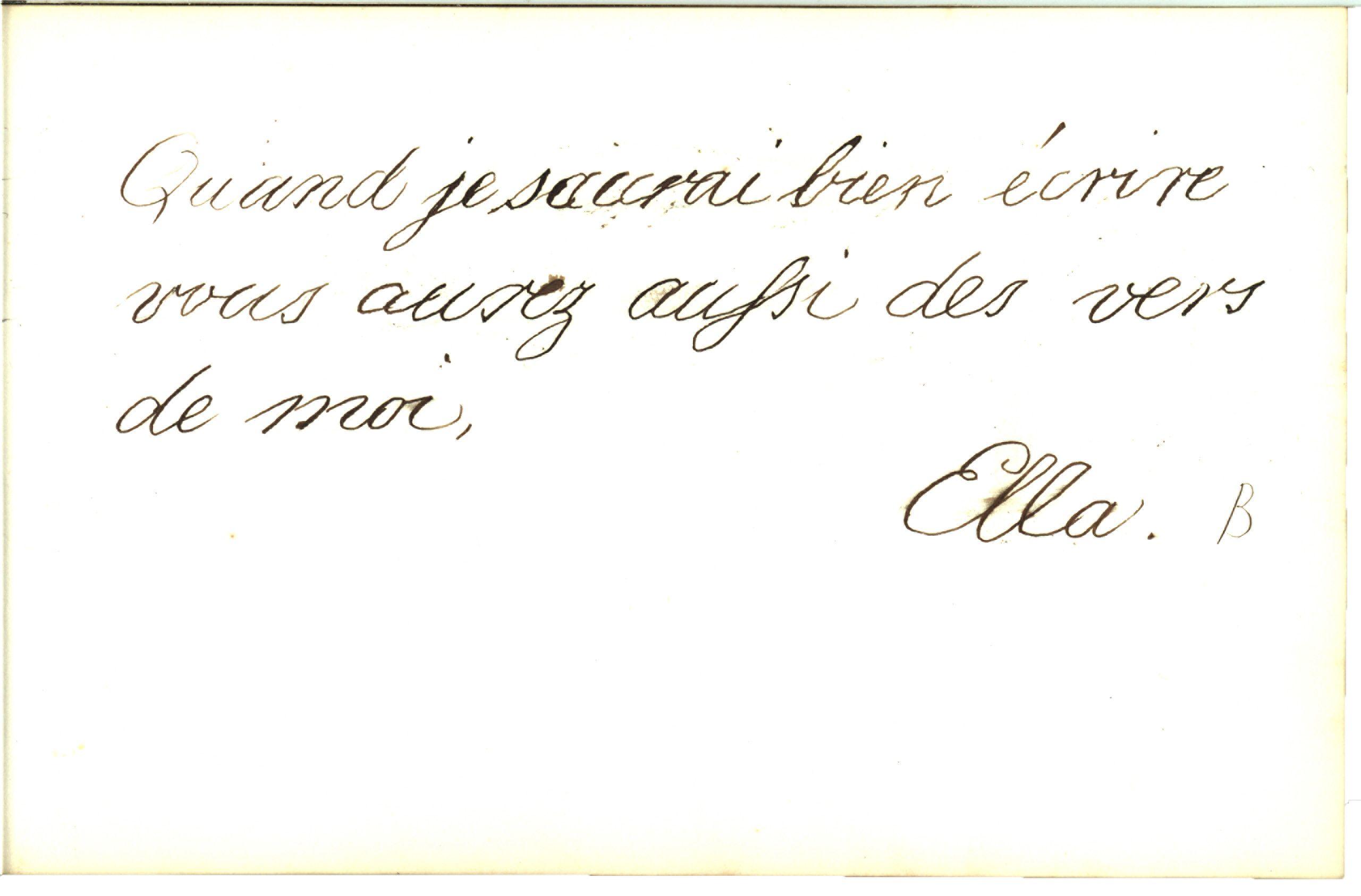
“When I know how to write well, you [will] also have verses from me. Ella B”
This touching promise was her only entry, capturing a fleeting moment of childhood expectation.
While little Fifi was looking forward to the day she could finally write her own verses, her older sister Meta was already demonstrating a remarkable emotional maturity. It is Meta who is left with the honour of the final entry in the Commonplace Book, dated the very next day, 15th February 1838. Written for her eldest sister Elisabeth, who had turned sixteen just a few weeks prior, Meta’s poem transitions the album from childhood sweetness into a profound, vivid portrait of the entire family group gathered together in Paris.
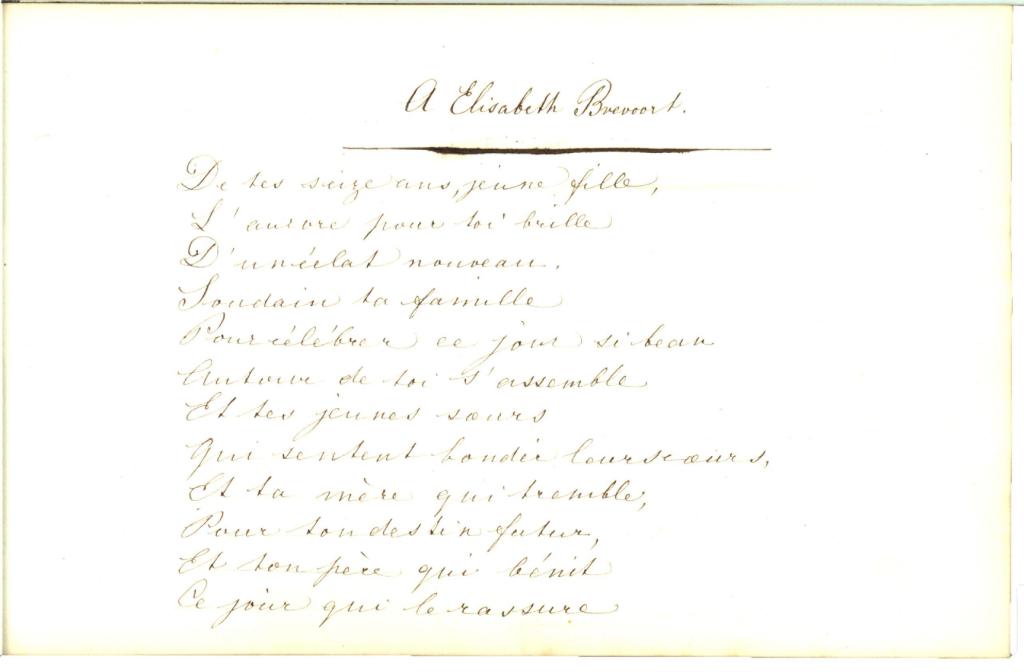
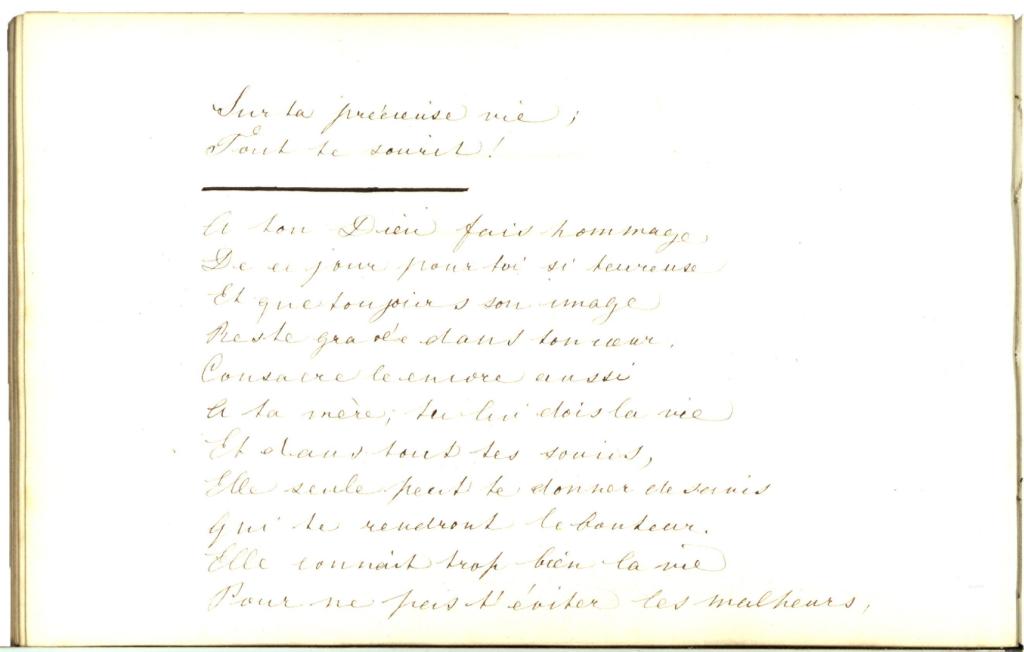
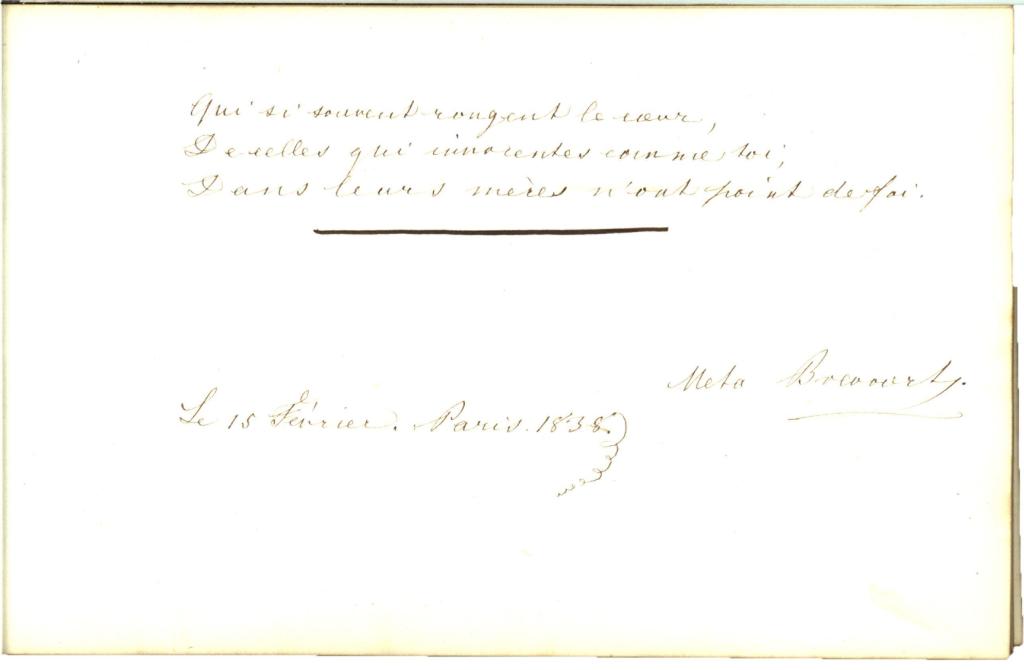
Translated into English, Meta’s contribution reads:
To Elisabeth Brevoort
In your sixteenth year, young girl,
The dawn shines for you
With a new radiance.
Your family gathers around you
To celebrate this beautiful day;
Your young sisters,
Whose affection grows stronger,
Your mother, who trembles
For your future destiny,
And your father, who blesses
This day which reassures him
Concerning your precious life –
All smile upon you.
Offer thanks to your God
For this happy day,
And may His image
Remain forever engraved in your heart.
Dedicate it also
To your mother; you owe her your life,
And in every anxiety
She alone can give you counsel
That will lead you to happiness.
She knows life too well
Not to spare you its misfortunes,
Which so often consume the hearts
Of girls who, innocent as you are,
Have no faith in their mothers.
Meta Brevoort
15th February, Paris, 1838
Meta’s poem serves as a stunning family portrait in verse. At just twelve years old, she perfectly captures the dynamics of the household: the rising affection of the younger sisters, a father blessing the day with profound gratitude for his daughter’s “precious life” – perhaps a quiet nod to the tragic loss of their fourteen-year-old brother, William Augustus, a few years earlier – and a mother “trembling” with an anxious, protective love for the woman her daughter is about to become.
Meta beautifully concludes the album on this scene of family unity, returning to the very theme Elisabeth introduced at the beginning of the book’s outset: the irreplaceable sanctuary of a mother’s love.
Nearly two centuries later, modern technology allows us a privileged digital glimpse into this fleeting, vibrant world of the Brevoort children in Paris. Through a glowing screen, these digitized handwritten pages transcend time – preserving the creative talents, youthful ambitions, and deep bonds of a remarkable family for generations to come.
The contributing siblings, born to Henry Brevoort Jr. and Laura Elizabeth Carson, later led remarkable lives:
- James Carson (1818–1887) became a prominent civil engineer and historian. He married Elizabeth Lefferts, and they had one son.
- Elisabeth Neville (1822–1875) married the Boston merchant Frederick William Skinner Coolidge, and is the author’s second great-grandmother. They had four children, though sadly only two survived childhood. One, Elizabeth Brevoort Coolidge (1857-1906) was the author’s great-grandmother, and the other was William Augustus Brevoort Coolidge (1850–1926) – who became a legendary Alpine mountaineer and historian, climbing extensively alongside his intrepid aunt, Meta Brevoort.
- Laura Whetten (1823–1861) married Charles Astor Bristed, grandson of John Jacob Astor. They had two children before her untimely death in 1861.
- Marguerite Claudia ‘Meta’ (1825–1876) never married and became a celebrated Alpine mountaineering pioneer, famously scaling the peaks of Europe with her nephew, William.
- Constance Irving (1828–1892) married into the prominent Sedgwick family, and they had six children.
- Henry Wortley (1831–1891) never married. In 1888 he went abroad on the yacht Interpreter and later died at Nice in the south of France.
- Edith ‘Fifi’ (1832–1908) married Lt Col Pierre Corné Kane, and they had five children.
The complete digital archive of the Brevoort Family Commonplace Book can be viewed via the JSTOR website.
[i] Commonplace Book of the Brevoort children, 1838. Winslow Family Papers, Shared Collections, courtesy of JSTOR and the contributing institution, the Salve Regina University Digital Collections. Public Domain Mark / No Known Copyright last accessed 03 Jun 2026
[ii] ibid
[iii] ibid
[iv] AI Assistant, “Analysis of Jean-Baptiste Rousseau’s Ode X (Palinodie),” AI-generated response, June 3, 2026.
[v] Commonplace Book of the Brevoort children, 1838. Winslow Family Papers, Shared Collections, courtesy of JSTOR and the contributing institution, the Salve Regina University Digital Collections. Public Domain Mark / No Known Copyright last accessed 03 Jun 2026
[vi] ibid
[vii] ibid
[viii] ibid
[ix] ibid
[x] ibid
