
It was late January 1840 and, despite temperatures falling as low as -14C, New York society was feverish with excitement. Hundreds of invitations had been sent out for what promised to be the first grand costumed ball the city had ever seen.
Until then, entertaining in New York had been relatively restrained. Across Europe, particularly in Paris and Vienna, extravagant bals costumés filled with masked guests in elaborate fancy dress had long been fashionable, the masks serving more as theatrical convention than genuine disguise.
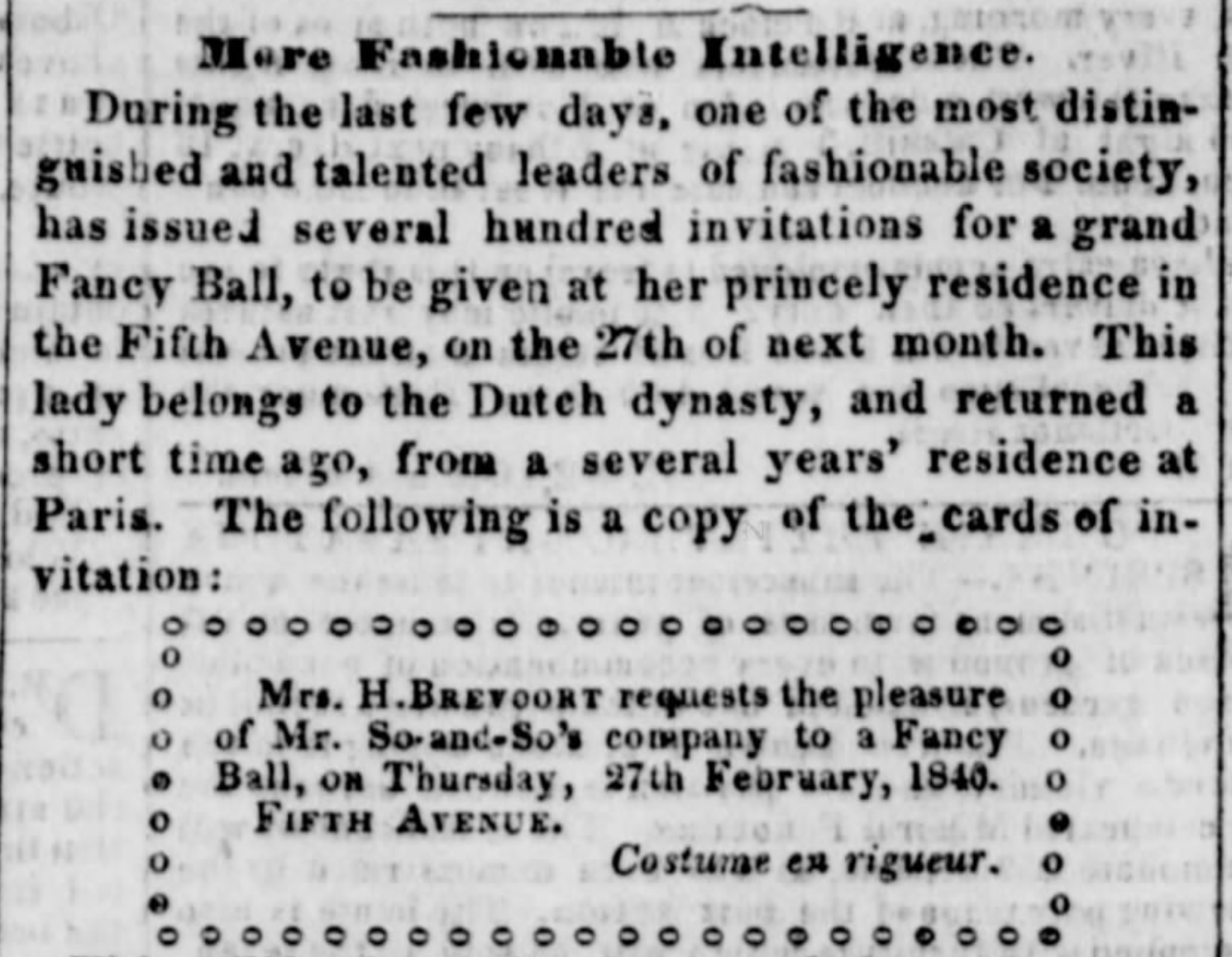
Contemporary accounts noted that people were “moving heaven and earth to get an introduction to this highly respectable Dutch family, and hence an invitation.” The final guest list included old New York names, foreigners including the Swiss and Neapolitan consuls, literary figures, and relatively new names in society like John Jacob Astor and August Belmont.
Invitations were dispatched not only across New York society, but to fashionable circles as far afield as Boston, Philadelphia, Baltimore, and Washington.
The diarist Philip Hone, former mayor of New York, captured the mood in his journal just days before the event: “The fashionable folk are remarkably well off just now in the possession of an inexhaustible topic of conversation in Mrs. Brevoort’s bal costumée, costume á la rigueur, which is to come off next Thursday evening”.[ii]
“Nothing else is talked about; the ladies’ heads are turned nearly off their shoulders; the whiskers of the dandies assume a more ferocious curl in anticipation of the effect they are to produce; and even my peaceable domicile is turned topsy-turvy by the ‘note of preparation’ which is heard.”
But who were the people extravagant enough to attempt something Parisian in freezing New York?
Mrs Brevoort was the former Laura Elizabeth Carson of Charleston, South Carolina. At the age of eighteen she had married Henry Brevoort Jr. in Grace Church, New York. Henry, then nearly twice her age, was already wealthy, widely travelled, and a familiar figure in the city’s elite social circles.
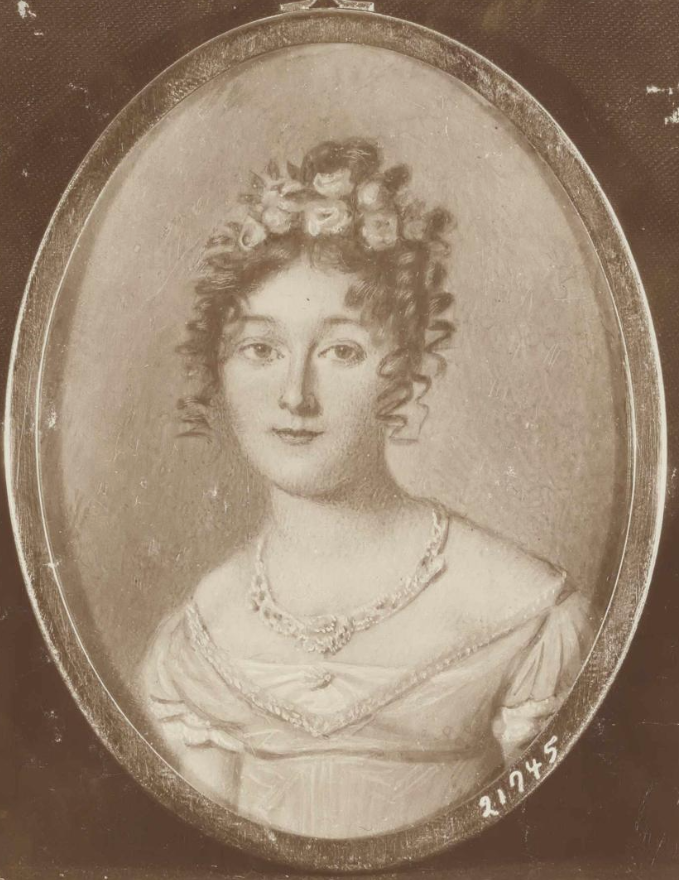
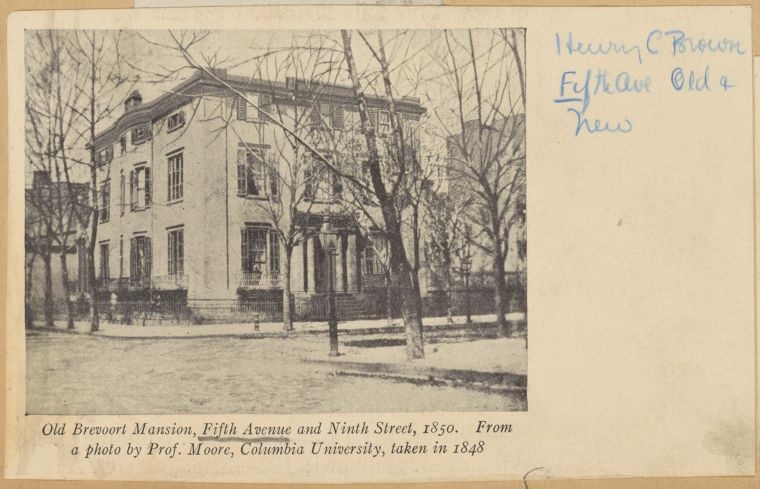
By 1840 Laura was the mother of a large family and had spent much of her married life moving between New York and Paris. Six years earlier, her husband had commissioned an imposing Greek revival mansion for his family on the corner of Fifth Avenue and Ninth Street. The plot, a western section of his father’s large farm, had been a gift, although Fifth Avenue was still unpaved, sparsely developed, and several blocks removed from the fashionable residential district clustered around Broadway.
Often described as the first private residence to be built on Fifth Avenue, the Brevoort mansion helped set the tone for the neighbourhood that would eventually become the city’s most fashionable address.
Designed as much for entertaining as for family life, the house, surrounded by gardens, contained a billiard room, a library, and two large parlours divided by a central entrance hall. Upstairs were seven principal bedrooms, while the upper floor housed the servants’ quarters.
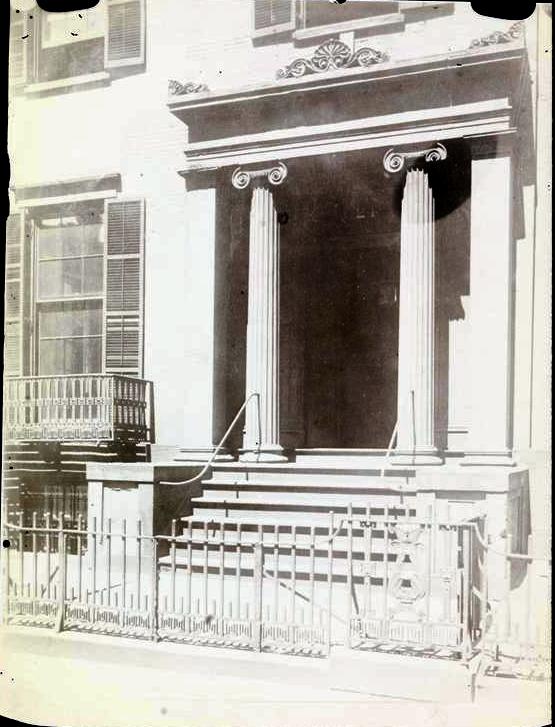
Soon after eight o’clock in the evening on Thursday 27th February 1840, a stream of carriages began to draw up outside the Brevoort’s home as the first of nearly six hundred guests arrived for the ball.
To shield guests from the freezing February rain and wind, a vast covered awning stretched from the front entrance to the kerb.
Police officers stationed outside managed the constant succession of carriages, ensuring there was no confusion in the narrow street and preventing any unseemly confrontation among drivers, servants, or curious onlookers.
Guests in their dazzling costumes stepped from their carriages into the bitter cold of the winter evening. At the entrance they were greeted by one of eight or so managers, instantly recognisable in plain evening dress adorned only with a red ribbon in their buttonhole.
From there the guests descended into the brilliantly illuminated rooms below, where Henry and Laura Brevoort received their guests before the evening’s entertainments began. Laura was attired as Joanna of Naples, the fourteenth-century queen, while their eldest daughter, eighteen-year-old Elisabeth – my second great-grandmother and future wife of William Skinner Coolidge – appeared as Rachel, the heroine of La Juive, one of the most popular grand operas of the day. Several of her younger siblings also took part in the spectacle, dressed variously as pages and brigands.[vi]
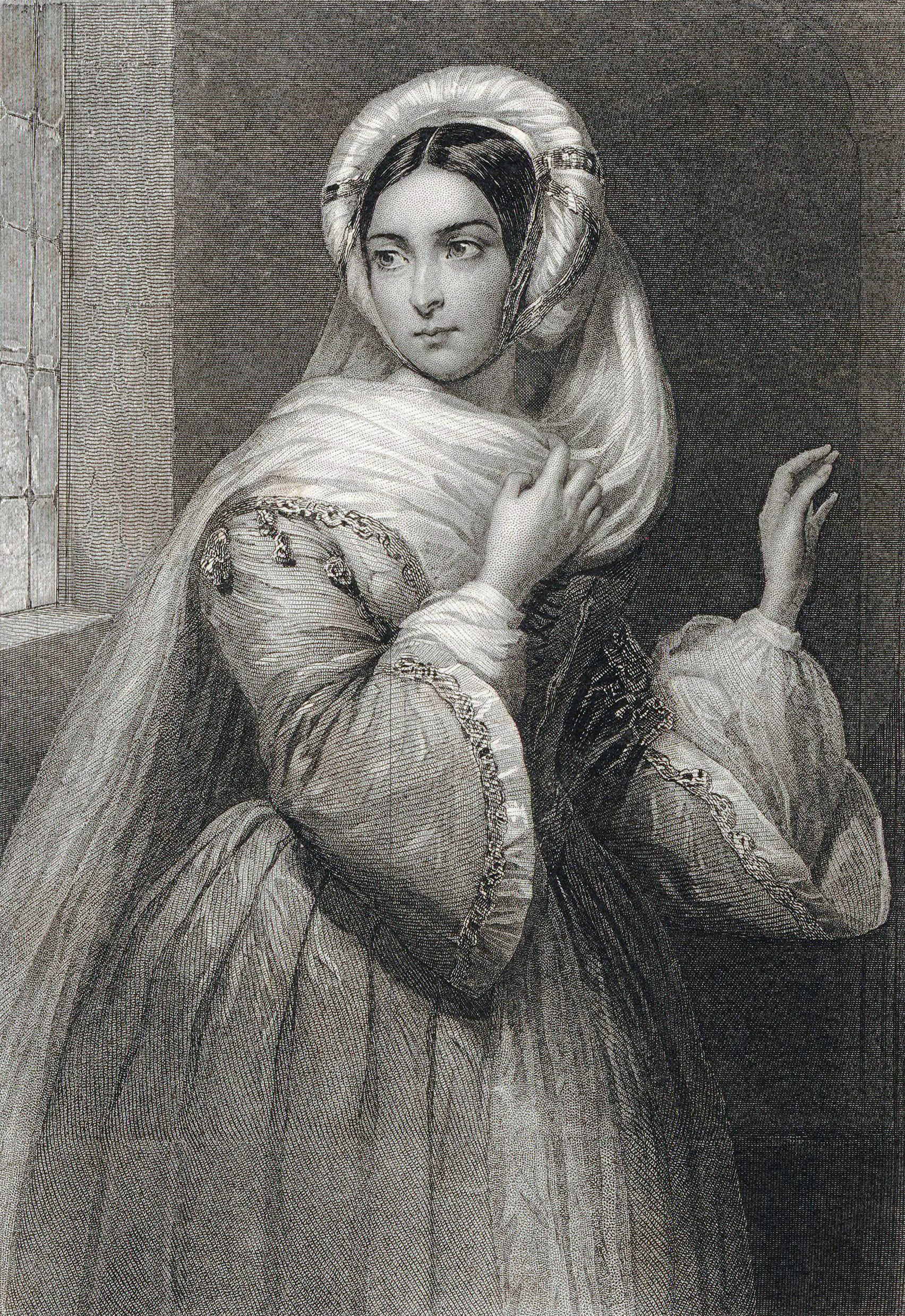
By all accounts, every guest arrived in costume. The effect, as the rooms gradually filled, must have been extraordinary. Sumptuous silks, shimmering satins, luxurious velvets, jewels, gold braid, feathers, and embroidered cloaks glittered beneath the chandeliers as figures from history, literature, theatre, and fantasy mingled together in the crowded parlours.
The excitement surrounding the event had spread far beyond New York’s elite circles. Reporting on the ball afterwards, the New York Times observed that the city had been captivated “from social centre to the humblest circumference,” from “the fashionable belle who aimed at conquest, to the poor artistes and needlewomen who had worked on the outfits.” Nothing on such a scale had ever before been seen in New York society.
Preparations for the ball provided work for dressmakers, tailors, jewellers, hairdressers, musicians, florists, confectioners, domestic servants, and countless other tradespeople across the city. Hotels were filled with out-of-town guests, and carriage drivers and livery stables also profited. In the midst of a difficult economic period, the Brevoorts’ extravagant entertainment brought a welcome burst of business during what might otherwise have been a quiet winter season.
Despite the size of the gathering, duplicate costumes were said to have been remarkably rare. Many outfits were lavishly ornamented with gold, silver, and precious stones, reflecting not only the wealth of the guests themselves, but the enormous effort and expense devoted to the spectacle.
Philip Hone arrived with his family, dressed as Cardinal Wolsey in a grand robe of scarlet merino wool. He wore a “well-contrived” cap of the same material and had borrowed an ermine cape, together with a gold cross, chain, and scarlet stockings to complete the effect.
The rest of his party were equally elaborate in costume. His daughters appeared as “Night and Day”, while his sons came respectively as a royal poet and a Highlander.
Elsewhere in the crowded rooms moved figures drawn from ancient and modern history, classical literature, theatre, and opera. There were military officers, priests, pirates, princesses, peasant maidens, and at least one notable young man dressed as an awkward schoolgirl in a short white frock and pantalettes.
“Soon after our party arrived the five rooms on the first floor, including the library, were completely filled,” Hone recalled. “I should think there were about 500 ladies and gentlemen . . . many who went there hoping each to be the star of the evening found themselves eclipsed by some superior luminary, or at best forming a unit in the milky way.”
One guest attracted little notice as he moved quietly from room to room dressed as a knight in armour. Beneath the costume, was Mr Attree, a reporter and editor for the New York Herald, the controversial penny newspaper founded by James Gordon Bennett.
Bennett had recognised the ball as a perfect opportunity to attract readers with detailed reporting on the behaviour and fashions of New York’s wealthiest families – an early forerunner of the society and gossip columns that would later become a staple of popular journalism.
Henry Brevoort had reluctantly granted permission for the Herald to cover the event. He had realised that refusing access might only have encouraged hostile reporting, whereas cooperation offered at least some hope of controlling the tone of the coverage.
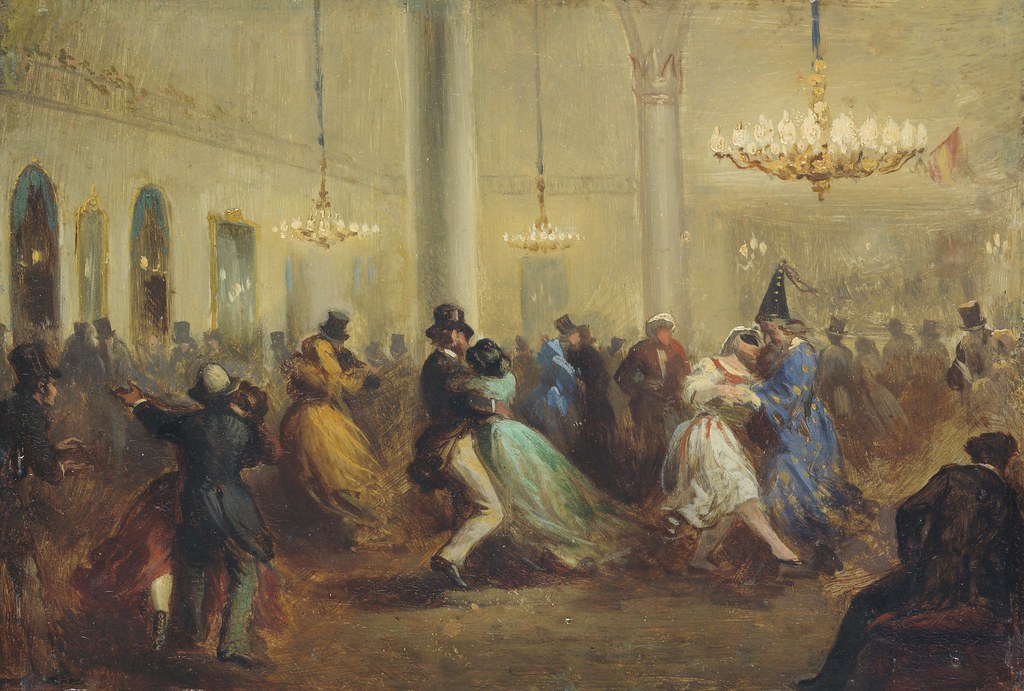
Unmindful that someone might be quietly observing and taking notes, the guests abandoned themselves to the pleasures of the evening. Dancing continued for hours beneath blazing chandeliers while masked figures drifted from room to room, pausing for conversation, flirtation, gossip, or introductions to newly encountered acquaintances whose identities were not always immediately obvious beneath wigs, veils, jewels, and velvet disguises.
The entire ground and first floors of the mansion had been thrown open for the entertainment. In the principal rooms musicians played quadrilles, waltzes, and cotillions while the dancers swept across polished floors in richly embroidered gowns, uniforms, and theatrical costumes. Elsewhere, guests crowded into smaller groups for animated conversation or laughter, the air growing steadily warmer and louder as the evening progressed.
Upstairs, supper rooms remained open throughout the night, attended by a constant stream of servants carrying wines, pastries, confectionery, oysters, game, jellies, and ices. Contemporary accounts agreed that no expense had been spared, either in the quantity or quality of the refreshments provided. Guests wandered freely through the house until the early hours of the morning, eating, drinking, dancing, and socialising in an atmosphere of almost theatrical extravagance and carefree indulgence, while the managers discreetly ensured that no single room became dangerously overcrowded.
Yet amid the splendour and confusion of the evening, one partygoer dressed entirely in black began attracting unwelcome attention. He wandered silently through the crowded rooms speaking to no one, appearing instead to listen and observe. None of the managers recognised him, and when challenged he refused to give his name.
Reportedly, as calls were made for the police, the mysterious visitor said in broken English, “Gentlemen, me am one stranger,” before quietly leaving the house without further disturbance.[ix]
The glamorous party, however, was not entirely without incident.
Among the guests was sixteen-year-old Matilda Barclay, daughter of the British Consul, George Barclay. Regarded as one of New York’s great beauties, she attended the ball dressed as Lallah Rookh, the heroine of the immensely popular oriental romance by Irish poet Thomas Moore, in a costume that reportedly cost $330 – over $12,000 today.
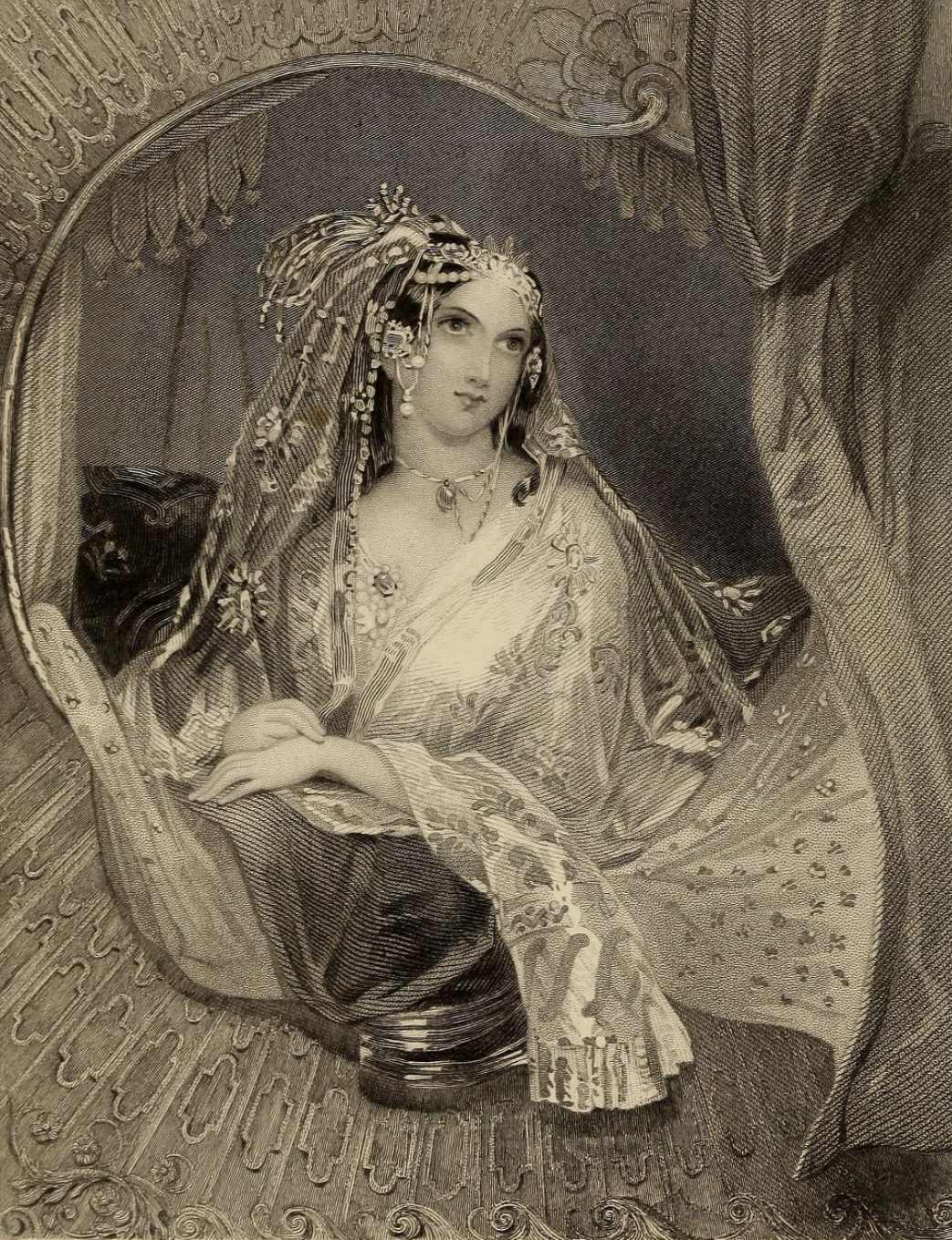
Another guest, later described by Philip Hone as “the dashing T. Pollock Burgwyn of South Carolina”, had chosen the complementary costume of Feramorz, the hero of the same tale.
The choice was an intriguing one. In Moore’s poem, Lallah Rookh is destined to marry a prince she has never met, but falls in love with the apparently humble poet Feramorz. Only at the end of the story does she discover that the poet and the prince are one and the same.
One can only imagine the conversation that passed between the two when they encountered each other amid the crowds of masked revellers.
At around five o’clock in the morning, as George and Mrs Barclay prepared to leave, their daughter could not be found. The celebrated beauty, described by one contemporary as “queenlike, with exquisite complexion and auburn hair”, had slipped away with her fictional lover.
By the time her parents realised Matilda was missing, the city’s most talked-about romance had taken an unexpected turn.
Before dawn, Matilda Barclay and Thomas Pollock Burgwyn were married.
Although the disappearance of Matilda Barclay provided newspaper editors with material for weeks to come, it did little to diminish the success of the evening itself. Contemporary accounts were unanimous in their praise for the organisation, splendour, and hospitality displayed by Henry and Laura Brevoort. More than simply a fashionable entertainment, the ball introduced New York society to a style of extravagant masked celebration previously associated with the great cities of Europe. For a few glittering hours, Fifth Avenue had become a stage upon which New York society could imagine itself Parisian.
In the years that followed, costume balls became a regular feature of the city’s social calendar, but the Brevoorts’ entertainment of February 1840 retained a special place in public memory as the event that had started the fashion.
James Gordon Bennett was quick to recognise that the affair had been as much a journalistic triumph as a social one. Teasers for the “very long, graphic, and precise account of this splendid affair” appeared in the New York Herald, generating extra interest in his ‘scoop’, which promised to “be the only correct account in the city, and the only one worth reading and preserving.”[xi]
The following Tuesday, the Herald devoted much of its front page to the ball, publishing detailed descriptions supplied by its reporter, Mr Attree. Readers were treated not only to accounts of the guests and their costumes, but also plans of the Brevoort mansion itself, allowing those who had not received an invitation to experience the evening vicariously.
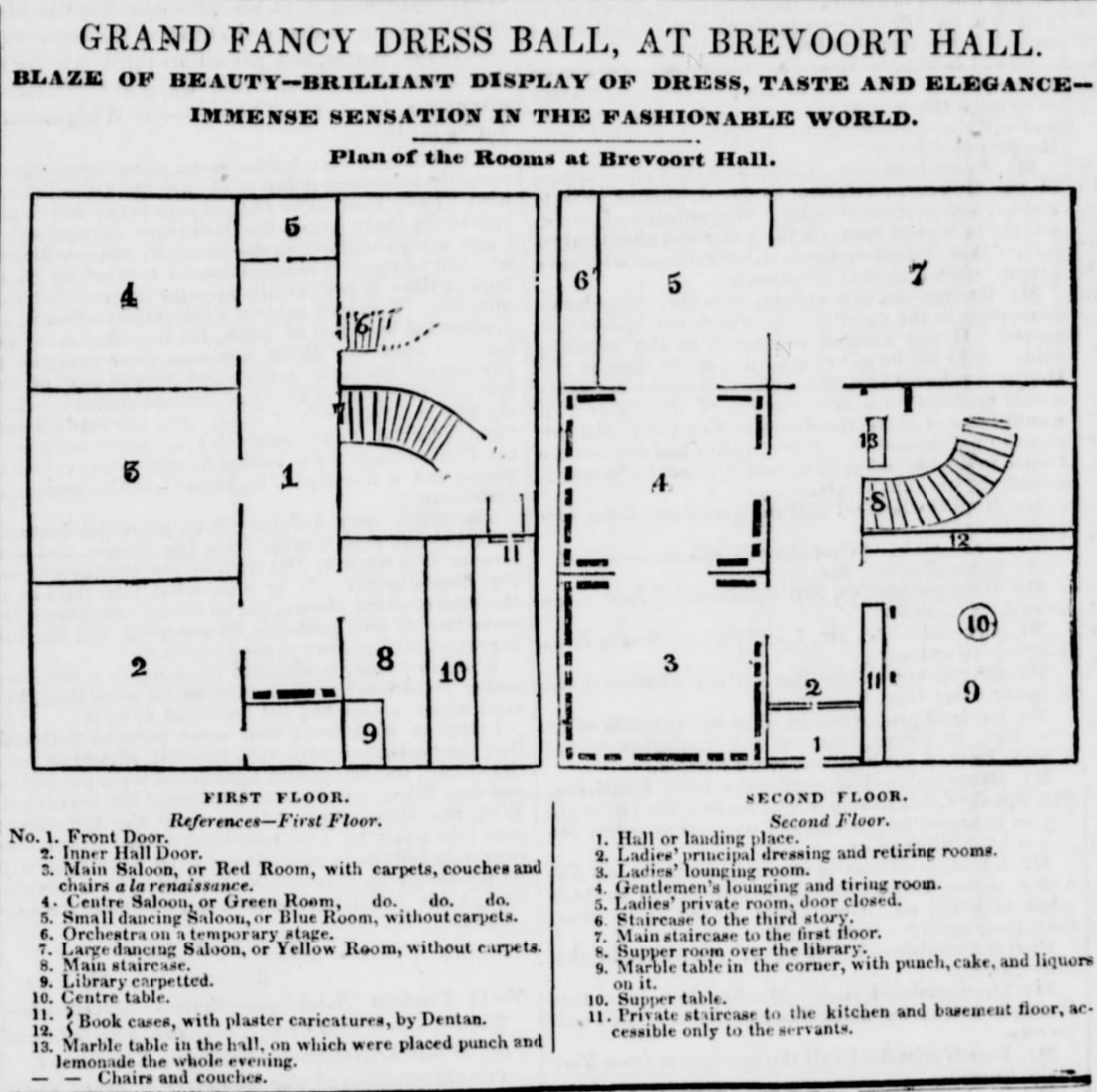
Henry’s gamble to allow reporting of the event by the Herald paid off: “In short it was a night of nights! a scene of scenes! Few will e’er look upon its like again. The dresses worn on this occasion, must have cost, we verily believe, nearly half a million of dollars. The attention to correctness of costume, and propriety of detail was really astonishing. The pleasure and delight experienced by all, never surpassed…. As it is the first of its kind, it is to be hoped it will not be the last.”[xiii]
For one winter night, Henry and Laura Brevoort had succeeded in making their Fifth Avenue home the centre of New York society – and thanks to Bennett’s newspaper, much of the city was able to look over their shoulders.
[i] New York Daily Herald, Wed 29 Jan 1840 via Newspapers.com accessed 27 May 2026
[ii] Diary of Philip Hone via archive.org last accessed 27 May 2026
[iii] Portrait of Laura Carson Brevoort via americanaristocracy.com last accessed 31 May 2026
[iv] Irma and Paul Milstein Division of United States History, Local History and Genealogy, The New York Public Library. (1900 – 1945). Old Brevoort Mansion, Fifth Avenue and Ninth Street, 1850. From a photo by Prof. Moore, Columbia University, taken in 1848 Retrieved from https://digitalcollections.nypl.org/items/6e6e3660-36d1-0132-a38a-58d385a7bbd0 last accessed 27 May 2026
[v] From the collection of the Museum of the City of New York via daytoninmanhattan.blogspot.com last accessed 29 May 2026
[vi] Diary of Philip Hone via archive.org last accessed 27 May 2026
[vii] Cornélie Falcon as Rachel in the opera La Juive by Halévy, image in the public domain via commons.wikimedia.org last accessed 31 May 2026
[viii] Ricardo Balaca – The Chaplain Dance [c.1″ (CC BY-NC-SA 2.0) by Gandalf’s Gallery via Flickr.com last accessed 27 May 2026
[ix] New York Daily Herald, Mon 2 Mar 1840 via Newspapers.com last accessed 29 May 2026
[x] Lallah Rookh an Oriental romance by Thomas Moore via archive.org last accessed 30 May 2026
[xi] New York Daily Herald, Sat 29 Feb 1840 v via Newspapers.com last accessed 29 May 2026
[xii] New York Daily Herald, Mon 2 Mar 1840 via Newspapers.com last accessed 29 May 2026
[xiii] ibid
