A few months ago, I was pleased to share a video call with my first cousin in Australia. This was the first time in about sixty years that we had connected, as our families had lost contact when we were still children. I was not immediately aware, but he told me that he had suffered a brain injury in a motorcycle accident in his teens. This has affected his memory; he gets easily confused and finds it hard to concentrate.
We spoke for a while, and it was lovely to see and hear him – his voice and London accent sounded just like his father’s – my father’s brother – both of whom had died nearly fifty years ago.
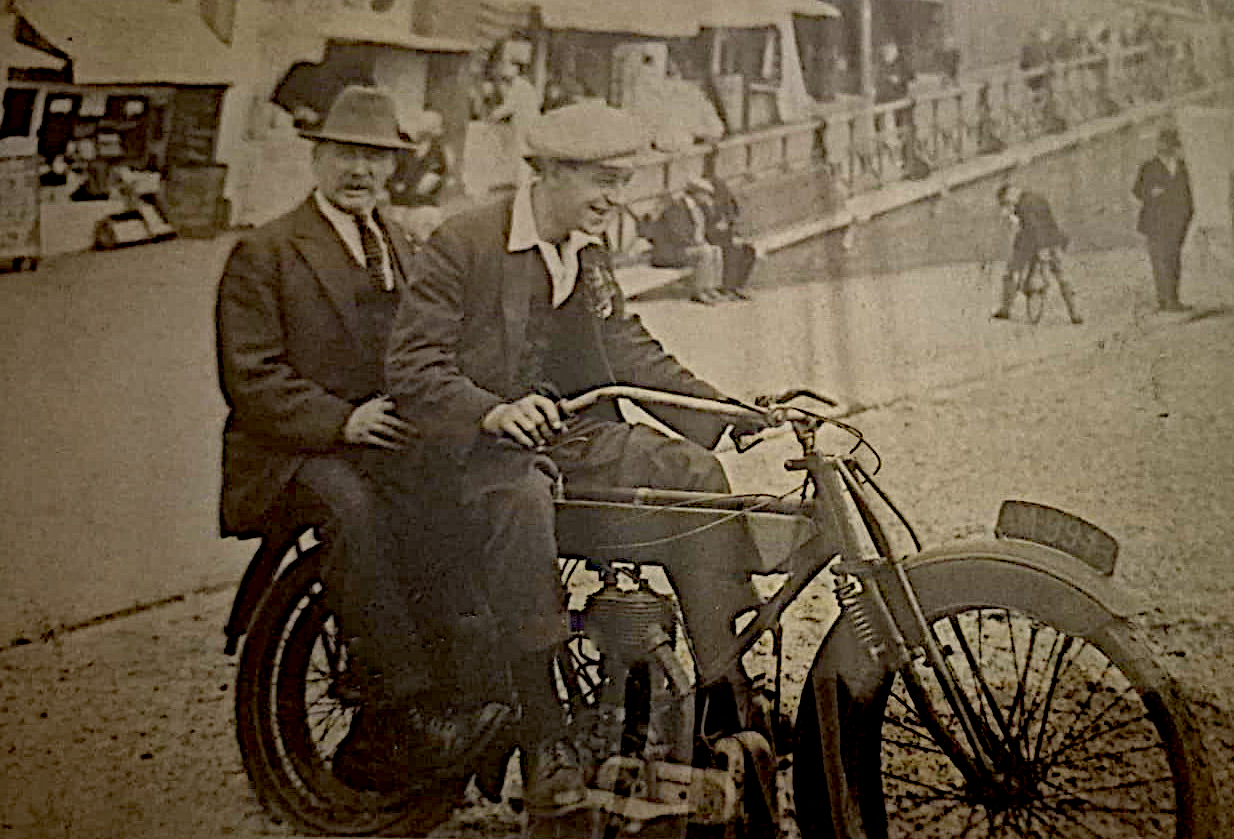
The conversation turned to family history, and he mentioned a photograph that I did not know existed of our grandfather as a young man, with his father. Although I remember our grandfather quite well in his final years, I had never seen any likeness of him as a young man, or of his father, our great-grandfather. My cousin snapped a copy of the photo on his phone and sent it to me via WhatsApp. It’s not a great copy, but this one image changed some of my thoughts about my own family history.
When I first began researching around twenty years ago, I didn’t even know my grandfather’s first name, never mind his father’s.
From paper records, censuses, and newspaper reports, I established that my grandfather had been named Richard Charles Mayhew, but was later known as Charlie. I also discovered that his father was Alfred George Mayhew, known as George.
Charlie’s mother Emma died in childbirth in 1908, before he was six. George remarried a couple of years later and raised a new family. The five children from his first marriage, including my grandfather, did not stay together and were brought up by various relatives or in institutions.
By the 1921 census, my eighteen-year-old grandfather was a boarder in a Fulham household, and his occupation was recorded as “Plumber’s Mate, Now in Army”. I assume he was conscripted for military service briefly, and later learned the craft of bricklaying, a trade he carried out until thromboses caused by a lifetime of smoking resulted in both legs being amputated in the second half of the 1960s. He died in 1969, on the day that man first walked on the moon.
I can only remember him as a grumpy old man living with disability, and I now realise that age and the loss of both legs must have affected him greatly. It is almost impossible to imagine that he had once been young, bold, and perhaps a little impetuous.
In the 1921 census, his father George, a general labourer, was living a few doors away with his second wife and four children aged between 10 years and two months. The proximity is not that surprising, as the area was a tight-knit working class community, with extended families often remaining within the same few streets for generations.
I had assumed that father and son would not have experienced a very close relationship during those years. Those grainy images in the photograph suggest perhaps otherwise.
The photograph is small and blurred, but certain details stand out. My grandfather, then a young man of around twenty-one, sits astride a lightweight motorcycle, holding the handlebars. He looks straight ahead, away from the camera, with a beaming smile. His jacket is rumpled, his collar open, and he sports a fancy – possibly silk – handkerchief in his breast pocket – a touch of style for a young man of the 1920s. Beneath his peaked cap, I can immediately see my own father’s face in the image. He has the relaxed confidence of someone greatly enjoying himself.
Behind him sits his father, upright in hat, suit, and tie, perhaps dressed in his Sunday best, suggesting that the outing was something of an occasion. His right hand rests lightly on his son’s hip, a small gesture that suggests an easy familiarity between them. He is not smiling, but has the air of someone humouring the occasion while pleased to be there. In the background, a small boy on a bicycle looks back over his shoulder at the scene, suggesting curiosity – or perhaps envy – at the machine.
I think I recognise the background, with the shops, the slope up to the promenade, and the railings, as Madeira Drive in Brighton, a seaside resort within easy reach of their home in south-west London. Brighton was then a popular destination for day trips along the London-to-Brighton road. The photograph itself feels very much “captured in passing”, rather than carefully staged, so perhaps it was taken by one of the roaming photographers who worked the promenade, selling prints afterwards.
I cannot prove any of this, but I imagine that my grandfather may have bought a second-hand motorbike, as the AM registration suggests the machine was first registered in Worcestershire, and offered to take his father for a day at the coast, perhaps to show off his new machine.
It is even possible that they were there for the Brighton Speed Trials. These motorcycle and car sprint races were held along Madeira Drive, and the event was revived in 1923, when my grandfather would have been twenty-one. I have attended the Speed Trials myself several times since the 1960s, and had long associated my enjoyment of motorsport and speed with my father, who bought his first motorbike while still in his teens and remained an enthusiast for the rest of his life.
Of course, these details are speculative and not really the point. What matters is that, for a family history so fragmented and so often marked by loss and separation, this one blurred photograph from over a century ago captures a fleeting but unmistakable connection through the generations.