
What drives a young man to take his wife and child, board a small vessel, and set out across the ocean towards an unknown land in search of a better life?
It is a question that still resonates today. Yet nearly four hundred years ago, in 1630, my eighth great-grandfather John Coolidge made precisely that choice.
To understand how he came to that decision, it helps to begin in the village where his story began.
John was baptised in the parish church at Cottenham, Cambridgeshire, in 1604, the youngest of eight children born to William Cooledge (sometimes spelled Coulledge, Coullidge, or Culledge,) and his wife Margaret (Mayse). Two of their children died young, and William, likely a yeoman or relatively prosperous farmer, later served as churchwarden between 1610 and 1611. When he died in 1618, William’s will divided the estate between his widow and six surviving children. John’s portion was thirty pounds (around £4,000 in today’s terms), to be held by his elder brother William until John reached the age of twenty-one, along with a mattress, a pillow, and two pairs of sheets.1
In early 17th-century England, religious life was tightly controlled. Attendance at the local Church of England parish was compulsory, and worship had to follow the Book of Common Prayer or risk penalties. Yet many – often labelled ‘dissenters’ or ‘non-conformists’ – felt increasingly uneasy. Among them were the Puritans, who sought a simpler, more reformed church governed by elders rather than bishops.
Inspired by the teachings of John Calvin, the French theologian whose ideas profoundly shaped the Protestant Reformation, the Puritans believed the Church of England retained too many practices rooted in Catholic tradition. They advocated a plainer, Bible-led faith and rejected elaborate ceremonies, most religious festivals, and even music in worship.
Around 1627, John married Mary (née Ravens), however no record of their marriage appears in the parish registers, nor is there a baptism recorded for their son John, likely born the following year. In a society where such events were normally documented, this absence is notable, and may reflect their nonconformist beliefs and a reluctance to submit to the prescribed ceremonies of the established Church.
By the late 1620s, pressure on dissenters was intensifying. When King Charles I dissolved Parliament in March 1629, he signalled his determination to enforce religious uniformity across the country. For many families, including John and Mary Coolidge, the options was becoming increasingly stark: conform – or leave.
Within weeks, they had made their decision and turned their backs on everything they knew.
The Great Migration
Led by Sir Richard Saltonstall, one of the principal investors in the Massachusetts Bay Company, groups of Puritan settlers from all walks of life gathered on the Isle of Wight in the spring of 1630 before embarking for New England as part of what became known as the Winthrop Fleet. John and Mary Coolidge and their infant son were among those who joined this movement, even if the precise details of their voyage are no longer certain.
Before the fleet sailed, Saltonstall, together with Governor John Winthrop and others, signed a moving address to their “brethren in and of the Church of England,” expressing both their loyalty and their sorrow at leaving their native land for what they described as “poor cottages in the wilderness.” It is not hard to imagine the Coolidges sharing in that mixture of conviction and quiet apprehension. Later published histories suggest that John Coolidge brought the timber frame of his house with him from England – a practical, and perhaps symbolic, way of carrying something of the old world into the new.2
The Atlantic crossing, whether undertaken in one of the principal ships such as the flagship Arabella or another vessel in the fleet, was long and uncomfortable. There was no heating and no running water; sanitation was rudimentary, with a simple bucket serving as a toilet, its contents thrown overboard – when they were not spilled in rough seas. Space was cramped, privacy almost non-existent, and seasickness must have been widespread. Those well enough passed the long days with Bible reading, prayer and other acts of devotion, alongside domestic tasks such as sewing, and caring for children. Beyond this, there was little to occupy them but conversation – and their own thoughts and faith.
Food was basic and monotonous: salted meat, dried peas and beans, coarse biscuits, and whatever provisions would endure the voyage. For a young family, maintaining strength and health must have been a constant concern.
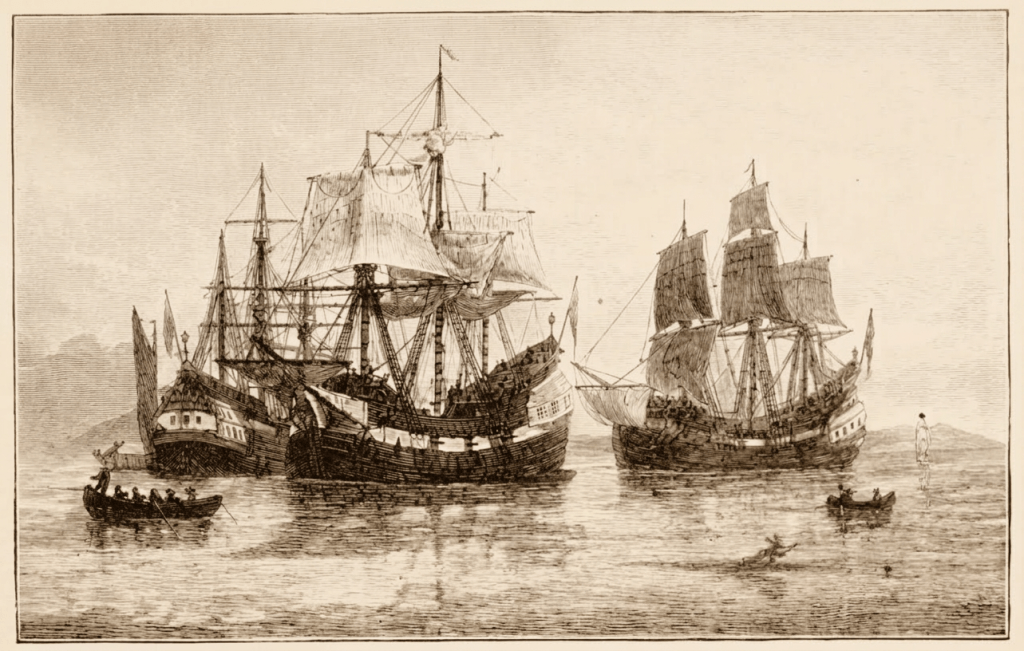
The Arabella reached Salem on 12 June 1630. However, the reality that greeted the settlers was far from the hopeful vision that had sustained them across the Atlantic. Another early arrival, Roger Clap, later recalled that there were few English inhabitants, provisions were scarce, and the planting season had already passed, leaving little prospect of immediate sustenance.4
For many, the first sight of New England must have brought not only relief, but a sharp sense of uncertainty – if not outright dismay. Yet, as Clap later reflected, such hardships were understood by many as part of “God’s remarkable providences” in bringing them to this new land.
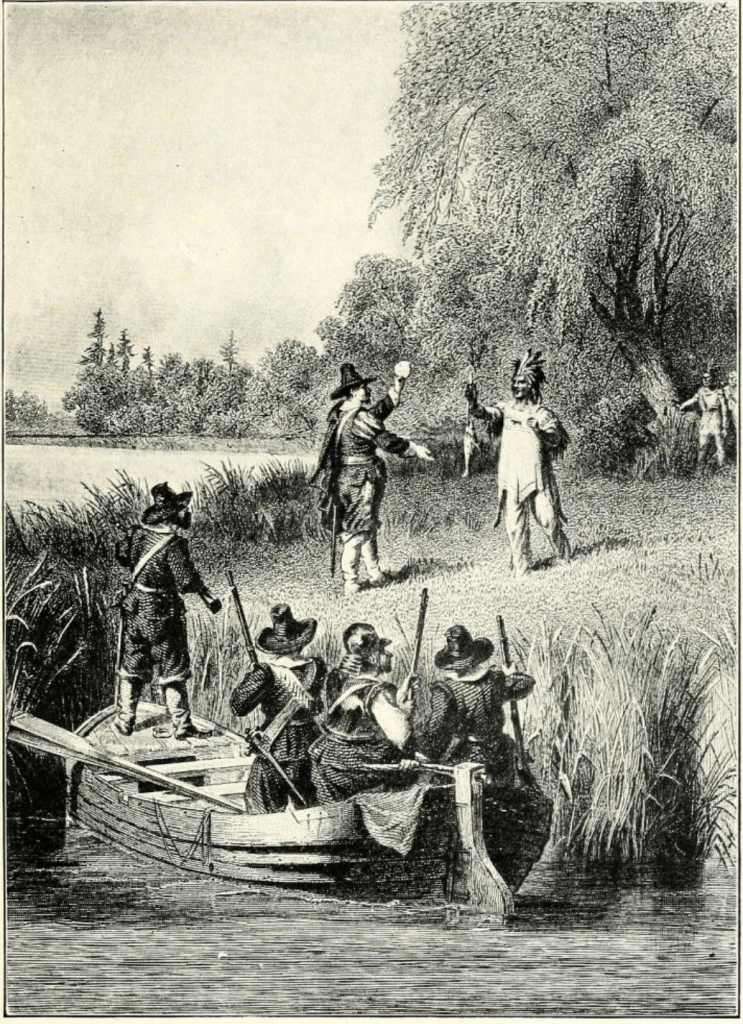
Within days, on 17 June, Saltonstall, Winthrop, and others – including servants, horses and cattle – set out inland through deep forests and largely pathless country in search of a suitable place to settle. Drawn by the availability of fresh water, the English settlers founded what became known as Watertown, on land long inhabited by indigenous people who knew the area as Piggsgusset.5
Some later accounts describe how the settlers were accompanied by an “old planter” able to converse with the local population, suggesting at least some degree of communication from the outset. Tradition also holds that relations between the newcomers and the existing community – said to number around 300 – were initially amicable, with exchanges of fresh fish for biscuits that appear to have suited both parties. While such details are difficult to verify with certainty, they suggest early encounters that were likely more complex than either conflict or harmony alone might suggest.
A Godly Community
On 30 July 1630, the settlers at Watertown entered into a simple yet profound agreement known as the Church Covenant. Among its forty signatories was John Coolidge. In a few carefully chosen words, they declared that they had come to New England to live more faithfully according to God’s will. They bound themselves together in a mutual promise: to walk in obedience to God’s ordinances, to support one another in their religious lives, and to build a disciplined and godly community.7
The covenant reflects a central Puritan ideal – that both church and society should rest upon shared moral commitment and collective responsibility. For John Coolidge and his fellow settlers, this was not merely a statement of belief, but a framework for daily life in an unfamiliar and often challenging world.
Watertown’s church soon came to hold a distinctive place in early New England history. It is generally regarded as the second church gathered in the colony, and among the first to put into practice the principle of congregational independence: the idea that each congregation should govern itself. The community also played an early role in shaping civil as well as religious life. In 1631, resistance among Watertown’s inhabitants to taxation without representation helped prompt the development of a more representative form of government in the Massachusetts Bay Colony – an important step in what would later be seen as the beginnings of constitutional thought in America.
The majority of the settlers had been small landholders in England, and their new community attempted to replicate their home environment, with a broadly-shared modest prosperity based on a mixed economy dependent on small farms, shops, fishing, timber, shipbuilding, and trade with the Atlantic World.
From this small but determined community, wider influences spread. Members of the Watertown church were among those who went on to establish new settlements, including in Connecticut. Others carried their religious mission further afield: Thomas Mayhew, another of the original forty signatories to the covenant, later became a pioneering Protestant missionary among the indigenous peoples of New England.
For John Coolidge, the covenant he signed in that first summer was more than a declaration of faith. It marked his place within a community bound not only by belief, but by shared purpose – a community he would help to shape for the rest of his life.
Building a Life in the New World
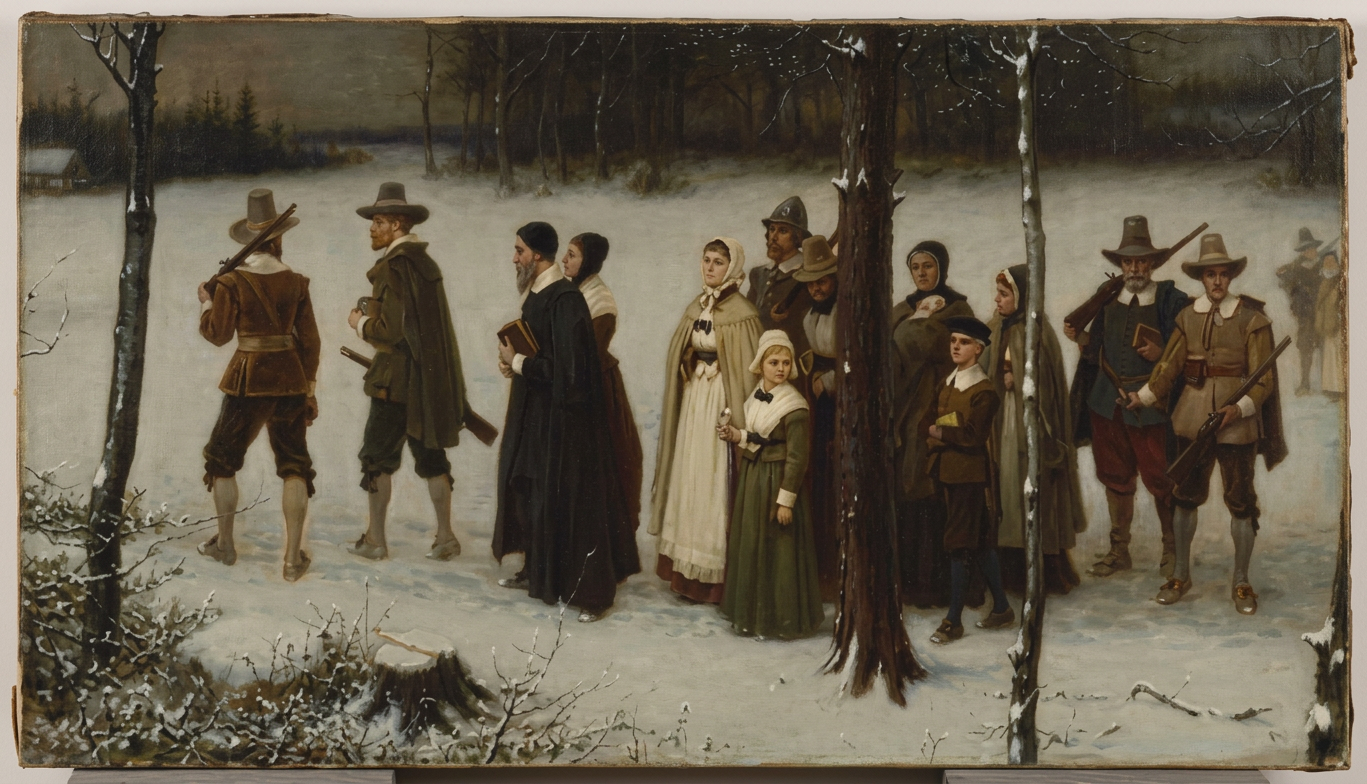
During those first years, life in early Watertown was dominated by survival. Land had to be cleared, shelters built, and fields made productive. Families farmed from dawn to dusk, their survival dependent on crops such as corn, beans, and squash, and later wheat and rye. Men and older boys worked the fields, tended livestock, and built and repaired fences. Women spent long hours grinding corn, baking, brewing, salting meat, and drying produce to see the household through the seasons. Sundays were strictly observed, with two lengthy services and catechism; all unnecessary work was forbidden.
Within this structure, women such as Mary Coolidge bore a wide range of responsibilities. Alongside cooking and cleaning, they spun, wove, sewed, and made soap and candles. They also played a vital role in care and knowledge within the community, acting as midwives, herbalists, and nurses, and teaching children prayers, Bible reading, and the principles of Puritan life. While excluded from formal political power, women held significant influence within both household and community networks.
Children were expected to contribute from an early age. Younger children helped with fetching water, gathering firewood, feeding poultry, and carding wool. As they grew older, boys worked alongside their fathers learning farming and practical trades, while girls were trained in domestic skills under their mothers’ guidance. Reading was encouraged primarily so that scripture could be read; writing and arithmetic were secondary. Childhood was shaped by discipline, work, and religious instruction – a pattern of labour, worship, and close family oversight.
Many Watertown households also relied on indentured servants, usually young men and women who exchanged several years of labour for passage from England before eventually gaining their freedom. Their work formed an important part of household and farm life in the struggling early settlement.
Winters were harsh and unforgiving, and careful preparation was essential. The success of each year depended on whether enough food had been grown, preserved, and stored before the cold set in. A poor harvest could threaten the survival of an entire household, reinforcing the constant pressure of planning ahead.
Taken together, the records suggest communities that were both fragile and resilient. Families were often large, and life was shaped as much by loss as by growth. Widowed husbands and wives frequently remarried within weeks or months, reflecting the practical realities of raising children and maintaining a household in the harsh conditions of early New England. Stability was never guaranteed; it had to be continually rebuilt through work, faith, and family ties.
John Coolidge and His Family Life
By the mid-1630s, John Coolidge was no longer simply a newcomer, but an established member of the Watertown community. His family with Mary continued to grow, with sons Simon and Nathaniel – my seventh great grandfather – born in 1632 and 1634 respectively.2
On 25 May 1636, John was admitted as a Freeman – an important mark of trust and standing in the colony, granting him both rights and responsibilities in its governance. Around the same time, he was recognised as one of the town’s earliest proprietors, holding land in the new settlement.
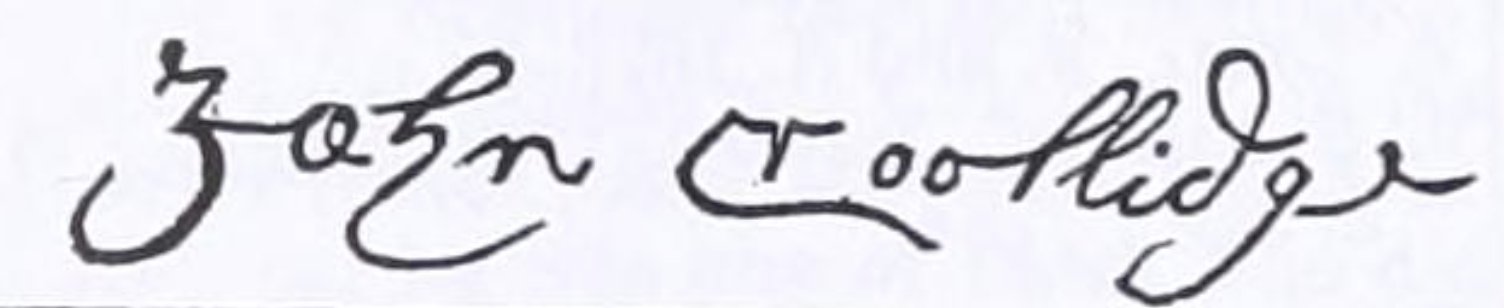
More children followed: Mary in 1637, Stephen in 1639, Obadiah in 1642, and Jonathan in 1646/47.9
Over the following decades, John played a steady and active role in public life. He served repeatedly as a Selectman of Watertown between 1635 and 1677, helping to oversee the town’s affairs through its formative years. In 1658, he also served as a deputy to the Massachusetts General Court, representing Watertown in the colony’s governing assembly and taking part in decisions affecting taxation, law, and administration. Beyond these formal duties, he was frequently called upon in more personal matters: witnessing wills, taking inventories, and helping to settle estates -tasks that suggest he was trusted by his neighbours for his judgement and integrity.
His home stood on land recorded in 1642 as bounded by the Cambridge line to the north, with neighbours including William Payne and David Fiske, and the highway leading to the pond to the south. Over time, his holdings expanded to include several additional lots, and in 1673 he acquired the homestead of his former neighbour, David Fiske, from Fiske’s son.
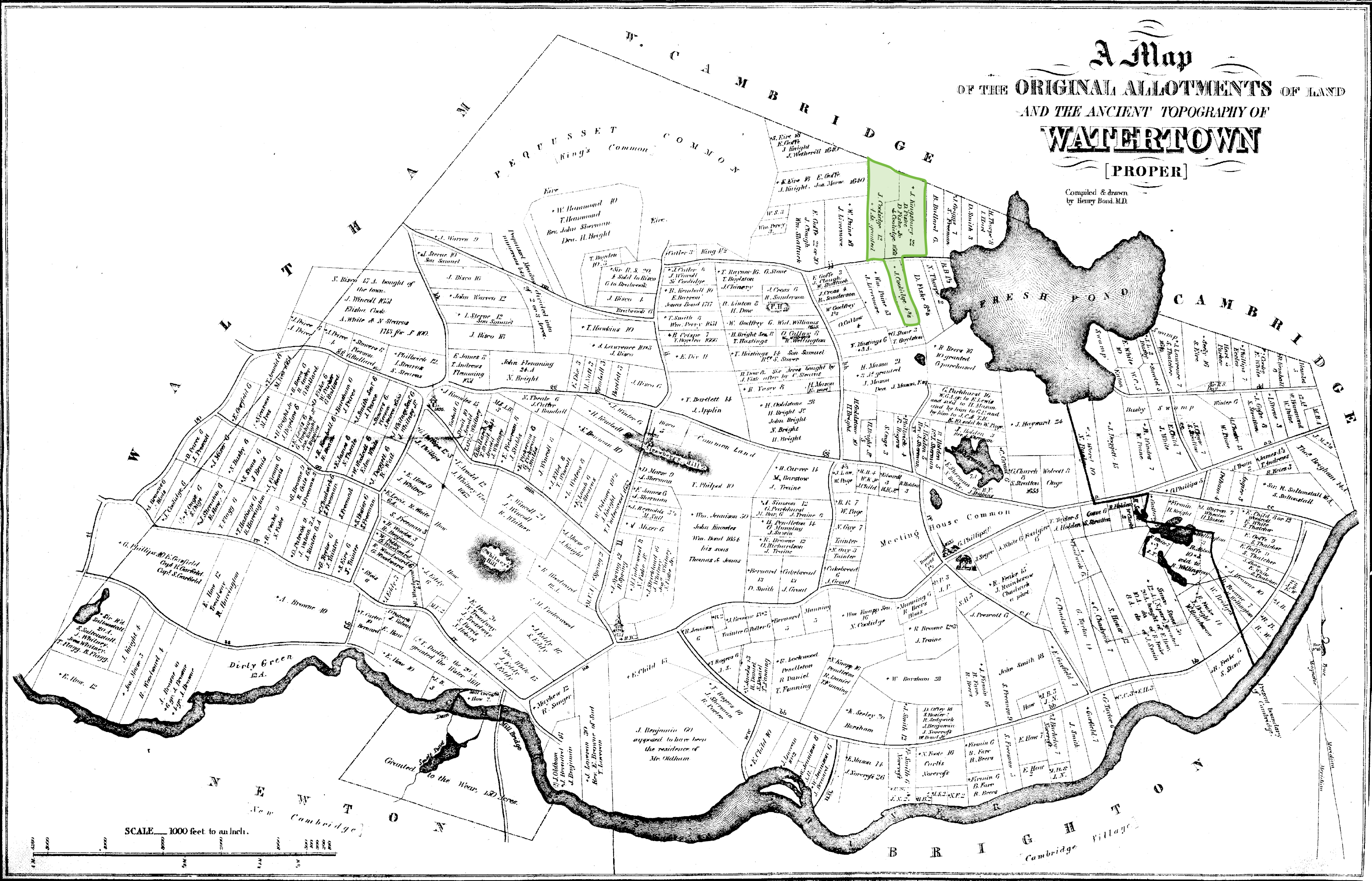
Taken together, these records show the emergence of a settled and structured community from the uncertain beginnings of the 1630s. The Massachusetts Bay Colony was not just a place of survival, but of organisation and growth, shaped by its Puritan values of discipline, education, and communal responsibility. Despite harsh winters, disease, and periodic tension with indigenous peoples, the colony gradually stabilised and expanded. For settlers like John Coolidge, life in New England was not only a physical relocation, but a long-term project: the building of a society aligned with deeply held religious and moral convictions.
John Coolidge’s Legacy
John Coolidge died on 7 May 1691, aged 88, and Mary died just four months later, also aged 88. They were buried side by side in the Old Burying Place, Watertown.2 John’s will, dated 19 November 1681 and proved on 16 June 1691, offers a final insight into his family life. He names his wife Mary, and his sons John, Simon, Nathaniel, Stephen, and Jonathan, as well as his granddaughters Sarah and Mary Mixer. Another son, Obadiah, who was not named in the will, died unmarried in 1693. John’s estate was valued at £237 7s, a respectable sum that reflects a lifetime spent building both property and standing in the community he had helped to shape.
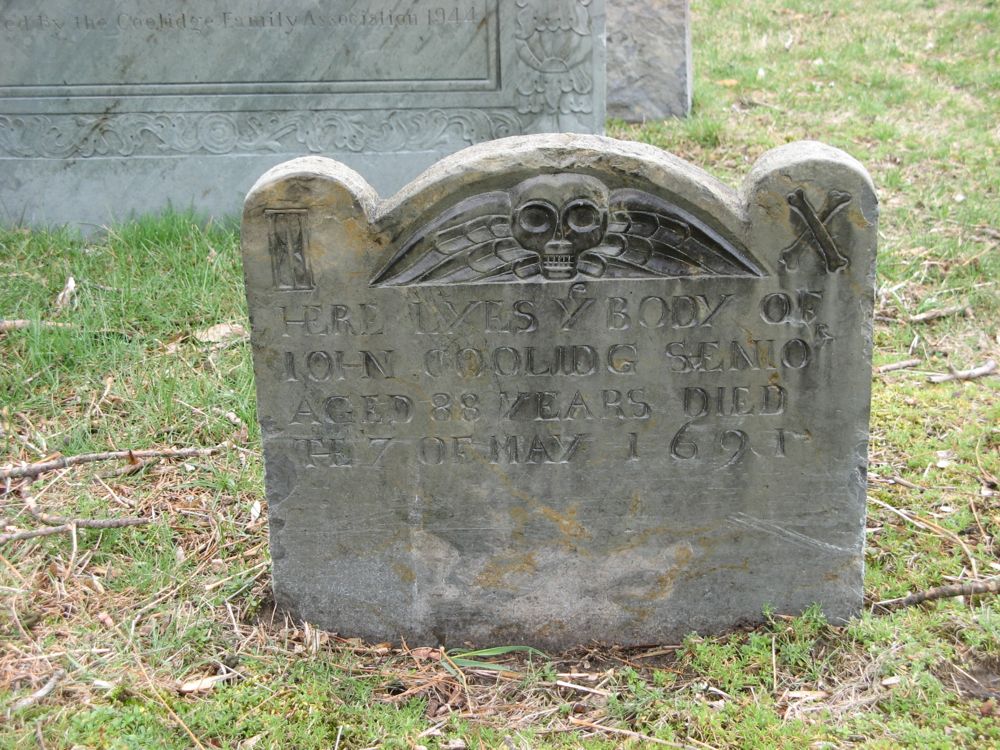
From a young couple with their infant son leaving behind everything they knew to cross the ocean into the unknown, the Coolidges became part of the founding fabric of New England. Their story is one among many, but together those early decisions helped to establish communities whose influence would extend far beyond their own lifetimes.
What began as a fragile experiment in the wilderness grew with astonishing speed; by 1700, the Puritan population of New England had reached around 92,000. Families such as the Coolidges became part of that transformation, helping to shape communities that prospered long after the hardships of the first generation had passed.
Today, the surname Coolidge has all but disappeared in the United Kingdom, with only four households recorded in the 1939 Register. In the United States, however, around 3,000 people still bear the name, with its greatest concentration remaining in Massachusetts: the place where John and Mary Coolidge chose to build a new life.
(1) Ancestry.com – English Origins of New England Families, Second Series, Vol. I. https://www.ancestry.com/imageviewer/collections/48556/images/EnglishOrigins2Vol1-003434-595?ssrc=&backlabel=Return&lang=en-US&pId=398681 (accessed 2026-05-06).
(2) Coolidge, E. D. Decendants of John and Mary Coolidge (Coolidge Foundation).
(3) Halsall, W. F. English: Arrival of the Winthrop Colony in Boston. https://commons.wikimedia.org/wiki/File%3AWinthrop_Fleet.jpg (accessed 2026-05-06).
(4) Clap, R.; Blake, J. Memoirs of Capt. Roger Clap; Re-printed by P. Allen: Pittsfield Mass., 1824.
(5) Francis, C. An Historical Sketch of Watertown, in Massachusetts, from the First Settlement of the Town to the Close of Its Second Century; Cambridge, E. W. Metcalf and comapny, 1830.
(6) Image from Our Patriots, by ,I. A. B. English:; 1918, https://archive.org/details/ourpatriots00ingord (accessed 2026-05-06)
(7) Locke, H. D. An Ancient Parish : An Historical Summary of the First Parish, Watertown, Mass[Superscript Tts]; [Watertown, Mass.] : Tercentenary Committee of the Parish, 1930.
(8) Early Puritans of New England Going to Worship; 1872. https://commons.wikimedia.org/wiki/File:Early_Puritans_of_New_England_Going_to_Worship_.jpg (accessed 2026-05-06).
(9) Bond, H.; Jones, H. G. Genealogies of the Families and Descendants of the Early Settlers of Watertown, Massachusetts, Including Waltham and Weston : To Which Is Appended the Early History of the Town.; Boston : N.E. Historic-genealogical Society, for the benefit of the “Bond fund,” 1860.
(10) M.D, H. B. English: “A Map of the Original Allotments of Land and the Ancient Topography of Watertown.” A Map from Henry Bond’s ‘Early Settlers of Watertown: Genealogies of the Families and Descendants of the Early Settlers of Watertown , Massachusetts,’ by Henry Bond, M.D., Second Edition with a Memoir by the Author , by Horatio Gates Jones, A. M., Published by the New England Historic Genealogical Society for the Benefit of the Bond Fund, Boston, 1860.; 1860. https://commons.wikimedia.org/wiki/File:Henry_Bond_map_of_Watertown_Massachusetts.gif (accessed 2026-05-06).
(11) John Coolidge (1604-1691) – Find a Grave Memorial. https://www.findagrave.com/memorial/14649325/john-coolidge (accessed 2026-05-06).


