There are some ancestors who appear in the records only faintly – a name, a date, a place. And then there are those, like Major Henry Baynes of the Royal Artillery, whose lives intersect with some of the defining moments of British history.
Born on 31 Mar 1785 in Gibraltar[i], Henry Baynes entered the army at an age that seems astonishing today. In May 1799, at just fourteen years old, he was appointed a Gentleman-Cadet, and by February 1801 – still only fifteen – he had been commissioned as a Second Lieutenant.[ii] His youth was spent not in quiet study or apprenticeship, but in preparation for a life of war.
By 1806, Baynes was serving in southern Italy during the Calabrian campaign, part of Britain’s efforts to resist Napoleonic expansion. It was an early taste of active service, but far greater trials lay ahead. Within a few years he would find himself in the Iberian Peninsula, serving under the command of Arthur Wellesley, 1st Duke of Wellington in what became known as the Peninsular War (later made familiar to many through the Sharpe series by Bernard Cornwell and its television adaptation starring Sean Bean).
At Talavera in July 1809, one of the war’s fiercest early battles, aged just twenty-four, Baynes commanded a company of artillery – a significant responsibility for a young officer. The guns he directed played their part in holding back French assaults, but the cost was personal. During the fighting, Baynes was severely wounded in the head.[iii] It was an injury that would trouble him for years afterwards and may well have shaped the course of the rest of his career.
Despite this, he continued to serve. Records place him in Spain as late as 1812, dining with fellow officers in Madrid and managing the vital – if less dramatic – work of ammunition supply.[iv] His active battlefield role may have been limited by his injuries, but he remained part of the army’s long struggle across the Peninsula.
In 1814, Baynes was sent to the Low Countries, where he took part in the unsuccessful bombardment of Antwerp. The following year he was present at one of the most famous battles in British history: the Battle of Waterloo. Serving as Brigade-Major in the Royal Artillery, he was once again wounded – this time in the face and body – but survived the conflict that brought an end to Napoleon’s rule. He remained in France until November 1818.
Following the war, Baynes continued his service, though he never rose to the highest ranks. He was promoted to Captain and was given command of a company of the 8th Battalion, Royal Artillery, stationed in Guernsey between 1823 and 1826.
In 1824, he married Henrietta Le Marchant[v], a member of a distinguished Guernsey family. Shortly after the birth of their first child, he moved onto half-pay – effectively semi-retirement – in December 1826, with the rank of Major.[vi] Five more children followed over the next decade, including my 2nd great-grandmother Frances Elizabeth Georgina Baynes, born in 1827.
The children’s birth records suggest that the family moved frequently around England before eventually settling in the Channel Islands. There, Mrs Baynes purchased a house, Choisi, in St Peter Port, which became the family home.[vii]
Although war had defined much of his early life – we catch perhaps the clearest glimpse of Henry Baynes’s character in a very different setting.
By the 1830s, he was no longer on campaign, but was serving as a senior officer in the Channel Islands, eventually becoming commanding officer at Alderney. It was here, far from the great battlefields of his youth, that an incident in 1834 revealed another side to his nature.[viii]
On the night of 6 November 1834, the ketch Buccleugh, carrying a cargo of dried fruit from Spain to London, was driven onto rocks in a violent storm west of Guernsey. The vessel was lost, and her crew of seven men escaped only by launching a small boat into the raging sea.
For twenty-four hours they struggled to survive – exhausted, half-clothed, and sustained only by a few raisins and a bottle of rum. With two oars (later broken) and a pocket handkerchief raised as an improvised sail, they drifted at the mercy of the winds and waves.
At last, in a state described as “almost miraculous,” they reached the shores of Alderney. But their ordeal was not yet over. Cold, injured, and barely able to walk, they were discovered by a sergeant-major of the garrison and brought to Major Baynes at around nine o’clock that night.
Here, the tone of the story shifts.
Rather than the artillery officer of Talavera or Waterloo, we see a man in a very different role. Baynes “very humanely rendered them every assistance in his power,” doing all he could to relieve their suffering. It is a brief mention in a newspaper report – easily overlooked – but it speaks volumes.
This was not the chaos of battle, nor the rigid structure of military command. It was a moment of compassion: a seasoned officer, long accustomed to hardship, responding instinctively to the distress of others.
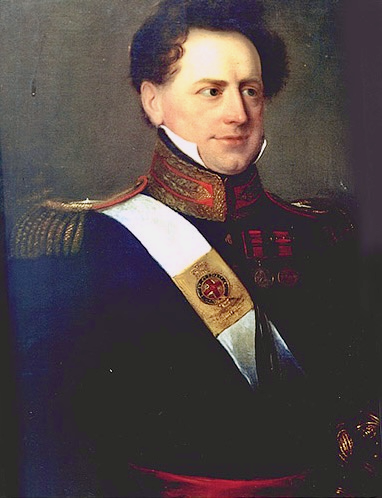
The only known portrait of Henry Baynes – painted around 1826 but sadly stolen in 2001[x] – offers a rare glimpse of the man behind the service record. He appears as a “red-faced, jolly looking man,” wearing the dark blue coat of the Royal Artillery with its scarlet collar and gold embroidery.[xi]
Displayed prominently are the medals that tell the story of his career: the Waterloo Medal and the gold medal for Talavera. This particular combination was unique among Royal Artillery officers, making his identity unmistakable even without a name attached.
There are hints, too, of the toll taken by war. He wears an eyeglass cord – perhaps a necessity following his head wound as a young man – though this remains speculative. His later years suggest a man who many never have fully recovered from his injuries.
In 1837, he was appointed a Knight of the Royal Hanoverian Guelphic Order – an honour awarded for his services, long after the guns had fallen silent.
In Guernsey, far from the battlefields of Spain and Belgium, he lived out the remainder of his life until his death from a stroke in July 1844, aged just fifty-nine.
For all his distinguished service, Henry Baynes remains, in many ways, an elusive figure. Only fragments of his personality survive: a diary entry describing him as “pleasant” and “gentlemanly,” and letters written in a lively, if somewhat untidy, style.
He was not one of history’s great generals, nor a figure of legend. Instead, he represents something perhaps more valuable to family history – the experienced, resilient officer who fought, was wounded, carried on, and quietly served through some of the most turbulent years of the early nineteenth century.
His story bridges the grand sweep of history and the quiet humanity of the life behind it.
[i] TNA Record of Officers Service WO/76/359/11
[ii] Journal of the Society for Army Historical Research, Vol. 39, No. 160 (Dec 1961), pp. 205-212
[iii] Ibid
[iv] Ibid
[v] TNA Record of Officers Service WO/76/359/11
[vi] Journal of the Society for Army Historical Research, Vol. 39, No. 160 (Dec 1961), pp. 205-212
[vii] Priaulx Library website: Lukis on Hutchesson last accessed 18 Mar 2026
[viii] Priaulx Library website: The Comet, Friday 14th November, 1834 last accessed 18 Mar 2026
[ix] https://www.britishempire.co.uk/forces/armyunits/britishartillery/rabaynes.htm last accessed 18 Mar 2026
[x] britishempire.co.uk: “This painting was sadly stolen from the home of W Y Carman on 3rd January 2001. The painting has been in his possession for 40 years and is now missing. If, by any chance, you should come across this painting could you please email us immediately so that we can take appropriate action. Thank you.” last accessed 18 Mar 2026
[xi] Journal of the Society for Army Historical Research, Vol. 39, No. 160 (Dec 1961), pp. 205-212
