Food has a way of anchoring memory. Long after faces fade and dates blur, tastes, smells and small domestic rituals remain vividly clear. What follows is a smörgåsbord of food memories from my childhood – some ordinary, some special – each one offering a peek into family life, habit and the times we lived in:
Sandwiches
Before sliced bread really caught on, sandwiches were made from thin slices of white bread. The end of the loaf was ‘buttered’ with margarine before slicing, as trying to spread anything onto a thin slice would cause it to fall apart. Fillings were only ever one item: ham, cheese, tomato, or cucumber. To even think of putting in more than one would have been thought extravagant.
Fish paste and potted meats
These were a staple in our household, small glass jars of savoury mashed something that would be spread on bread or toast for tea. Nowadays these would probably be called ‘pâté’ and sold at a premium price. The lids and labels were different colours depending on the contents, though they were all quite similar. I wasn’t too keen on the meat ones, chicken paste was an unappealing beige, and the beef didn’t taste as nice as ‘real’ beef and smelt faintly of cat food. The fish pastes were much nicer, and included salmon, crab, bloater, and my favourite sardine and tomato. I found some sardine and tomato paste in my local supermarket not so long ago and bought a couple of jars for old times’ sake – but it wasn’t nearly as nice as I remembered.
Meat and two veg
Most main meals consisted of meat, with a carbohydrate such as potato, rice or pasta, and a vegetable that had usually been overcooked. Any cooked meat left over from a roast dinner on Sunday would be minced down using a mincer that was clamped to the kitchen table. My mother’s cooking skills were limited, and she approached the kitchen with little enthusiasm. Roasts were always overcooked, but the potatoes that sat around the meat were the best I have ever tasted – all crunchy and savoury, with very little actual potato left in the middle. Her repertoire for the minced leftovers was also limited: add an onion and a tin of tomatoes to the meat, then top with ‘Smash’ dried potato mash for ‘cottage pie’; serve it with pasta, which came dried in long thin blue packets, for ‘spaghetti bolognese’; or with rice for ‘risotto’.
Tagliatelle
My maternal grandmother was born in Italy, and although the family returned to England in 1913, when she was about nine years old, she had already learned some wonderful Italian cooking skills which she retained throughout her life. I can remember her in her kitchen, around fifty years later, making tagliatelle by pouring a mound of flour onto the pine kitchen tabletop and making a divot in the middle into which she would break three or four eggs. She would work the flour into the eggs with her hands, then knead the resulting mixture for several minutes to create a smooth dough. She’d then cover it with a damp (clean!) tea-towel and leave it to rest for a while.
The dough ball would be cut into several pieces and each rolled out into sheets about 1-2mm thick, keeping the thin sheets covered with the tea-towel as she worked. She’d take a large rectangular wooden bread board and cover with a sheet of pasta then, leaning the board at about 45 degrees angle from the table-top, quickly slash the sheet of dough into thin strips to create the tagliatelle.
Sauces were typically based upon onions and tomatoes gently cooked in olive oil, back then bought from the chemist in town in small brown bottles with ribbed sides, with seasonal vegetables and herbs, which would be simmering slowly in a pan.
The pasta would be dropped into boiling water for just a minute or two before being dished up on plates with the glistening sauce. Delicious!
Cured meats and sausages
I loved cured meats as a child (I still do) and – somehow – at a very young age realised that raw bacon and prosciutto ham were very similar. I would get into trouble for ‘stealing’ small bits of bacon before it was cooked. My best friend was fond of uncooked sausage meat, this was no secret and one day our local butcher said to her mum, “Mrs B, you’ll have to tell Pat to stop nibbling raw sausages as we’re going to be buying them in now and won’t know what goes into them.” My ‘Italian’ grandmother would always claim that salami was donkey meat, but my brother and I were not put off. When I was about sixteen, I’d spent some time in France and bought a whole salami sausage to bring home. I remember looking at the ingredients on the label: “Bœuf, porc et âne”.
I was surprised that she had been right all along.
Christmas pudding
My grandmother always made a Christmas pudding a month or two before the big day. The mixture of raisins, currants and mixed peel, breadcrumbs and flour, beef suet, eggs and spices was laced with a large quantity of alcohol, including sherry and brandy. Sixpences would then be hidden in the mixture, each wrapped in a tiny piece of tin foil for hygiene reasons. The pudding was wrapped in a cloth and boiled for several hours. Such a tantalising aroma – but having to wait weeks to taste it was pure torment.
Dessert
The main meal on a Sunday was often followed by a sweet course, known variously as pudding, dessert or simply sweet. I don’t think I ever quite understood the rules governing the names; but they seemed to depend largely on what was being served.
Tinned fruit – peaches, pears, or fruit salad that included cherries which neither looked nor tasted like cherries – would be accompanied by Carnation Evaporated Milk poured thickly from a tin. Fresh or tinned fruit might instead find itself suspended in a brightly coloured jelly, made by dissolving cubes from a packet in boiling water, adding the fruit, and leaving the concoction in the fridge overnight to set.
Another favourite was Angel Delight: a vividly coloured powder whisked with milk and left to stand for a few minutes, magically transforming itself into something mousse-like and improbably sweet. It came in several chemical-tasting flavours. In our house, strawberry was the most prevalent, but butterscotch was the nicest, though seemingly hard to come by, as it was rarely served – and banana was just foul.
Looking back, these foods say as much about time and circumstance as they do about taste. Some were born of skill, some of thrift, some of convenience, and many were shaped by habit rather than choice. A few remain delicious, others less so – but all of them still carry the flavour of the past.
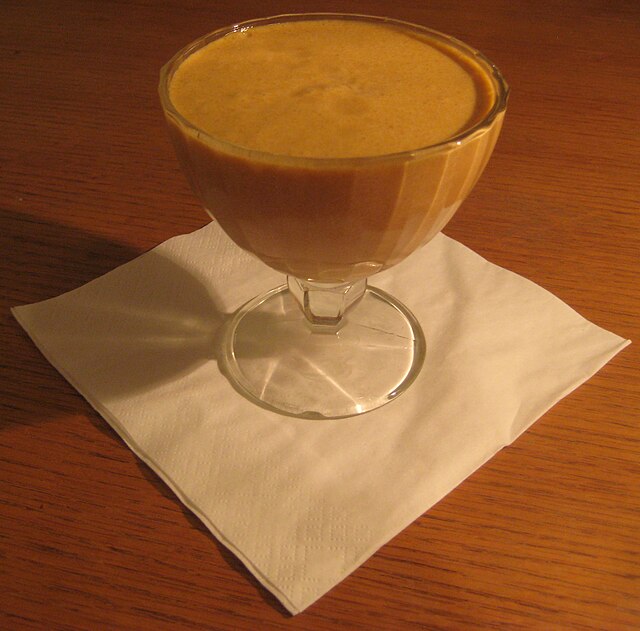
[i] A serving of butterscotch Angel Delight by Hex, Licensed under CC BY-SA 3.0, via Wikimedia Commons
