More than twenty years ago, the National Memorial Arboretum was officially opened as the UK’s centre for remembrance – a living tribute with thousands of trees and hundreds of memorials dedicated to those who have fallen in service. Set in 150 acres of peaceful parkland between Birmingham and Derby, it’s somewhere I had long wanted to visit. But at nearly two hundred miles from home, it always felt a little too far for a day trip.
Recently, after a weekend in the Peak District, I realised a detour to this significant site might finally be possible – and with ancestors from the nearby villages of Croxall and Edingale, it felt doubly appropriate. Although time was short, I decided to fit in a brief stop at the Arboretum, followed by a drive through those familiar village names to get a sense of the landscape my forebears once knew, before heading back to Tamworth to rejoin the motorway home.
There’s no entrance fee to the Arboretum, though the website advises booking in advance to guarantee entry and benefit from a discounted parking rate. I had planned to arrive around 11am, but unexpected road closures along the way set me back nearly an hour. For a moment I almost turned back but I’m so glad I didn’t.
The main car park was already full, and the overflow area a few hundred yards away was busy, but there was still plenty of space. As I dashed through the visitors’ centre, a friendly volunteer handed me a small map, and moments later I stepped out into the landscaped parkland beyond.
It’s a stunningly beautiful place. With over 400 memorials and some 30,000 trees, I quickly realised I would not have time to see everything. My first stop was the Armed Forces Memorial, a striking circular wall of pale stone set on a grassy mound that dominates the area beyond the buildings.
This powerful memorial is dedicated to 16,000 men and women who have lost their lives in service since the end of the Second World War – with space for a further 15,000 names. Inside the enclosure stands two sculptural groups, each slightly larger than life. On the eastern side, a small gap in the wall draws the eye as one of the figures points directly towards it. The inscription beside the opening reads “Through this space a shaft of sunlight falls at the eleventh hour on the eleventh day of the eleventh month.” Nearby, another figure holds a hammer and chisel, preparing to carve more names.
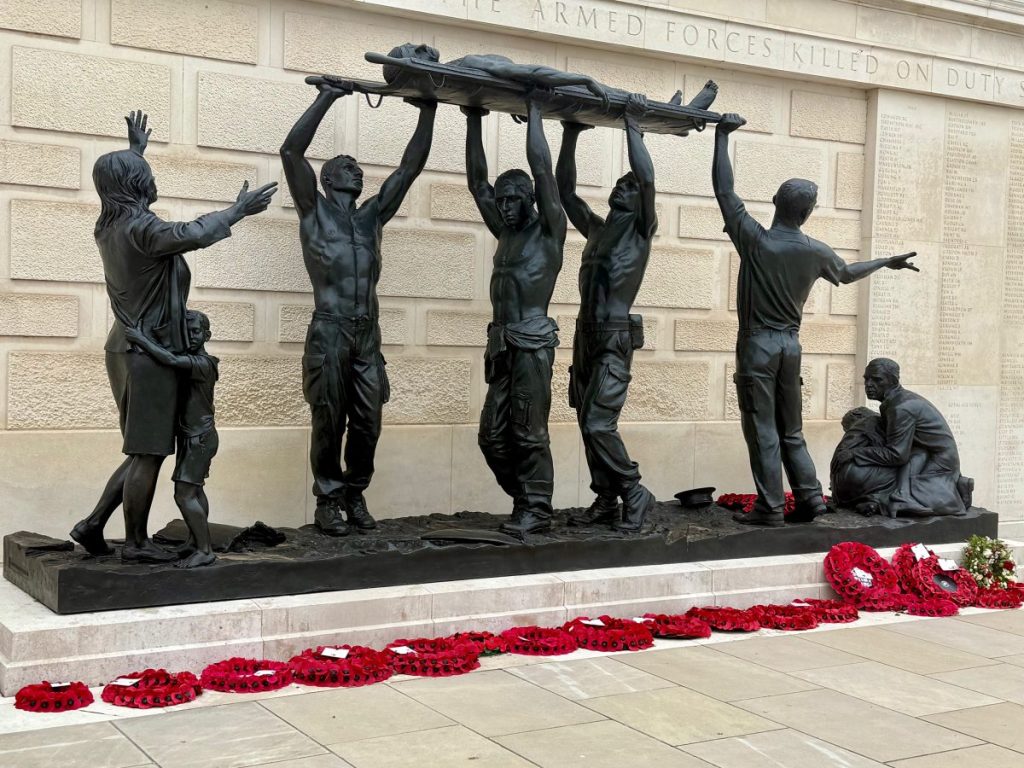
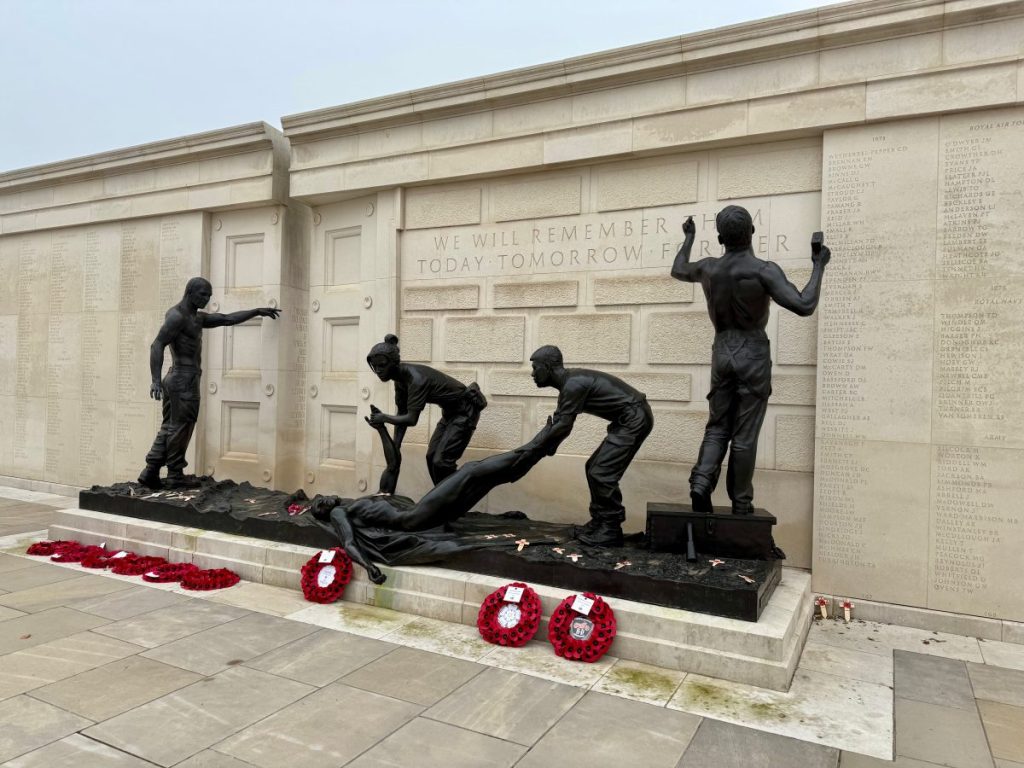
It was incredibly moving – no sense of celebration or glory, only quiet dignity, grief, and remembrance.
Although it felt almost disrespectful to step away from this scene, I decided to head off through the woodland to pay my respects at the “Shot at Dawn” memorial which lies just beyond the Polish Forces War Memorial.
I didn’t intend to linger, but the Polish Memorial stopped me in my tracks. At its centre stands a powerful bronze sculpture of three men and one woman representing the four branches of the Polish Armed Forces: the Army, Navy, Air Force, and Underground Home Army resistance movement. Above them, the Polish Eagle spreads its wings, symbolising unity and courage. Curved grey walls encircle the figures, inscribed with accounts of Poland’s wartime struggle.
After the fall of France in 1940, thousands of Poles escaped to the UK, and around half a million members went on to fight under British command. Many never returned home. Poland lost its freedom again after the war, this time to Soviet domination, which lasted into the 1980s. It was sobering to be reminded that, proportionally, more Poles died during the Second World War than any other nation.
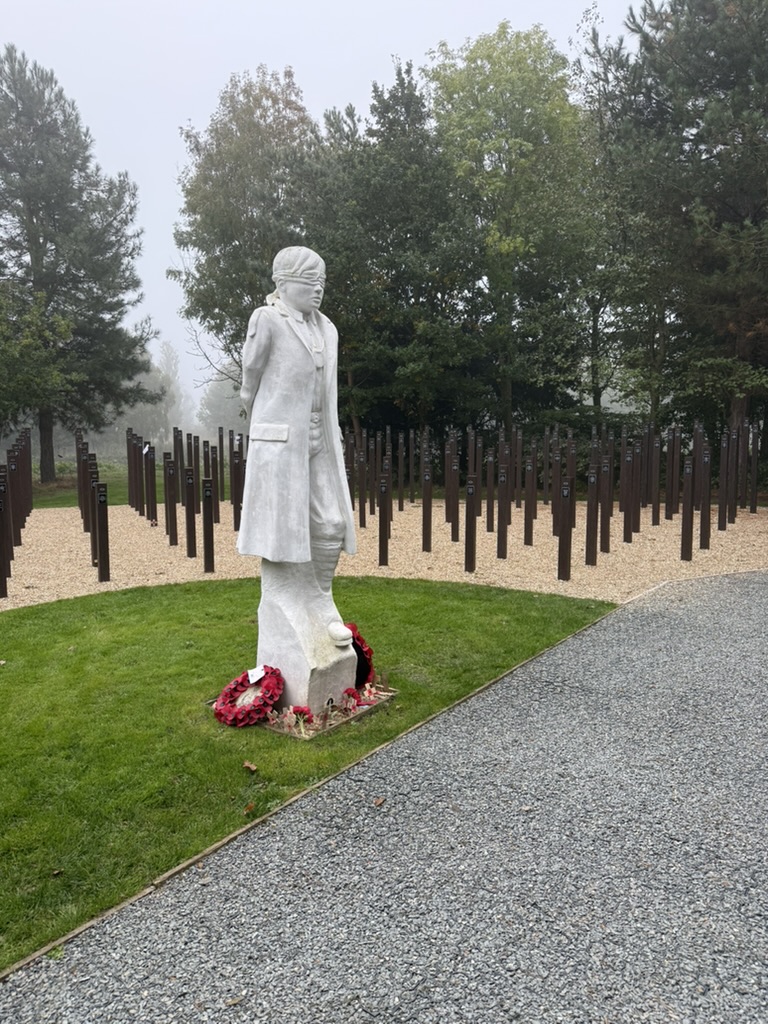
Still reflecting on that immense sacrifice, I continued on to the “Shot at Dawn” memorial, commemorating more than 300 soldiers executed during the First World War for alleged offences such as cowardice, desertion, or sleeping at their post. Many were denied fair trials and were almost certainly suffering from what we now recognise as post-traumatic stress disorder (PTSD). Of the 346 men executed during this period, 309 were posthumously pardoned nearly a century later. The remaining 36 had been convicted of murder and would have faced the same penalty under civilian law at the time.
In a quiet clearing stands the sculpture of a young man, blindfolded, with a target hanging from his neck. Behind him are 307 dark wooden stakes arranged in a semi-circle, each bearing the name and service details of a man who faced a firing squad, symbolised by six bright green conifer trees. It is one of the most poignant and haunting places I have ever stood.
That morning, visitors of all ages and nationalities wandered quietly among the memorials. Some had clearly come to find a particular name or monument that held personal meaning. Others, perhaps local people, strolled the paths with their dogs as part of a Sunday morning routine. For me, three memorials had been enough. I felt deeply moved – saturated, almost – by the sheer weight of sadness and sacrifice. It was time to leave, to let the experience settle.
I followed the peaceful riverside path around the edge of the Arboretum, then drove on through Croxall and Edingale as planned. But my thoughts were no longer on my ancestors. I had just spent a couple of hours in one of the most extraordinary places I have ever visited, and I knew I would return one day.
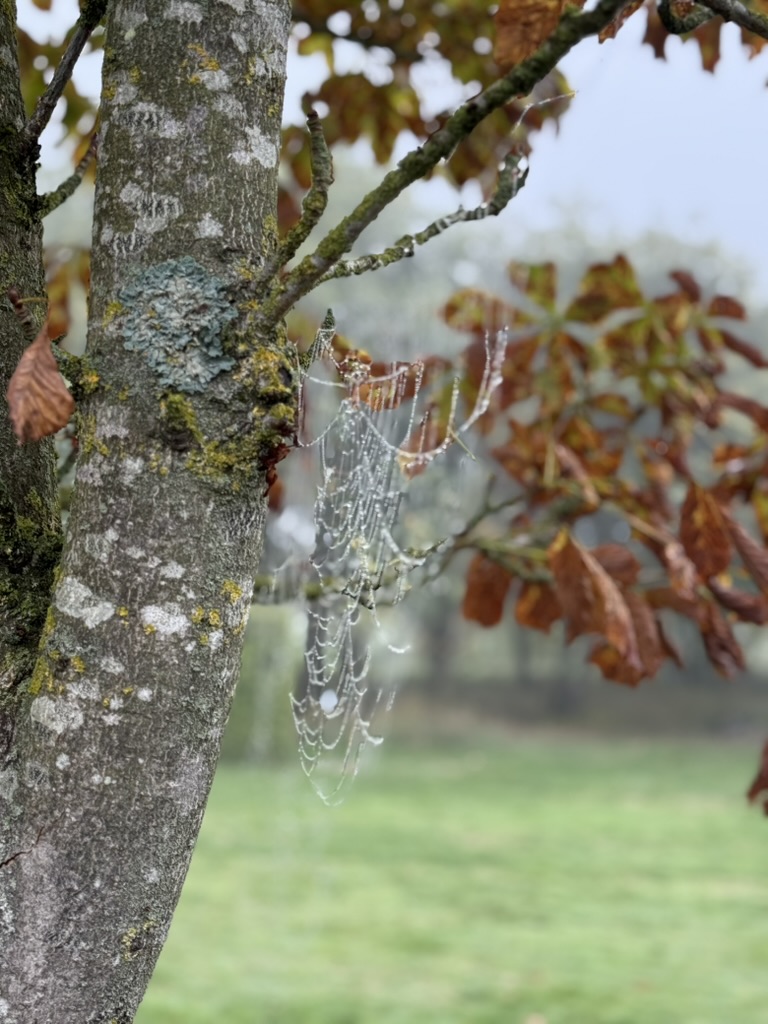
It had been a damp and chilly autumn day, with mist hanging in the air – the sort of weather that seems to suit a place of remembrance. As I made my way back to the car, I took one final photograph: a spider’s web strung with dewdrops, glistening between the branches of a tree whose leaves were turning gold. Among those hundreds of solid memorials to thousands of lost souls, it seemed a fragile and fleeting thing – a silent reminder of how precious life is.