Wickham Market, a picturesque village nestled in the River Debden valley, Suffolk, lies within the Suffolk Coastal heritage area. Bypassed by the busy A12 trunk road, it is located about 21km (13 miles) north-east of Ipswich and 8km (5 miles) north-east of Woodbridge. First recorded in the Little Domesday Book in 1086 as Wikham[i], the village historically held some importance, boasting a town hall in which quarter sessions were held. In 1440, King Henry VI granted permission for a weekly market and two fairs to be held in Wickham, though these lapsed several centuries ago.
By the late 18th century, Wickham Market experienced a modest industrial revolution, with its iron and engineering works producing steam engines, water wheels, windmills, and machinery especially for corn and flour mills[ii].
Today, the historic market square known as ‘The Hill’ survives, and is still flanked by Georgian and timber-framed buildings. The skyline is dominated by All Saints Church, a 14th century structure with an octagonal tower and lead spire, visible for miles across the surrounding countryside.
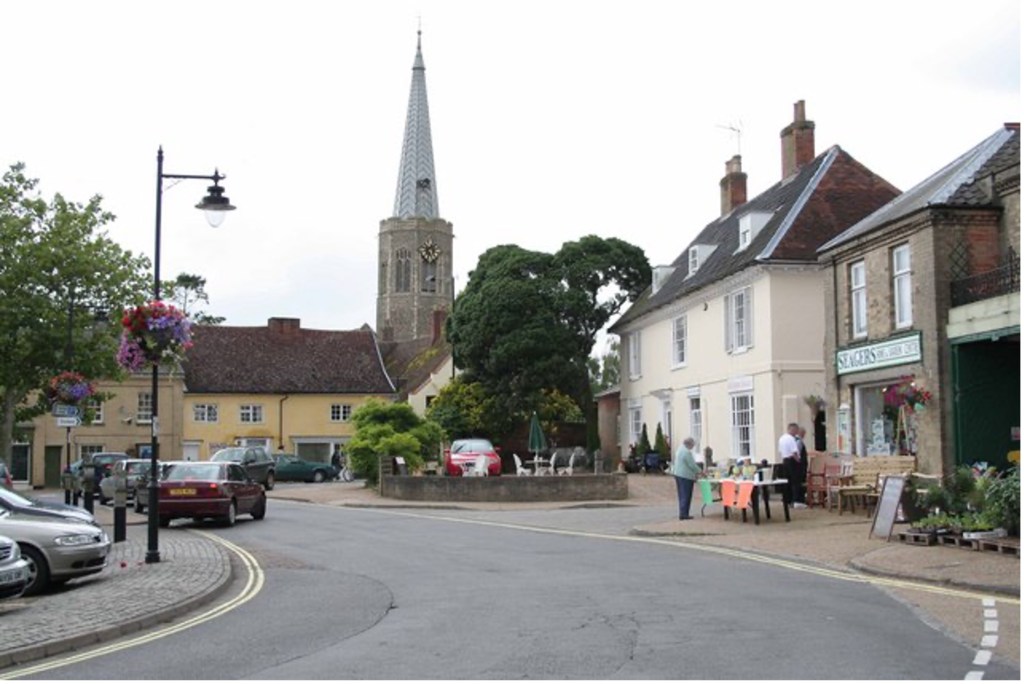
Among the many families who lived in Wickham Market were my Mayhew ancestors, including Michael Mayhew (1777-1855), a carrier who served the local community for over fifty years. Every morning, rain or shine, Michael left his home in Upper Street with his horse and cart, taking passengers and deliveries to Woodbridge and returning each afternoon from ‘The Lion’ public house[iv].
In 1799, Michael married Elizabeth Barrett[v], and together they raised a large family of thirteen children born over a twenty-two-year period. Their home, centrally located next door to the blacksmith’s forge, would have been a busting hub of activity in the village.
While Michael Mayhew and his family’s story may seem fairly unremarkable at first glance, recent research for a Pharos Tutors course on Nonconformity – Its Records and History 1600 – 1950, uncovered records of events that would have profoundly impacted the Mayhews and their community. These events would go on to change the face of Wickham Market forever.
The Seeds of Conflict
This story begins in late summer 1810, when Reverend John Thompson, a Baptist minister, attempted to introduce Congregationalism into this small community of just 906 residents (as recorded in the 1811 census[vi]).
Acting quite properly and within the law, Reverend Thompson rented two rooms in a cottage to hold services, offering an alternative the regular Protestant worship at nearby All Saints Church. However, the announcement of his first service, scheduled for Sunday 2nd September 1810, sparked fierce opposition.
The day before the first planned service, a town crier warned the villagers to guard their homes and property against an incoming ‘dangerous group’[vii]. Word quickly spread, and by Sunday, a large crowd from nearby villages had gathered outside the meeting house causing a disturbance using drums, gongs, loud shouts, and catcalls to drown out the sermon and intimidate worshippers.
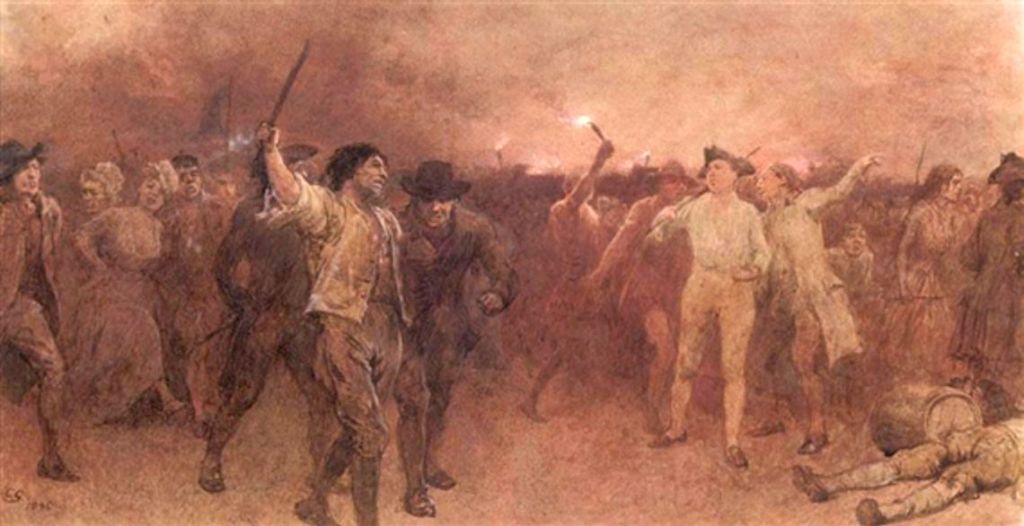
During the following weeks, the protests escalated. By some accounts, up to 3,000 rioters gathered, many in disguise, every Sunday. They hurled stones, set off fireworks, and smeared human waste on the meeting house walls. The ringleaders, including yeomen, farmers, tradesmen, and even a churchwarden, wore cockades and laurel leaves inscribed with ‘Church and State’. One particularly mocking act involved a procession through the village, with a man dressed as a preacher distributing bread to ridicule the dissenters.
On another occasion, the mob carried a gallows through the streets, attempting to terrorise Reverend Thompson further, then pelted him and his horse and carriage with rotten eggs, stones, and fireworks. Records from the time refer to the dissenters as ‘Pograms’ and their opponents as ‘Anti-Pograms’ – a striking use of language given how the term ‘pogrom’ evolved in later history.
Legal Acts and Consequences
The violence reached a horrifying climax on Sunday, 2nd December 1810, when the mob stormed the meeting house. They forcibly dragged out the property owner, William Barker, and his brother, threatening them with conscription into the press gang – a dreaded form of legal kidnapping. Armed with tools and weapons – including at least one gun – the mob, driven by fury, launched a brutal assault on the building. They smashed all the windows and shutters and attempted to tear down the cottage, rendering it uninhabitable.
For three long months, the rioters had terrorised the dissenting congregation with increasingly brazen acts of hostility. Stones, fireworks, buckets of stinking fish, and even human excrement inside scooped out turnips, had been hurled at the minister and the meeting house, while threats and physical intimidation targeted anyone who dared to participate in the services. However, despite the escalating violence and public disorder, the local courts dismissed the initial charges against the ringleaders.
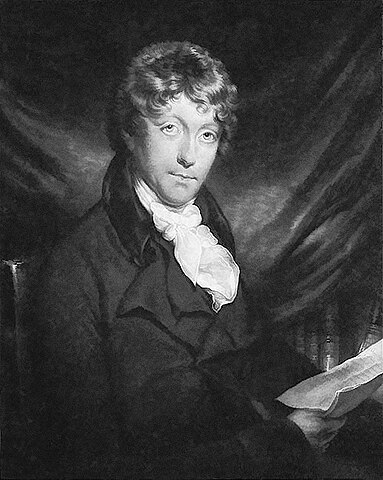
Determined to uphold justice and protect religious freedoms, Sir William Garrow (1760–1840), then Attorney General to HRH the Prince of Wales, brought the case before the King’s Bench. Best remembered for coining the principle ‘presumed innocent until proven guilty’[ix], Garrow was steadfast in demanding that the accusers and their evidence undergo rigorous scrutiny in court.
In May 1811, presiding under Lord Ellenborough, the court delivered a landmark ruling: the defendants had conspired to deny dissenters their lawful right to worship[xi]. Seven men were found guilty and fined the substantial sum of 200 guineas each. Additionally, the parish itself was ordered to “keep the peace,” placing the onus on local authorities to prevent further riots and ensure public order[xii].
The Ringleaders
The accused ringleaders represented a cross-section of local society. Amongst these were:
- James Churchyard, a farmer, organised logistical support for the mob and threatened Reverend Thompson, stating that he would disrupt services for years if necessary.
- Benjamin Garrard, a tradesman, led a procession mocking the dissenters and was involved in throwing stones and fireworks.
- William Hewitt, a collar-maker, procured drums and other noise-making instruments used to disrupt the services.
- Phillips Dykes, a yeoman and parish churchwarden, encouraged the mob and was described as more culpable because of his elevated social standing.
- William Moore, a farmer, shouted inflammatory cries of “Burn them!”, and threatened Barker with the press gang.
- John Culpeck, a shoemaker, played a gong during the riots and shouted derogatory slurs at the dissenters.
Others, including tradesmen and agricultural labourers, were alleged to have participated in acts ranging from throwing rotten fish into the meeting house to smearing excrement on the walls.
A Lasting Legacy
Despite the fierce opposition, Reverend Thompson persevered with the support of figures such as the Reverend Matthew Wilks, founder of the London Missionary Society. By 1826, a Congregational chapel seating 650 was established in Wickham Market[xiii]. By March 1851, attendance at the chapel surpassed that of All Saints Church[xiv], reflecting the changing religious landscape.
The aftermath of the riots also led to the formation of the Society for the Protection of Religious Freedom, ensuring that such persecution would not recur. In 1860, the village celebrated the Jubilee of the Independent Church, with a thriving congregation that stood as a testament to the resilience of Reverend Thompson and his followers.
My 4th great-grandparents, Michael Mayhew, with his daily routes between Wickham Market and Woodbridge, and his wife Elizabeth, at home looking after their many children, would have witnessed these turbulent events and seen how the events shaped the village. The eventual establishment of the Congregational chapel and the growth of its congregation highlight the triumph of perseverance and the value of religious freedom.
Today, Wickham Market reflects a more tolerant and inclusive community, a far cry from the unrest of 1810. In telling this story, I sincerely hope this serves as a reminder of the challenges faced in securing those freedoms and the importance of respecting diverse beliefs.

[i] www.visitwickhammarket.co.uk > History and Heritage last accessed 15 Jan 2025
[ii] www.visitwickhammarket.co.uk > History and Heritage last accessed 15 Jan 2025
[iii] By roger geach, CC BY-SA 2.0, https://commons.wikimedia.org/w/index.php?curid=13568087 last accessed 15 Jan 2025
[iv] www.ancestry.co.uk Pigot’s Directory > Suffolk > 1830
[v] Tunstall Parish Records last accessed 22 Oct 2011
[vi] http://www.histpop.org > Observations and enumeration abstract, 1811, p324 > Wickham Market last accessed 11 Nov 2024
[vii] https://heritage.suffolk.gov.uk/media/pdfs/wickhammarket.pdf 11 Nov 2024
[viii] By Charles Green – http://www.mutualart.com/Artwork/THE-GORDON-RIOTS/0B3EC15174672097, Public Domain, https://commons.wikimedia.org/w/index.php?curid=15245708
[ix] https://en.wikipedia.org/ William Garrow last accessed 15 Jan 2025
[x] By Engraver: Dunkarton, Robert (1744–1811/17); painter: Devis, Arthur William (1762–1822) – http://via.lib.harvard.edu:80/via/deliver/deepLinkItem?recordId=olvwork178120&componentId=HLS.LIBR:96992 Transferred from en.wikipedia by SreeBot, Public Domain, https://commons.wikimedia.org/w/index.php?curid=16963602
[xi] www.findmypast.co.uk taken from articles which appeared in the London Courier and Evening Gazette : 12 Feb 1811; Pilot (London) 12 Feb 1811; and Evening Mail (London), 13 Feb 1811. A shorter version appeared in General Evening Post (London) 12 Feb 1811, Drakard’s Stamford News (Lincolnshire) on 15 Feb 1811, and many other local publications over the next months.
[xii] The Baptist Magazine 1811 Vol 3 p393 and The Evangelical Magazine 1811 Vol 19 p 524 via Google Books last accessed 11 Nov 2024
[xiii] TNA Ecclesiastical Census Returns 1851 HO 129/224/22
[xiv] TNA Ecclesiastical Census Returns 1851 HO 129/224/22
[xv] From watercolour painting by Grace Hastie as a postcard in the author’s personal library
