Click here to go back to the previous chapter
It is unlikely that, as a young working mother, Catherine had any permanent help at home. Whilst she was out at work as a lady’s maid for the Wyatt’s, another neighbour’s daughter might have helped care for Norah while her mother was at work, allowing Catherine to balance motherhood with the need to earn a living.
She probably worked for the Wyatts for at least two years, leaving their employ shortly before the birth of her second child. In November 1882, an advertisement appeared in the local newspaper, placed by Miss Wyatt, of Weston, Nutbourne, seeking a “good general servant” who must have “good character”.[i]
While Catherine was employed at Weston Farm, probably as a maid-of-all-work cum lady’s maid, she and her family may have lived in a tied cottage – a home provided rent-free in exchange for her service. Such arrangements were common in rural households, but the right to live there usually ended when employment did. When Catherine’s term of service came to an end, just two months before the birth of her second child, the family may suddenly have found themselves without a home.
This could explain why Catherine’s second daughter was born in January 1883 at Graffham, at the foot of the South Downs, another tiny rural village some seventeen miles north of Weston Farm and about fifty miles from Catherine’s family on Hayling Island.
My great-grandmother Eva May (later known as Evelyn) was probably born in circumstances similar to Norah’s birth, with no family nearby to help. A kindly female neighbour or paid midwife may have assisted. Perhaps, now that Catherine’s brother-in-law Tommy was living with them, the family could afford a ”monthly nurse” – a woman engaged to care for a mother and her newborn during the lying-in period, usually around a month.
Once again, it was Catherine’s husband Joseph who registered the birth, about three weeks later, in keeping with the common practice of the time.
If Catherine had the help of a monthly nurse, it would have been short-lived. The reality of daily life soon reasserted itself: with two young daughters to care for, Catherine would been fully occupied at home – keeping the fire going, washing and ironing laundry, mending clothes, baking bread and cooking from scratch, and all the while making garments for her growing children.
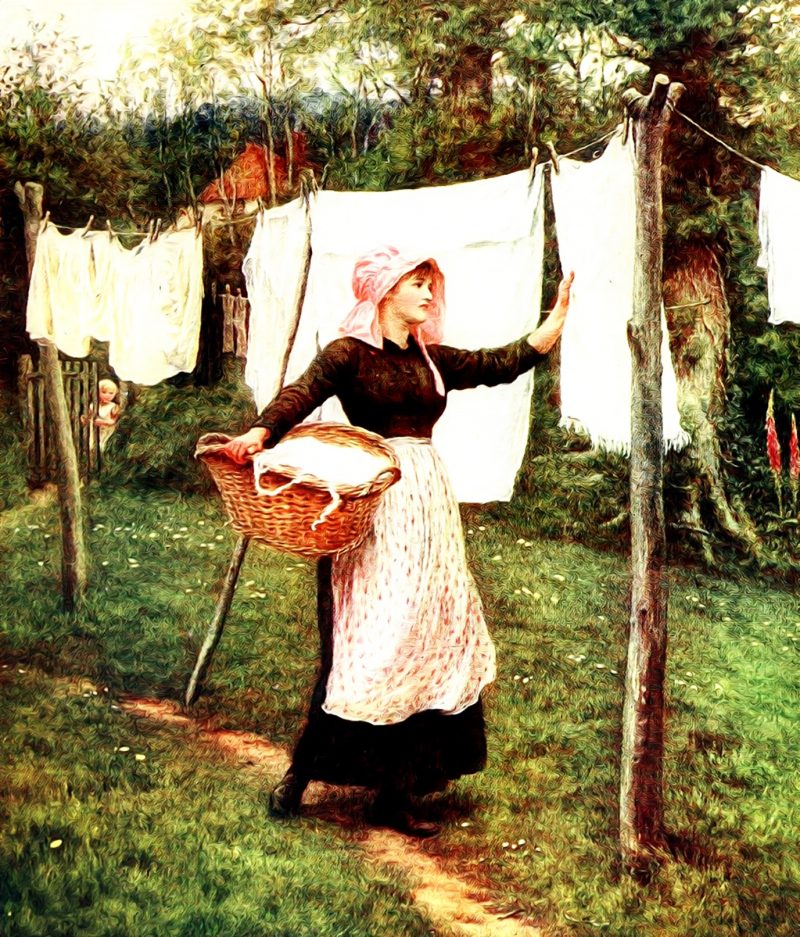
Like many village women, she probably tended a small garden for vegetables and fruit, and kept a few hens for eggs and some rabbits for meat, providing much of the household’s food. A pair of young rabbits about a month old could be bought for around a shilling and would begin to breed five or six months later. It was calculated that “if all accidents are set aside”, a single pair could increase in to about 1.25 million in four years![iii] Kitchen scraps were reused: fruit and vegetable peelings fed to the hens and rabbits, and other organic waste and ash returned to the garden as compost.
All of this was managed without electricity or running water, meaning every drop had to be carried, heated, and used sparingly. The rhythms of the household were shaped by daylight and the constant need to keep the fire alight. With her husband and brother-in-law at home during the day, Catherine also had the added work of providing meals and maintaining order in a busy household.
At home, Catherine made clothes for herself and her family. As babies, her daughters would have worn white cotton gowns, and as they grew older, they would have been dressed as miniature versions of their mother, with clean pinafores over dark coloured dresses that reached just below the knee – practical and less likely to show the dirt – worn with boots laced to the calf. Men’s suits were typically navy blue, black, or “pepper-and-salt”, while women wore corsets beneath long heavy dresses generally in dark colours, their skirts sweeping the roads as they walked. These dresses relied upon heavy materials and stiff petticoats to create the evolving silhouette of the late nineteenth century – from full skirts supported by crinolines to the later bustle with its flat front and exaggerated rear. Outdoors, every member of the family would have worn a hat of some sort, not just for respectability but to guard against chills and pneumonia.[iv]
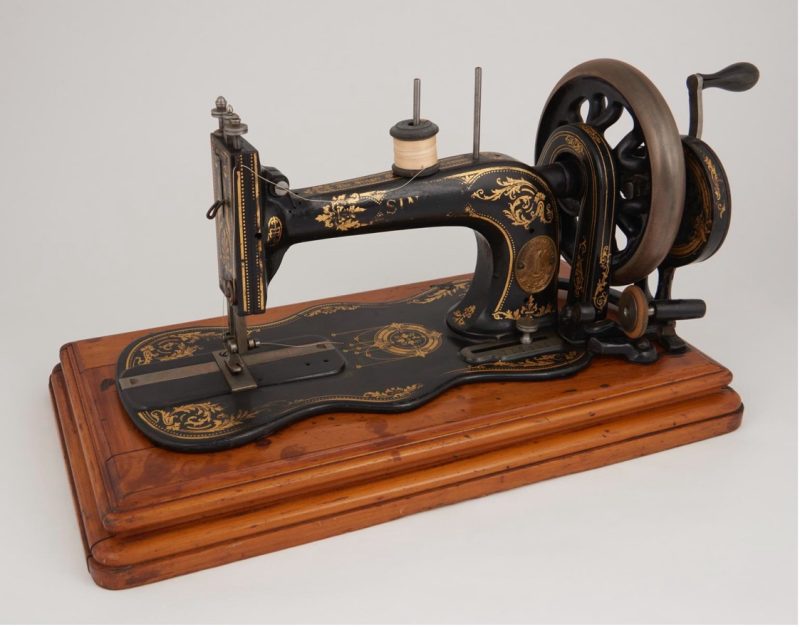
Everything in Catherine’s household was likely sewn by hand, though she may have owned a Singer “New Family” lockstitch sewing machine. Over four million were built between 1865 and 1883, selling for around four guineas.[v] These were heavily advertised in the Hampshire press, often alongside with vacancies for “energetic young men” to sell them door-to-door.[vi] I remember that Catherine’s daughter, Evelyn – my great-grandmother – owned one of these, and she tried (unsuccessfully) to interest me in learning to sew on it in the 1960s.
Catherine probably saved old garments and scraps of fabric for patchwork or for making rag rugs – a traditional craft that gave worn-out clothing a new life. Although we might now imagine such rugs brightening a cottage floor, they were more often made in dark, serviceable colours, using whatever material was to hand. However, as the wife of an army staff-sergeant, Catherine may even have had access to “condemned” red serge (wool twill dyed with madder or cochineal) from worn out uniforms. This durable cloth sometimes found its way into children’s coats, or rag rugs as a prized material. Although this fabric was officially sold in bulk to wholesale dealers, small amounts occasionally reached local communities[viii].
These rugs were valued less for decoration than for warmth, softening the chill of a brick or flagstone floor. Each year, a new rug might be made, with the older one relegated to the bedroom, then the kitchen, and eventually outdoors – perhaps to the dog’s kennel or laid over the compost heap. In Catherine’s household, nothing would have been wasted.
Click here to read the next chapter
[i] Hampshire Post and Southsea Observer 17 and 21 November 1881 via findmypast.go.uk
[ii] Washing Line vintage public domain Helen Allingham painting under License: CC0 Public Domain via www.publicdomainpictures.net
[iii] Cassell’s household guide to every department of practical life: being a complete encyclopaedia of domestic and social economy published in 1869 by Cassel, Petter, Galpin in London and New York via archive.org
[iv] The King Holds Hayling by FGS Thomas published by Pelham, Havant, 1961
[v] Science Museum Group. Singer ‘New Family’ sewing machine, 1865-1883. 1949-220 Science Museum Group Collection Online. Accessed 13 October 2025. https://collection.sciencemuseumgroup.org.uk/objects/co44768/singer-new-family-sewing-machine-1865-1
[vi] Various Hampshire newspapers published 1880-1890 via findmypast.co.uk
[vii] Science Museum Group. Singer ‘New Family’ sewing machine, 1865-1883.. 1949-220 Science Museum Group Collection Online. Accessed 14 December 2025. https://collection.sciencemuseumgroup.org.uk/objects/co44768/singer-new-family-sewing-machine-1865-1883.
[viii] https://api.parliament.uk/historic-hansard/commons/1889/jul/18/disused-army-clothing
