Click here to go back to the previous chapter
Catherine married in June 1869, aged just nineteen, at St Peter’s Church, North Hayling, where her father was parish clerk. Catherine’s husband, Joseph Twohey – a career soldier from Ireland thirteen years her senior – had served in the Crimea and India, taking part in some of most the bloodiest confrontations of the nineteenthcentury before returning to England. By the 1871 census,[i] the couple were living far away from her family, in Army married quarters at Tynemouth, Northumberland.
In 1874, Joseph was transferred to the permanent staff of the Royal Sussex Militia in Chichester, and the couple returned to the south of England. He retired two years later with an Army pension.
For nearly a decade after their marriage, there were no children – something unusual for the time. Their first daughter, Norah, was not born until July 1879, followed by a second daughter, Eva May (later known as Evelyn), in January 1883. The reason for the delay can only be guessed at. There is no evidence that Joseph’s military service kept the couple apart, although they may have chosen to wait until after his retirement in 1876 before starting a family. It is also possible that they faced health or fertility problems: Catherine may have endured a series of miscarriages, or stillbirths, while Joseph may have suffered lingering physical or psychological effects from his years of active service.
Nevertheless, by the summer of 1879, Catherine faced her first confinement. At the time, she and Joseph were living in Nutbourne, a tiny hamlet in rural Sussex, about five miles from Catherine’s parents, who were then in their sixties. Her sisters had left home, and were either married or in service, so Catherine likely relied on the help of neighbours rather than family. Like most women of her generation, she was probably attended by a kindly local woman or, if they could afford it, a hired “monthly nurse”, who might charge a few shillings.
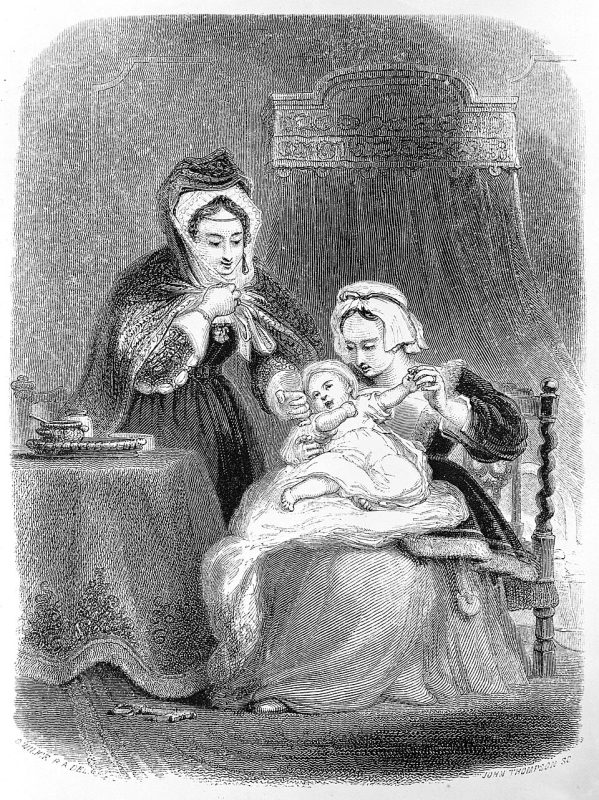
Although midwives had been able to obtain certificates of competence from the London Obstetrical Society since 1872,[iii] Catherine’s attendant was unlikely to have been formally trained. Her skill would have come from experience – from having assisted at dozens of births in her own community. Catherine’s labour probably took place in a familiar bedroom with windows kept closed against draughts. Beforehand, she may have received a dose of castor oil or an enema of salt water to empty her bowels and, as labour advanced, the midwife might have eased the delivery by oiling the birth canal with lard.[iv]
While chloroform was becoming fashionable among the wealthy as a form of pain relief, Catherine would likely have had to rely on a towel tied to the bedpost to grip during her pains. Assuming all went well with the delivery, and no doctor was required, the midwife would have tied the umbilical cord with waxed string in two places – about two and four inches from the baby – then cut between the ties. The afterbirth would have followed within twenty minutes.[v]
Cassell’s Household Guide (1869),[vi] a popular domestic encyclopaedia, advised that after a safe delivery a mother should try to remain in bed for up to nine days, sustaining herself on weak tea with bread or a little gruel. It also recommended putting the baby to the breast as soon as possible; however, if the mother was unable, which was often the case during the first thirty-six hours, the newborn could be fed “a little oatmeal gruel, very thin and smooth.” Nurses, it added, often administered a few drops of castor oil with this first meal.
For Catherine and Joseph, the arrival of Norah marked a new chapter in their lives after ten years of marriage. Whether or not they had expected to remain childless for so long, her safe delivery must have brought both relief and joy to the couple, and perhaps a sense of fulfilment to Catherine as she entered motherhood at last.
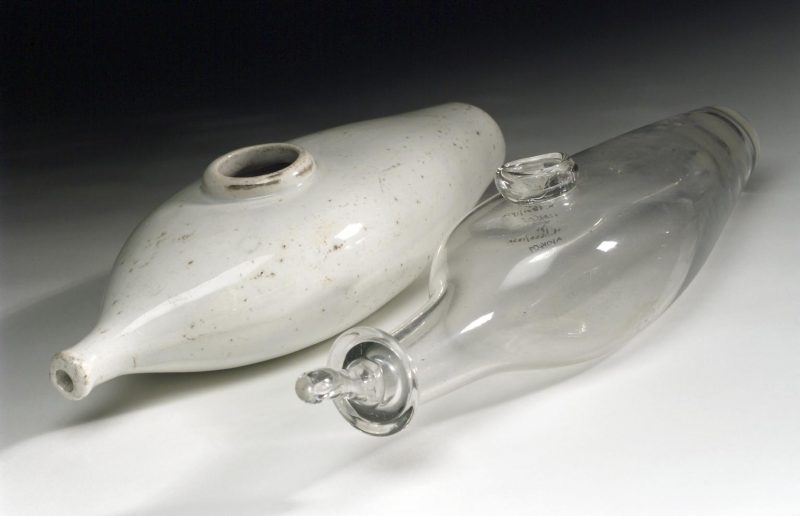
Norah probably slept beside her mother and, in the early days, was likely fed on demand, though Catherine may have hoped to quickly establish a routine that suited them both. If she had been unable to nurse, Cassell’s Household Guide[vii] recommended keeping a couple of feeding bottles, to be used on alternate days, each fitted with a rubber teat – or even one fashioned from a calf’s teat – which should be stored in a little gin or whisky and then rinsed in warm water before use. Prepared food might include rusks, “tops and bottoms”, or plain biscuits, soaked in hot water, beaten to a pulp, sweetened, and finished with a teaspoonful of cream at feeding time.
Norah’s father registered his first-born daughter’s birth about five weeks after her arrival. In the nineteenth century, it was more common for fathers to deal with “official” matters such as registering births, marriages, or deaths. The law required the informant to be the father, the mother, or someone present at the birth, and many families preferred the father to appear before the registrar.
In 1880 – the first year that Westbourne, of which Nutbourne was a part, was included in the Medical Officer of Health’s report[ix] – forty-two births were recorded in the parish, with only two infant deaths, a rate of just under five per cent. This was notably lower than the figure for the wider West Sussex sanitary district, where 125 births and thirteen infant deaths gave a rate of more than ten per cent. Westbourne’s comparatively low mortality may suggest that most babies were breast-fed, or that the village enjoyed healthier conditions than some of its neighbours.
On the 1881 census,[x] despite being married with a daughter aged under two, my great-great-grandmother Catherine is recorded as a “lady’s maid”. This is curious, as it was unusual at that time for a married woman in rural England to work outside her home – especially one with such a young child.
Looking around the neighbourhood in that census, and in earlier ones, it becomes clear that Nutbourne was a tiny hamlet around an ancient manor house, originally assigned to Richard de Weston around 1312[xi]. The property then consisted of a hall with solar and cellar, pantry and buttery, and several outbuildings. By the late nineteenth century, “Weston” referred to a farmhouse and few cottages on the western bank of Nutbourne Creek, near Chichester in Sussex.
In 1881,[xii] Weston House was home to twenty-three-year-old farmer John Alexander Wyatt, his two older sisters Marian (27) and Lucy (25), and Harriet Worth, a housekeeper in her late sixties who had been with the family for at least twenty years. John had taken over the running of the 200-acre farm after the death of his father, also named John, in 1876 when the elder Mr Wyatt – the largest ratepayer in the area – drowned in the nearby Mill Pond after tying a millstone around his neck.[xiii]
John junior employed six men and two boys, and the six nearby cottages were occupied by a tight knit community: two agricultural labourers and their families, a blacksmith and family, a retired farmer and his wife, a retired rigger and his family, and Catherine, her husband and brother-in-law – both retired soldiers – and their toddler daughter. It’s likely that some of the tenants provided labour in lieu of rent, while others paid money.
Catherine may have worked in domestic service before her first pregnancy – almost ten years after her marriage – perhaps to supplement the family income or to keep herself occupied while her husband fulfilled his duties as Sergeant Paymaster for the Royal Sussex Militia. It is unlikely that she had any formal training to prepare her for employment as a domestic servant, then later running her own boarding house. She probably learned basic household management skills as a girl from her mother and from other army wives during her early married life in barracks, which she later applied to advance her own career.
During her time with the Wyatts, Catherine likely fulfilled the role of maid-of-all-work and lady’s maid, assisting the housekeeper with day-to-day duties running the house. Her working day would have begun early, around half-past six, opening shutters, sweeping hearths and lighting fires. She would then prepare the breakfast room, dusting and polishing the furniture before sprinkling the carpet with damp tea-leaves – which helped gather dust while leaving a faintly pleasant aroma – and sweeping the floor.[xiv] Next, she would take jugs of hot water to the sisters’ rooms, waking them and helping them to dress.
Breakfast for the Misses Wyatt would have been served around eight o’clock. After clearing the breakfast table and washing the china, Catherine would move on to the bedrooms, opening windows, putting away clothes, and tidying dressing tables. Without a dedicated housemaid, she would have cleaned the washstands and emptied the slops and chamber pots herself, before carefully turning and making the beds. Once the rooms were in order, she would carry the candlesticks and oil lamps downstairs for cleaning and trimming before returning them to their proper places. She may also have been responsible for cleaning boots and shoes and running small errands to the nearby village.
As the day went on, Catherine would have assisted the housekeeper in preparing and serving luncheon and dinner, before washing up and tidying the kitchen. Her working day would have been long, often ending only when the fires were banked up for the night and the lamps extinguished.
Alongside her household duties, Catherine would have spent quieter hours sewing and mending her mistresses’ clothes. She may have made or repaired underwear, skirts, summer frocks, evening dresses, and other personal items, as well as re-sewing buttons and trimming bonnets or collars when required.
All of the daily routine – the cleaning, serving, organisation, and steady hard work – would have provided valuable experience for the years ahead, when she took on the greater challenge of running her own boarding house.
Click here to read the next chapter
[i] 1871 England census RG10/5120/72
[ii]Monthly Nurse via https://wellcomeimages.org CC-BY-4.0
[iii] Fox, S., & Brazier, M. (2020). The regulation of midwives in England, c.1500–1902. Medical Law International, 20(4), 308-338. https://doi.org/10.1177/0968533220976174 (Original work published 2020)
[iv] Gunn’s new family physician, or, Home book of health : forming a complete household guide, giving many valuable suggestions for avoiding disease and prolonging life, with plain directions in case of emergency, and pointing out in familiar language the causes, symptoms, treatment and cure of diseases incident to men, women, and children with the simplest and best remedies : presenting a manual for nursing the sick, and describing minutely the properties and uses of hundreds of well-known medicinal plants : with supplementary treatises on anatomy, physiology, and hygiene, on domestic and sanitary economy, and on physical culture and development by John C Gunn published 1867 by Moore, Wilstach & Baldwin, Cincinnati via archive.org
[v] Gunn’s new family physician by John C Gunn via archive.org
[vi] Cassell’s household guide: being a complete encyclopaedia of domestic and social economy and forming a guide to every department of practical life published 1869 by Cassell, Petter, and Galpin in London, via archive.org
[vii] Cassell’s household guide: being a complete encyclopaedia of domestic and social economy and forming a guide to every department of practical life published 1869 by Cassell, Petter, and Galpin in London via archive.org
[viii] Science Museum Group. Glass infant feeding bottle, Europe, 1801-1900. A101409 Science Museum Group Collection Online. Accessed 14 December 2025. https://collection.sciencemuseumgroup.org.uk/objects/co120771/glass-infant-feeding-bottle-europe-1801-1900.
[ix] Medical Officer of Health Report, West Sussex Combined Sanitary District, for 1880 via wellcomecollection.org
[x] 1881 England census RG11/1135/109
[xi] ‘Westbourne’, in A History of the County of Sussex: Volume 4, the Rape of Chichester, ed. L F Salzman (London, 1953), British History Online https://www.british-history.ac.uk/vch/sussex/vol4/pp126-132 [accessed 22 October 2025].
[xii] 1881 England Census > Nutbourne, Westbourne, Sussex, RG11/1135/109/6 via ancestry.co.uk
[xiii] Hampshire Telegraph 18 Mar 1876 and other publications via Findmypast.co.uk
[xiv] Mrs Beeton’s Book of Household Management via gutenberg.org and The Rise and Fall of the Victorian Servant by Pamela Horn, published 1990 by Alan Sutton Publishing, Gloucestershire
