Most people are familiar with the sound of church bells ringing in celebration or tolling mournfully in grief. Whether it is the bitter-sweet sound of a single bell or the majestic resonance of a full peal, bell ringing –particularly change ringing[i] – has been a popular and intricate art in English churches for centuries
Historically, bells in churches and monasteries were mounted on a single spindle and swung from side to side, operated by deacons pulling ropes. However, the Protestant Reformation under Henry VIII led to the desecration of many religious buildings, often resulting in the removal and destruction of their bells. After the Reformation, many churches began to rehang their bells using a new technology: bells mounted on a wheel. This innovation offered much greater control, allowing the ringer to rotate the bell 360 degrees to start and stop ringing at will, thanks to the additions of a stay and slider.
Watch a short (57 second) BBC video about the history of bell ringing below:
By around 1630, groups of ringers in London and Norwich began to experiment with mathematical sequences of bell changes – known as ‘methods’ – some of which are still in use today, nearly 400 years later.
In 1668, after several years of experimentation, Cambridge printer, Fabian Stedman, collated all the available information, including some new methods of his own, and published Tintinnalogia – or the Art of Ringing[ii]. Nine years later, he published Campanologia[iii], refining the rules of change ringing and setting the foundations for the long sequences of bell changes that became a hallmark of the art.
One remarkable performance took place on 17th January 1734 in the bell tower at Croydon Minster. A full peal of Plain Bob Triples – an intricate system involving seven bells changing order at each pull of the rope – was rung by members of the Society of Croydon Youths, including several members of the Levens family. This peal involved 5,040 changes in just three hours and 12 minutes, requiring an extraordinary degree of concentration and stamina from the ringers.
This was the first time such a peal was rung in Croydon Minster, and it remains one of the earliest peals rung in the south of England outside London[iv]. The event was notable not only for its length but also for demonstrating the skill and endurance of the bellringers. At that time, bellringers sought to challenge themselves with longer peals, and ringing over 5,000 changes was considered a significant accomplishment.
A course of Plain Bob Triples performed in 2017:
Croydon Minster, formerly known as St John the Baptist, the Croydon parish church, was central to the lives of the Levens family, who had strong ties to the church across several generations. A Peal Board on the eastern wall of the Ringing Chamber once commemorated this historic performance but was tragically lost when the church was destroyed by fire in 1867.
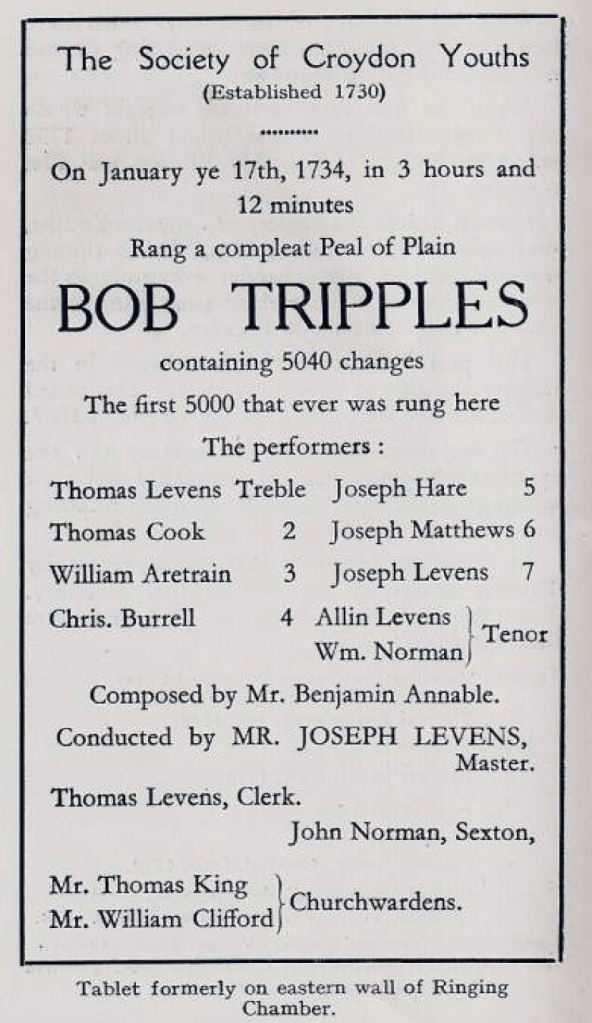
Although the Peal Board named five members of the Levens family, it is likely there were just three: Joseph Levens, the conductor and “Master” of the peal, Thomas Levens, the parish clerk, who rang the treble (the highest-pitched bell); and Allin (Allingham) Levens, who rang the tenor bell (typically the heaviest and lowest-pitched bell). Joseph rang the seventh bell. These three brothers were sons of Richard Levens, an innkeeper at the White Horse on what is now Duppas Hill[vi], and his wife, Rachel Allingham.
By the 18th century, although the advent of railways was reducing reliance on horses and carriages, the inn would still have been a vital part of Croydon’s local economy and social life. Richard’s management of the inn was significant for the family’s social standing, and it may have served as a key venue for local events, possibly including gatherings related to Croydon’s bell ringing society.
Richard was born in Croydon around 1671[vii] and was an influential figure in the area. He and his wife Rachel, had a large family of at least eleven children, including Allingham, (born in 1706)[viii], Thomas (born in 1708)[ix], and Joseph (born in 1710)[x]. The family’s involvement in bell ringing at Croydon Minster spanned nearly sixty years, significantly elevating the art of bell ringing in the town.[xi]
Allingham’s eldest son, also named Allingham, was born exactly one month after the historic peal[xii] . Allingham senior died in 1772 aged about 66, and is buried at Dulwich College Chapel,[xiii] Camberwell, London.
Thomas Levens, my 6th great-grandfather, became a master barber and remained in Croydon throughout his life. He died in 1797[xiv] at the advanced age of 89 and was buried in the churchyard, although his gravestone no longer survives. His eldest son, also Thomas, born in 1748 would succeed his father as parish clerk and bell-ringer, and his grandfather as innkeeper of the White Horse.
Joseph Levens was a subscriber to some of the earliest books on the art of change ringing, but died in 1751[xv], apparently a victim of typhoid fever known locally as “Croydon fever”[xvi].
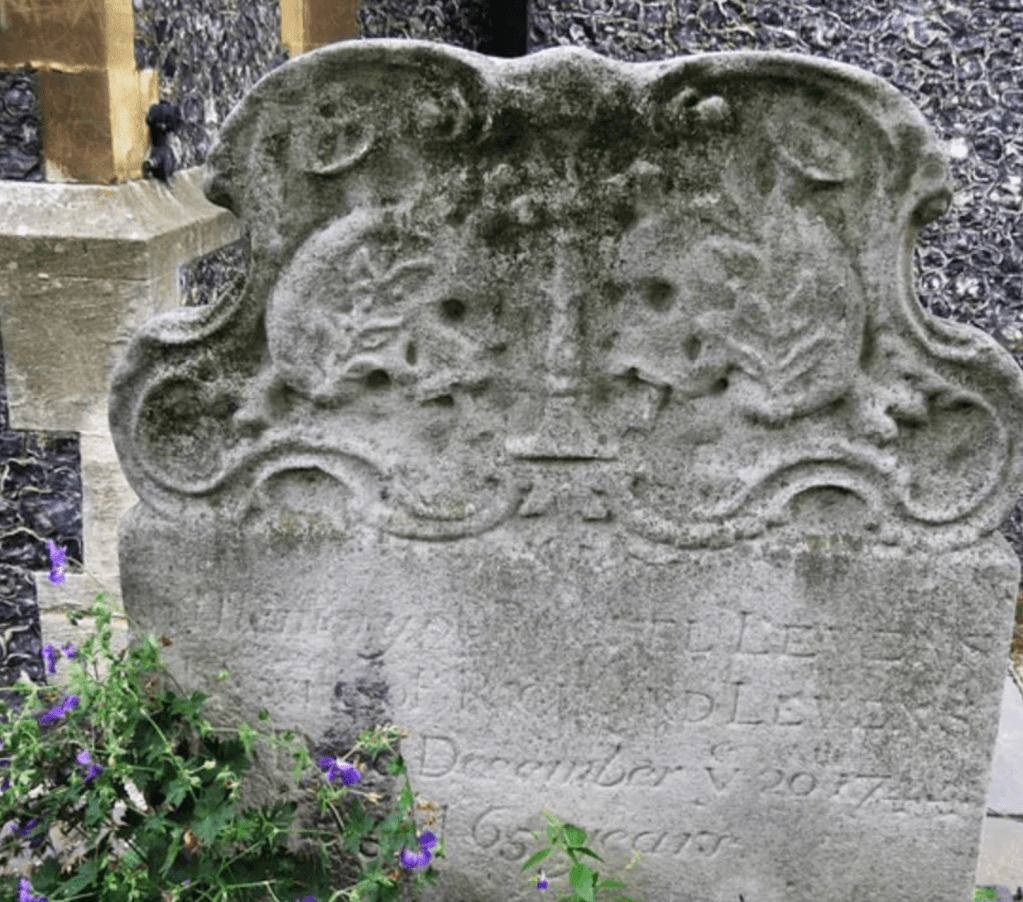
Rachel, their mother died in December 1744, followed by Richard in September 1748, and their gravestone, though faded, can still be seen today on the south side of Croydon Minster.
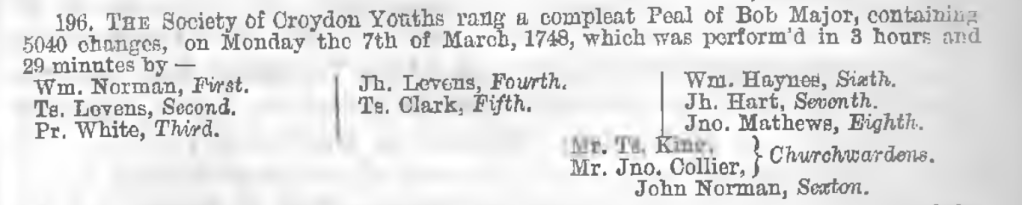
The Croydon bells were recast in 1738[xviii], and the Levens brothers, led by Joseph, must have taken great pride in attempting new and more complex peals. Indeed, in 1748, shortly before their father’s death, the Society of Croydon Youth, with Thomas on treble and Joseph on fourth, completed a Peal of Bob Major with 5,040 changes in three hours and 29 minutes[xix].
Forty years later, Thomas Levens junior, now parish clerk and a member of the Society of Ancient College Youths, helped set another belfry record when a Peal of Bob Major was rung twenty-seven minutes faster than his father’s and uncle’s achievement[xx].

During the catastrophic fire of 1867, the bells melted where they hung, except the tenor, which crashed to the ground and was smashed to pieces. Sadly, hundreds of years worth of records, tombs and artworks, together with other priceless artifacts, including the church clock, chimes and records of the ringers, were lost forever.
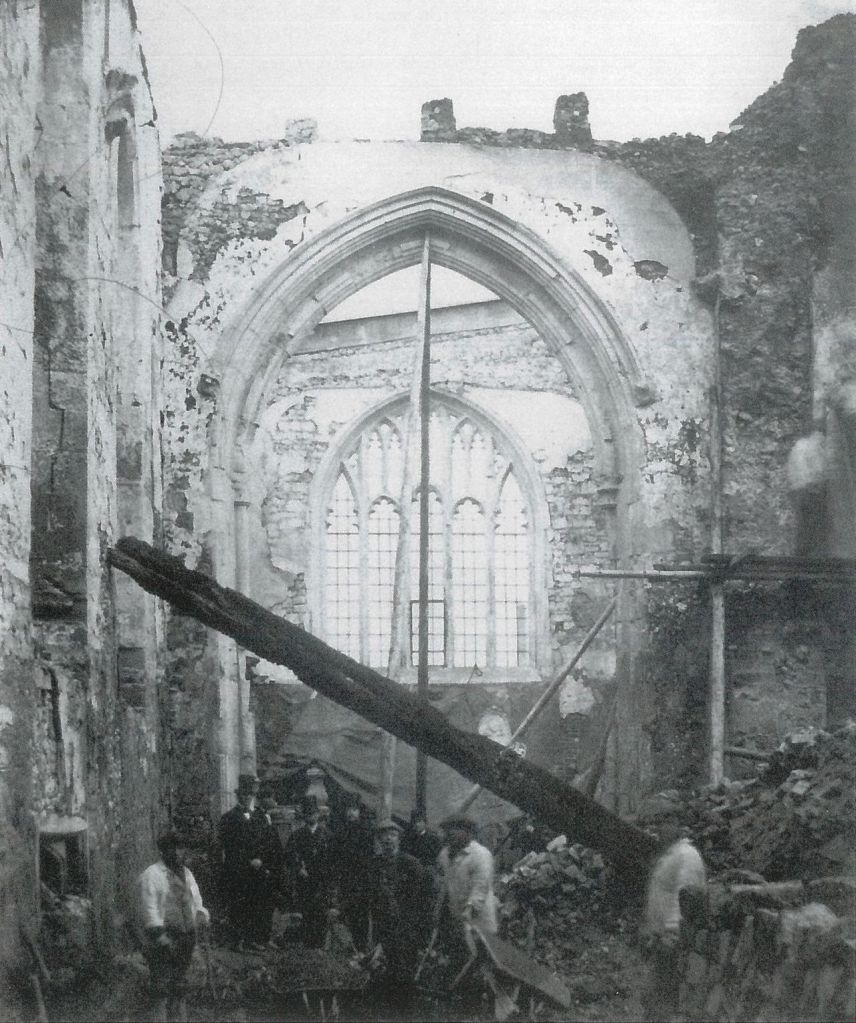
The church was rebuilt, and the bells of Croydon Minster have long been woven into the town’s history. For the Levens family, bell ringing was more than a skill; it was a precious tradition passed down through generations. Although much of that world has changed, the sounds of church bells can serve to remind us of the many lives touched by their music and the timelessness of the art they represent.
Those Croydon bells, those Croydon bells
How many a tale their music tells.
Of peals attempted, left undone
A sweeter tale to tell, my lines shall run[xxi].
[i] www.archive.org Bell ringing: chimes, carillons, handbells; the world of the bell and the ringer by John Michael Francis Camp, published 1974, last visited 8 Oct 2024
[ii] Ibid
[iii] Ibid
[iv] https://croydonringers.yolasite.com/ Bellringers and Bellringing by James E Cooper, published 1950, last visited 8 Oct 2024
[v] https://croydonringers.yolasite.com/ Bellringers and Bellringing by James E Cooper, published 1950, last visited 8 Oct 2024
[vi] PROB 11/765/394 Will of Richard Levens, Innholder of Croydon, Surrey via National Archives
[vii] www.ancestry.co.uk Surrey Church of England Parish Registers; Reference: 2888/1/2
[viii] www.ancestry.co.uk Surrey Church of England Parish Registers; Reference: 2888/1/7
[ix] www.ancestry.co.uk England & Wales Christening Records, 1530-1906 > Thomas Levens baptised 1708 Croydon Parish Church
[x] www.ancestry.co.uk England & Wales Christening Records, 1530-1906 > Joseph Levens baptised 1710 Croydon Parish Church
[xi] Minster bells have been ringing the changes for four centuries via Inside Croydon last accessed 17 Jan 2023
[xii] www.familysearch.org England, Select Births and Christenings, 1538-1975
[xiii] www.findmypast.co.uk South London Burials Index 1545-1905
[xiv] www.ancestry.co.uk Surrey Church of England Parish Registers; Reference: 2888/1/10
[xv] www.ancestry.co.uk Surrey Church of England Parish Registers; Reference: 2888/1/9
[xvi] https://croydonringers.yolasite.com/ Bellringers and Bellringing by James E Cooper, published 1950, last visited 8 Oct 2024
[xvii] Minster bells have been ringing the changes for four centuries via Inside Croydon last accessed 17 Jan 2023
[xviii] https://croydonringers.yolasite.com/ Bellringers and Bellringing by James E Cooper, published 1950, last visited 8 Oct 2024
[xix] https://cccbr.org.uk Church Bells > Bells and Bell Ringing column, Vol 2. 02/12/1871 – 23/11/1872 last accessed 9 Oct 2024
[xx] https://cccbr.org.uk Church Bells > Bells and Bell Ringing column, Vol 3. 30/11/1872-29/11/1873 last accessed 9 Oct 2024
[xxi] www.insidecroydon.com Minster bells have been ringing the changes for four centuries 11 Apr 2021 last accessed 8 Oct 2024
