I was recently asked if I could perhaps shed some light on a member of a friend’s family who had vanished in early 1928. This man, Arthur Earle, has a fascinating history that spans both World Wars, military service, and a significant personal transformation. Here is what I discovered about his life and times.
Arthur Earle was born on 3 December 1896 in Salisbury, Wiltshire. He was the first son and the eighth child of Frank Earle and Mary Ann (nee Rattue). His baptism took place on 15 April 1897 at St Martin’s in Salisbury where the records indicate that his father Frank was a Paperhanger and they lived at 3 Park Terrace, The Friary.

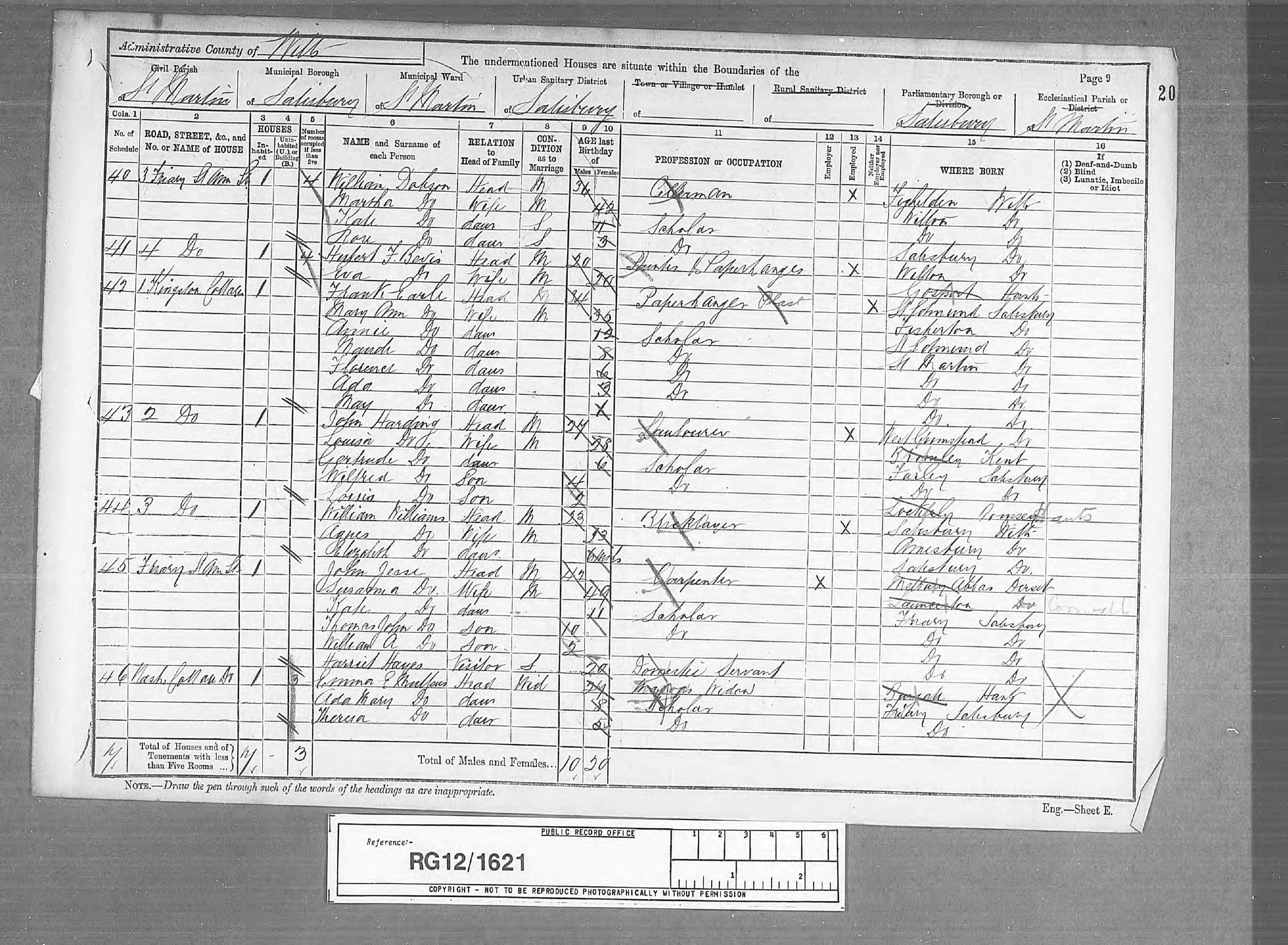
In the 1901 Census, Arthur, aged 4, was living at home at 3 Park Terrace with his parents Frank, a self-employed paper hanger, and Mary Ann, together with older sisters Annie, Flory, Ada, May, Gertie, and Lily.
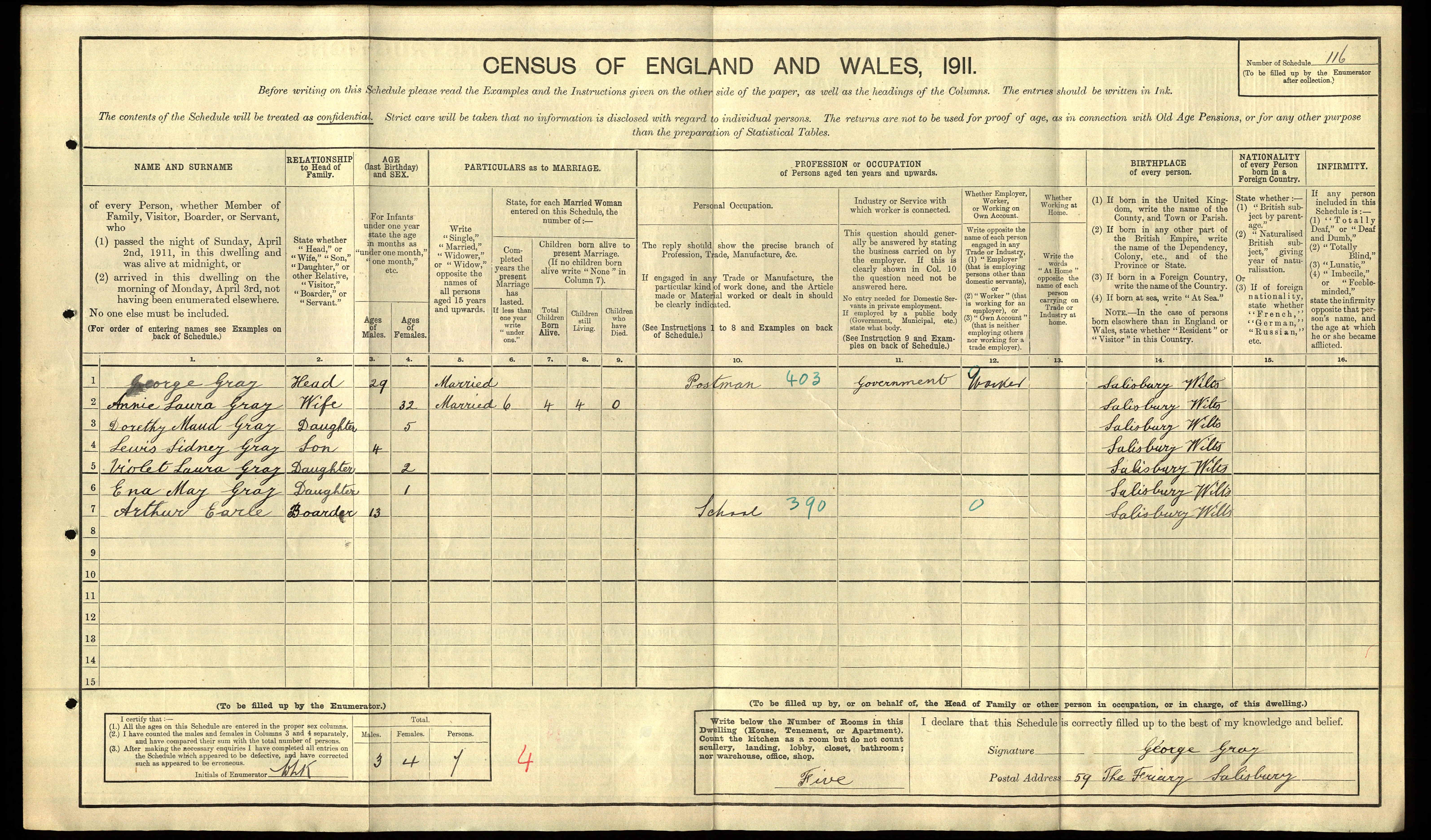
By the 1911 Census, 13-year-old Arthur, still at school, was boarding with his sister Annie and her husband George Gray, a postman at 59 The Friary, Salisbury. The household included Annie and George’s four children: Dorothy Maud, Lewis Sidney, Violet Laura, and Ena May.
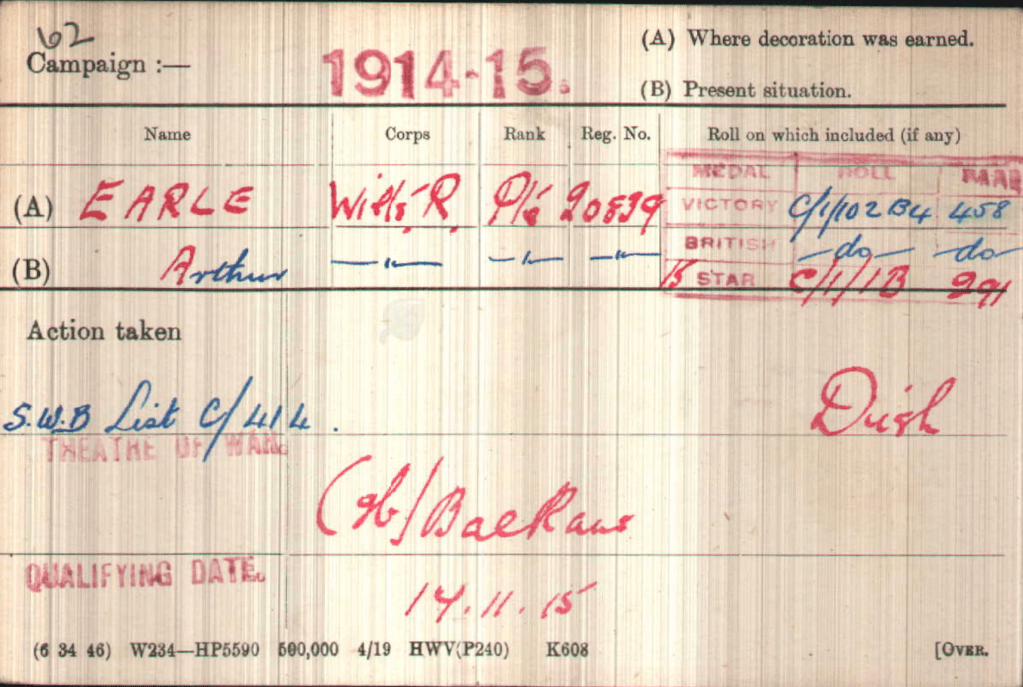
Arthur joined the Duke of Edinburgh’s (Wiltshire Regiment) of the British Army on 2 May 1915, with the regimental number 20839, at around 18½ years old. Unfortunately, his detailed service record was destroyed in the September 1940 fire at the War Office, which consumed two-thirds of the 6.5 million soldiers’ records from the First World War.
However, his Medal Index Card has survived, revealing that he was deployed overseas to the Balkans on 17 November 1915. It is likely that he served with the 7th (Service) Battalion of the Wiltshire Regiment, which arrived in Salonika in November 1915, as part of the 26th Division. The 7th Wilts, being a service battalion, were responsible for handling the supply of goods, equipment, and ammunition.
Arthur’s service in active combat zones is confirmed by his family’s possession of two of his Campaign medals: the 1914-1915 Star and Allied Victory Medal.
The 1914-1915 Star was awarded to those who served in any theatre of war outside the UK between 5 August 1914 and 31 December 1915, effectively before conscription was introduced in Britain. The Allied Victory Medal, a bronze disk about 36mm across depicting the winged figure of Victory on the front and inscribed with ‘The Great War for Civilisation 1914-1919’ on the reverse, was awarded to those who had served in the armed forces, or certain voluntary services, overseas during WW1.
The 1914-1915 Star was never awarded on its own; recipients also received the British War Medal and the Victory Medal. The British War Medal, a solid silver disk weighing about 30g, was awarded to officers and men and women of the British and Imperial forces for service during WW1. About 6.5 million were issued, giving some indication of the scale of the First World War.
Unfortunately, Arthur’s collection is missing the British War Medal, which was awarded to those who entered a theatre of war or served overseas between 5 August 1914 and 11 November 1918, with approximately 6.4 million silver medals minted, plus another 110,000 in bronze, the latter awarded to, amongst others, the Chinese, Maltese and Indian Labour Corps, giving an indication of the huge scale of the First World War.
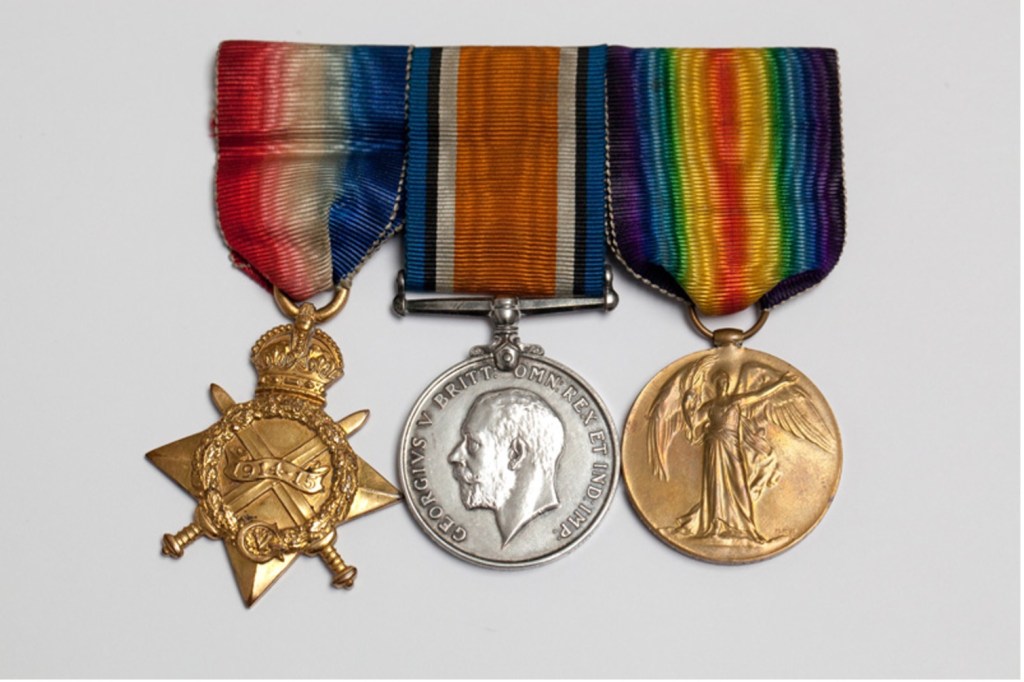
Arthur’s medals retained by his family are a ‘split group’ as one or more medals is missing. If the British War Medal alone is missing this usually indicates that it was once pawned or sold for its scrap silver value and melted down.
Arthur was discharged from the Army on 3 February 1917, due to injuries that rendered him unfit for further military service. The exact nature or origin of these injuries remains unspecified however, in recognition of his service, he was awarded a Silver War Badge on 14 February 1917.

The Silver War Badge was issued in the United Kingdom to service personnel who had been honourably discharged due to wounds or sickness during the First World War. Also known as Discharge Badge, Wound Badge or Services Rendered Badge, it was first issued in September 1916 along with an official certificate of entitlement. This sterling silver lapel badge was intended to be worn in civilian clothes. Since the beginning of the war, when they gave up campaigning for the Vote, it had been the practice of the militant Suffragettes to present white feathers to apparently able-bodied young men not in uniform to shame them into enlisting. The badge was intended to prevent this by indicating that the wearer had been honourably discharged due to injury or illness. It was worn on the right breast while in civilian dress and was forbidden on a military uniform.
As this badge is missing from Arthur’s medal collection it may have been pawned or sold and melted down along with his British War Medal.
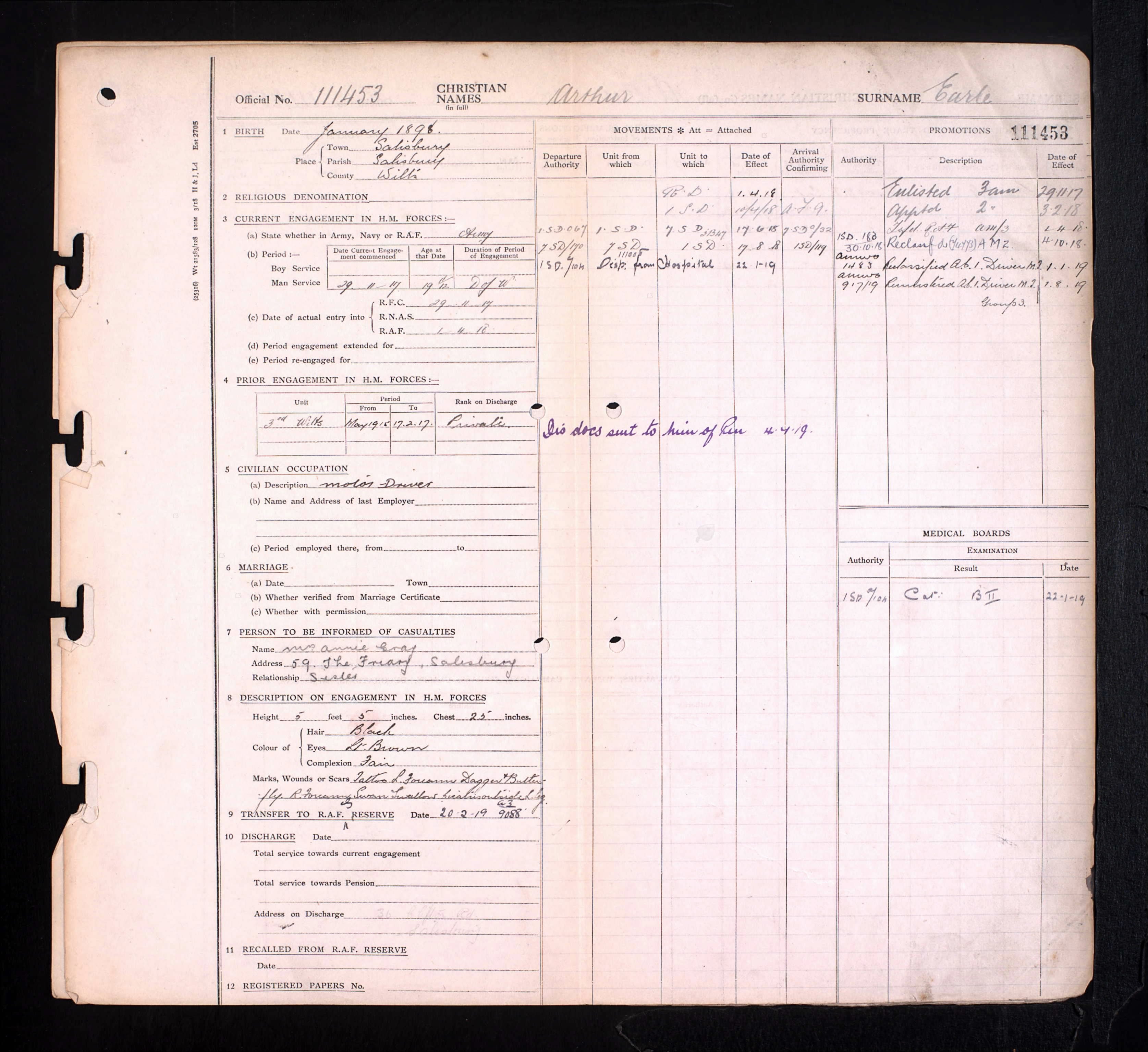
Having been discharged from the Army as medically unfit, Arthur enlisted for the Royal Flying Corps, the air arm of the British Army, on 29 November 1917 aged19½. His service record provides a valuable insight into his military service and other personal information.
On 1 Apr 1918 the Royal Flying Corps merged with the Royal Naval Air Service to create the Royal Air Force (RAF). Arthur’s record notes that the entered the RAF on 1 Apr 1918 and was issued service number 111453.
The same record confirms that Arthur had previously served as an army private in the Wiltshire Regiment from May 1915 to 17 Feb 1917, and that he was a ‘Motor Driver’. Various pension records indicate that he also served in the Army Service Corps (ASC) with the service number of M/31393, a very early number (pre-WW1) and the letter M indicates he was in Mechanical Transport. It is likely then that he had been trained as a very young man to drive motor vehicles, a highly desirable skill in the military services at the time, as only about 1 to 5% of the population could drive in those days.
The RAF record also includes some personal details, listing his next of kin as his sister, Annie Gray, who was still living at 59 The Friary, Salisbury. Arthur was 5ft 5in tall (165cm) with a chest size of 25in (63.5cm), indicating a very slight build. He had black hair, light brown eyes, and a fair complexion. Distinguishing features included tattoos of a dagger and a butterfly on his left forearm, a swan and a swallow on his right forearm, and a scar on the outside of his left leg.
Initially appointed as an Air Mechanic 3rd Class as a driver and later reclassified as an Air Mechanic 2nd Class in October 1918, Arthur continued his service as a driver. He was stationed at RAF Kidbrooke in the No. 1 Stores Depot close to Greenwich in south-east London. However, in late 1918, Arthur fell seriously ill with appendicitis. He was initially treated at Tidworth Military Hospital, and later transferred to the Salisbury Infirmary, from which he was discharged on 17 January 1919.
Arthur’s military career concluded when he was transferred to the RAF Reserve on 20 February 1919, after the end of the War. His discharge documents were sent to him on 4 July 1919.
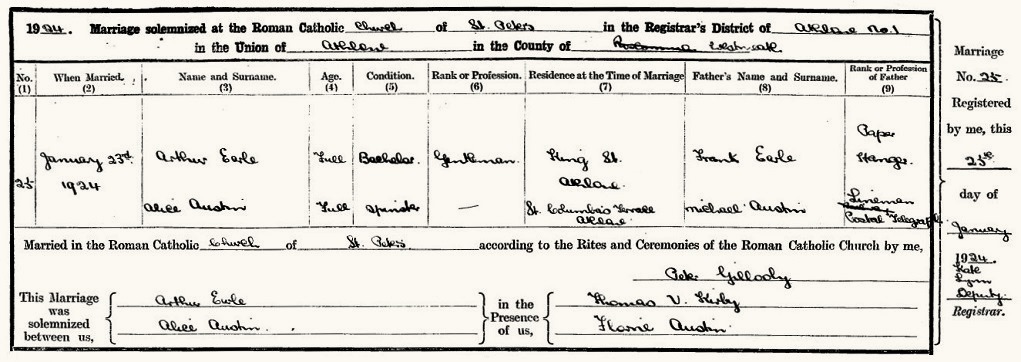
There is no trace of him during the next five years until, on 23 January 1924, he married Alice Austin at St Peter’s RC Church in the town of Athlone, Ireland. Both bride and groom were over 21 and single at the time of the marriage. Arthur identified himself as a ‘gentleman’ of King St, Athlone, with his father listed as Frank Earle, a paperhanger. Alice lived at St. Columbus Terrace, Athlone, and her father, Michael Austin, worked as a lineman for the Coastal Telegraph. They were married by the priest Peter Gillooly and witnesses were Thomas V Kirby and Florrie Austin.
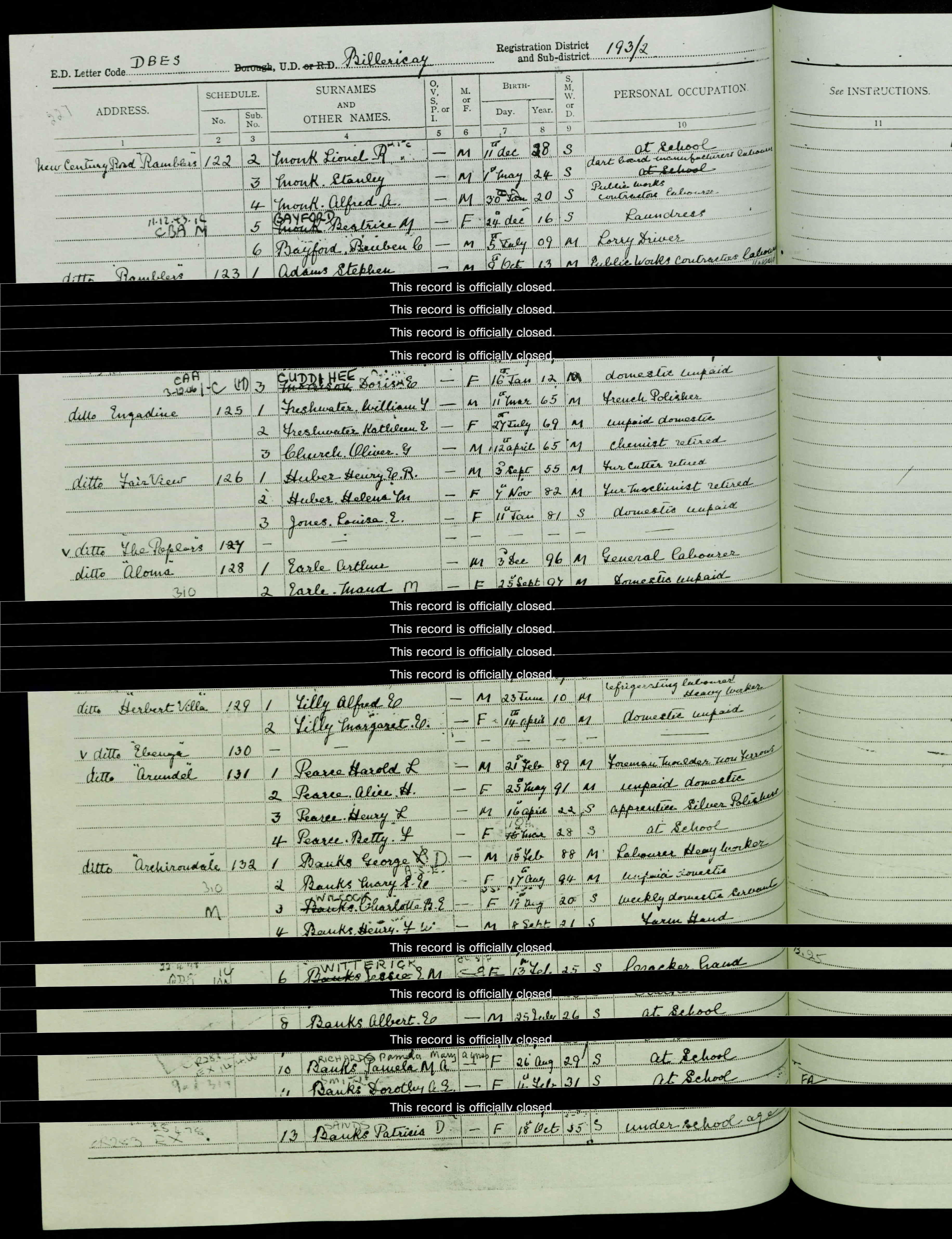
Arthur apparently left his wife and family around early 1928, telling them the army had recalled him, but they never heard from him again. However, he seems to have returned to England to start a new life. The 1939 Register, taken days before the start of the Second World War, records that Arthur, now a general labourer, living at “Aloma”, 128 New Century Road, Laindon, near Billericay, Essex. Arthur told the enumerator that he was born on 3 December 1896, which fits with what we know, and that he was ‘married’ to Maud, a housewife born 25 Sep 1897. Four names on the Register below theirs have been redacted, indicating that those individuals might still be alive today. These could be their children, evacuees billeted with them, or a mixture of both.
Maud died on 22 October 1976, and the probate record shows that her surname was Greed, although she also called herself Earle. Her home address was Aloma, New Century Road, Laindon, Basildon, confirming her identity. Probate was granted in Ipswich in January 1977, and she left an estate valued at £962.

Maud Mary Jackson, born 25 September 1897, married Edward Walter Robert Clark in 1915. They had two children: Elsie Edith Maud, born in 1915, and Ivy Lilian Grace, born in February 1917. Edward was a soldier in the 13th Middlesex Regiment but died of wounds received in action on 7 April 1917 and was buried in France.
Maud then married Edward P. Greed in 1925, and they had one son, Kenneth E R Greed, born in 1926.
Maud and Arthur probably got together around 1928, as their son Arthur was born in the first half of 1929, followed by daughters Patricia in 1930, Jean in 1933, and Maureen in 1937. These four children are likely the redacted records on the 1939 Register and may still be alive today.
Arthur died in 1977 and, as he left a will, the National Probate Calendar records his date of death as 1 March 1977 and lived at Aloma, New Century Road, Laindon, Essex. Probate was granted in Ipswich on in June of that year, and he left an estate valued at £3,072.

Arthur Earle’s life was marked by service, resilience, and transformation. From his early days in the British Army and the Royal Flying Corps to his eventual disappearance and new beginning in England, Arthur’s story reflects the extraordinary era in which he lived. Despite the mystery surrounding his departure from his first family, the later years with Maud and their children in Essex suggest a man who sought to rebuild and find peace after the ravages of war. Hopefully, through the records that detail his journey, this story will offer his family a glimpse into the life of a soldier who forged his path in the shadow of some of history’s great events.
