During the 1960s, spending Christmas at our family home in Fulham was rare as my mother’s mental illness usually manifested itself in autumn and culminated in her being admitted to hospital around December, so my brother Nick and I were often sent down to stay in our grandmother’s house on the Dorset coast near Portland.
It was pretty grim staying there, but I do have some good memories such as, during the days preceding Christmas, we would be given packets of coloured strips of paper each about 20mm (just under 1in) wide and 200mm (8in) long to make into paper chains using a mixture of flour and water for glue. These were easy to make and quite fun as a short section of the outside end of each strip would be painted with paste, then a similar section of the inside of the opposite end. The two sticky ends were then pressed together to create a loop, then a strip of a different colour paper was passed through the loop and the ends of that one pasted and stuck together, and so on, until we had created a long chain. One end of the chain was pinned to the top of the picture rail and strung across to the light fitting, then on to the picture rail on the other side of the room. Shorter chains were draped over the top of picture frames, or down the side of a tall piece of furniture.
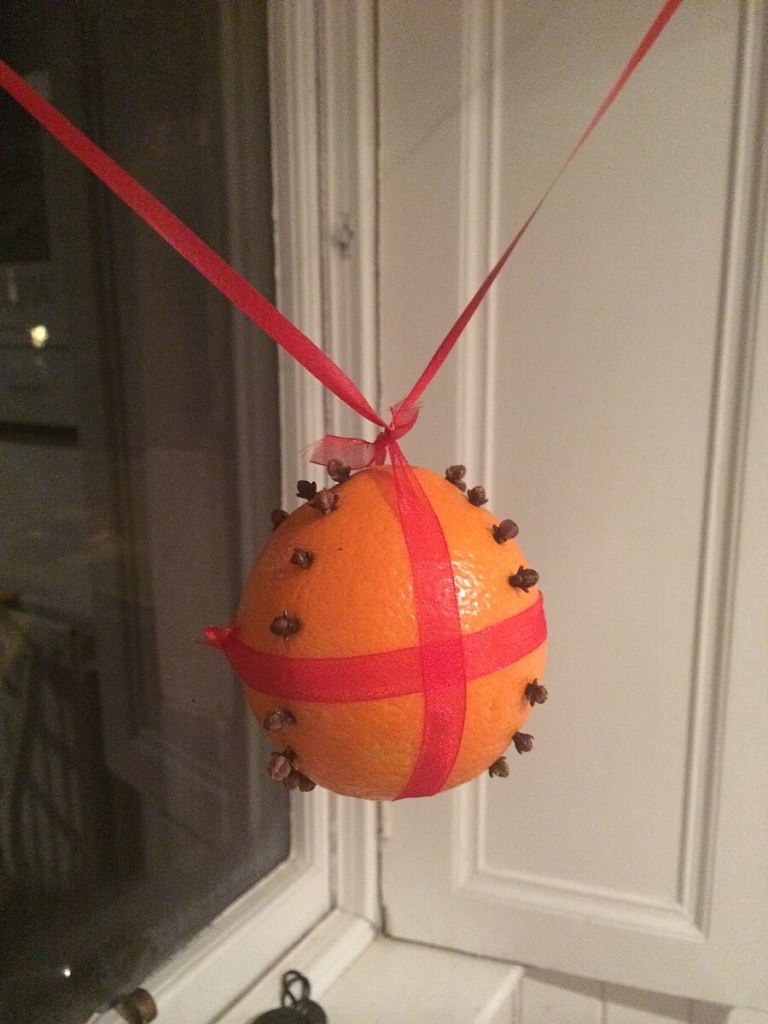
Another pre-Christmas delight was making scented pomander balls from oranges and apples. A length of ribbon was tied around each piece of fruit like a parcel, then the skin of the fruit was pierced several times, each at least a finger’s width apart, using a thick darning needle and a clove pushed into each hole. These treats could be hung from hooks or door handles around the house and, although the fruit would shrink during the following days (which is why the holes had to have gaps between them), the delicious aroma of fruit and spice lasted for weeks.
At last, Christmas Eve arrived, and a real Christmas tree was brought indoors on and installed into a galvanised bucket filled with soil, with another bucket of water plus mop placed on standby in the corner of the room whilst the tree was decorated. Throughout the rest of the year, the Christmas decorations were stored wrapped in newspaper in a couple of worn and dented ancient biscuit tins with their own peculiar scent, not quite the same as iron or copper, but nonetheless distinctive.
Fragile glass baubles and tinsel were hung from the tree’s branches, then candles in metal holders were clipped into place on the tree. These pressed-tin holders each featured a scalloped drip-catcher around 30mm (1½in) across, some of which still bore traces of previous years’ wax, and most of their spring clips were plain or lined, but the choicest had been pressed to resemble pine cones. The slim red candles were of varying lengths, as most had been lit in previous years but not completely burnt out. Each candle, starting with the shortest of the stumps, was inserted carefully into a holder, but this was quite a perilous business as the outer edges of the holders were razor-sharp and the thin tines that held the candle in place could easily snap. Once the candles were secured in their holders, these were clipped into place in as upright a position as possible on a branch of the tree. Close by, in the fireplace, lived a small ceramic vase containing several long slim flat strips of wood called ‘spills’, each about the length of a drinking straw. Finally, once the tree was decorated, a spill was lit from the open fire in the grate and the flame used to ignite the wick of each candle on the tree.

We would gaze in awe at the magical sticks of wax each glowing with their single flame of light twinkling among the branches, but sadly the spectacle didn’t last long as the candles were never left unattended because of the risk of accident – which was presumably why there were so many half-burnt relics from previous years. I can only once remember a branch above a candle beginning to smoulder, but – disappointingly to us children – this was quickly spotted and extinguished with a wet mop before any fire could take hold.
I’m not sure when my brother and I actually believed or stopped believing in Father Christmas, but every year a pair of my thick woollen brightly coloured tights were hung at the end of our beds on Christmas Eve. We woke on Christmas morning to find the tights stuffed with enticingly shaped gifts which always included a couple of satsuma oranges and some chocolate coins in the toes, plus a couple of story books, and some small toys such as a yo-yo, cap gun, playing cards, and colouring books with crayons, pencils, or a tin of watercolour paints.
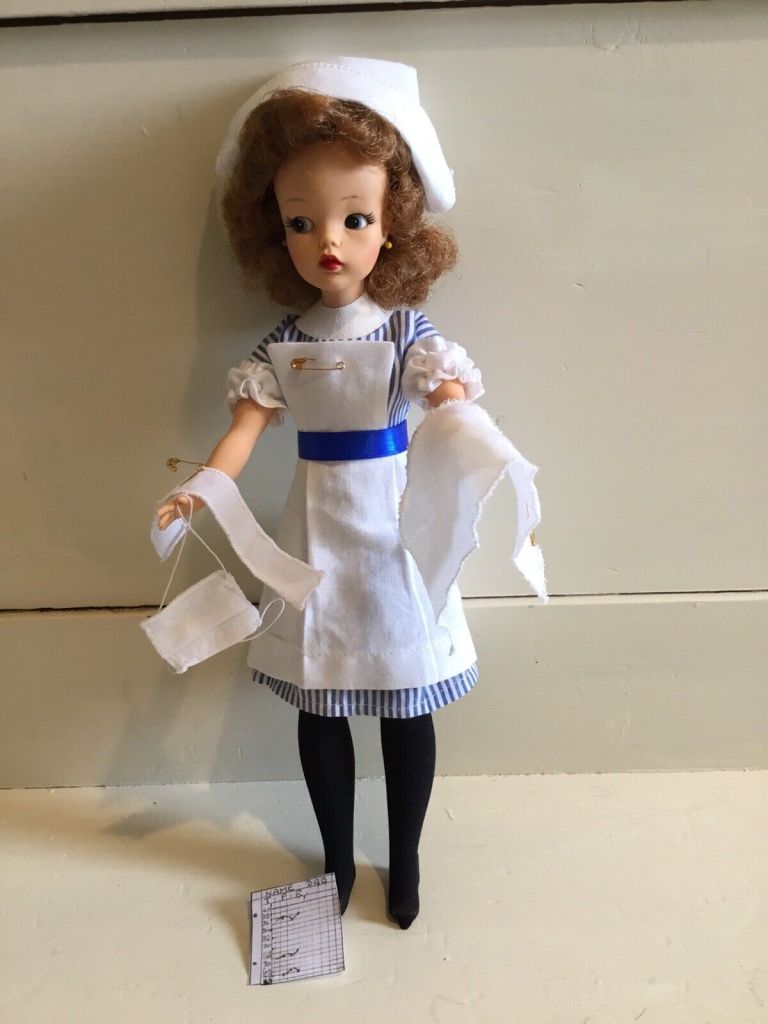
I have never had any interest in dolls that looked like babies, but once I found a Sindy ‘Emergency Ward’ nurse doll in my stocking, whilst my brother got an Action Man figure. He insisted with typical ‘boy logic’ that Action Man wasn’t a doll because it was a soldier and of course a soldier can’t be a doll… Make believe games often involved Sindy having to be rescued by the heroic Action Man, or Sindy dutifully patching Action Man’s wounds after some conflict or another. Regrettably, poor Sindy was once tied to a fireguard in front of a lit fire and all her brown nylon hair shrivelled up from the heat. Fortunately, we managed to liberate her before she truly caught fire and burned the house down, which would have got us into really big trouble.
Strangely, our two cousins of similar ages, who also spent some Christmases as our grandmother’s under supervision of their nanny, each had a pillowcase at the end of their bed which were filled overnight with similar presents to ours plus extra items such as board games and selection boxes filled with popular chocolate treats. This inequality was never an issue, it just was what it was, until one Christmas my father arrived our grandmother’s house to visit us bearing an (empty) Jeroboam sized Champagne bottle which he gave to my brother and me. Although an empty bottle is only good for decoration, this was a real treasure to us as our cousins had never beheld such a wonderous object.
In 1970, when I was twelve and my brother ten, my mother had another relapse and went back into hospital. Our father – in desperation I now understand – went along to a parent-teacher evening and asked if anyone could help by taking my brother and me in so that we could stay on at school in London, rather than uprooting us once again down to Dorset. As a freelance film editor working unpredictable hours, he must have been justifiably relieved and grateful when one kind family offered to help out.
However, to my eternal shame and mortification, at school the next day word quickly spread that our mother was in a ‘loony-bin’. Children can be horribly cruel, and it seemed that everyone knew of our humiliating plight. Nevertheless, the following Saturday, our bags were packed, and we were duly delivered to a house in Notting Hill which was intended to become our home for the foreseeable future. This was a rambling four-storey townhouse, with a family room featuring a black and white television set in the basement, and several rooms on the other three floors. The father was a well-known author and television critic who had sole use of the first floor where he worked from home, so silence was generally expected around the house except in the basement two floors below. With hindsight, the writer and his wife were kind and treated us well. They already had four children of their own aged about fourteen to seven years, and the youngest but one was one of my brother’s classmates, so it was already a busy household and perhaps another two wouldn’t be difficult to absorb.
Nick and I were shown to a boxroom we were to share on the top floor. The tiny room was sparsely furnished with a pair of bunk beds with thin and narrow lumpy mattresses covered with dark purple scratchy bri-nylon sheets. Unfortunately, the bottom sheets were designed to be ‘fitted’ but were intended for a wider and deeper mattress, so they were far too loose and wouldn’t stay in place. Those hateful sheets and pillowcases felt cold and slimy to the touch, yet would crackle with static electricity on contact with our pyjamas creating sparks and giving us little electric shocks. We absolutely loathed those sheets.
Worse still, before we’d had to leave our home in Fulham, Nick and I had regularly enjoyed watching the popular surreal comedy series ‘Monty Python’s Flying Circus’ on BBC television. It was a ridiculously silly collections of short sketches, heavily influenced by the subversive and absurd ‘The Goon Show’ radio series from the 1950s, interspersed with weird animation sequences. It’s hard to appreciate today just how influential this show was at the time but, the morning after a new episode had been aired, school children could re-enact entire skits from memory – long before video had been invented to record stuff. Unhappily, for my brother and me, this particular TV series was simply not tolerated in our new ‘home’.
With the benefit of hindsight, it’s obvious why we were so miserable. Yet, at the time and for years afterwards, we blamed the hated purple nylon sheets and the ‘Monty Python’ ban as the catalysts that pushed us into our decision after a couple of weeks to take action and run away.
I picked my brother up from school as usual one afternoon but, instead of boarding the Underground to Notting Hill Gate, we headed in the opposite direction back to Fulham and our family home. I remember it was a cold evening, but we sat on the front step and waited, and waited. Eventually, after it was quite dark and we were becoming tired, cold, and hungry, our father came home and found us. He wasn’t angry at all, but he must have been very shocked to find us just quietly waiting for him. I don’t know quite what happened next, but he must have telephoned our foster family to let them know what we had done as, thankfully, he had listened to our tale of woe and agreed that we could stay.
I was thus issued with a house-key on a shoelace to wear around my neck and given strict instructions to collect my brother promptly each day from school. We should then come straight home, go to the back of the house, and remain there quietly until our father got home. Although we could make ourselves something to eat, we were not allowed to use the front room, nor turn on any lights that could be seen from the street, nor answer the telephone whilst we were alone because, if the authorities found out, we would probably be taken into care. However, there was an agreed secret code that, if our father needed to contact us, he would ring the house ‘phone, hang up, repeat, and dial again when we were to pick up on that third ring.
We were sworn to absolute secrecy that we must not tell anyone of our situation lest they inform the authorities. Of course, we didn’t let on and, mercifully, we were never sent away again – which was simply the best Christmas gift we could ever have wished for.
[i] Densvenskabjörnen4, CC BY-SA 4.0 <https://creativecommons.org/licenses/by-sa/4.0>, via Wikimedia Commons
[ii] from Wind Against Current by Vladimir Brezina and Johna Till Johnson licensed under a Creative Commons Attribution-NonCommercial-NoDerivs 3.0 Unported License


